
Heavy’s Blog – May 2013
Meeting at Glenmore Lodge – Everest – National Scenic Areas in Scotland Map!
Posted on May 1, 2013 by heavywhalley.MBE
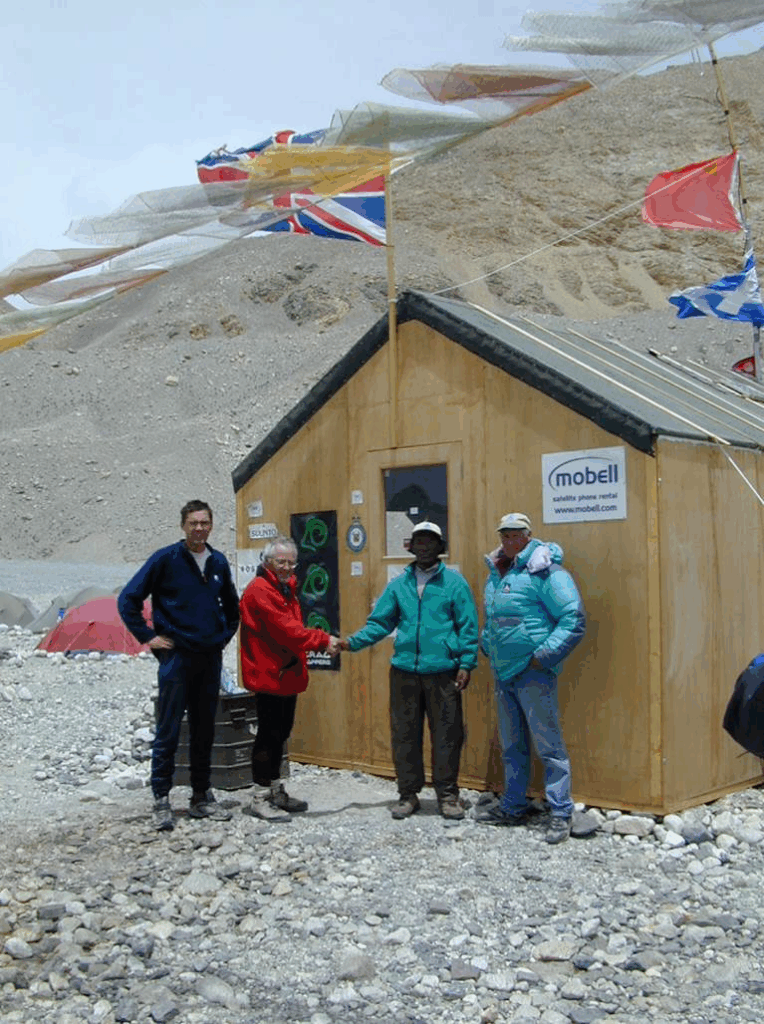
Today I am off to Glenmore Lodge for a working group on Mountain Accidents, it is a group hopefully that may be able to assist in getting the Safety message across after a sad winter. It will be interesting to see what comes up. I think we must keep trying to improve the Safety message. I also commented on the “fight on Everest”; there are some interesting comments on the UK Climbing Forum, many arguing their case. Some of it makes very ugly reading. Whatever happened , and only those who were involved know, it is a sad day for mountaineering. My trip in 2001 to Everest in our own small trip was a wonderful experience. It was to Tibet on the North side, I was the Base camp Manager and managed at the end of the trip to get to the North Col. No one else was on the mountain, all the other trips had gone home after a huge Storm. The rest of my team were at Base Camp 4000 feet below. As the only European left and it was an incredible feeling, the place was deserted and we had this wonderful place to ourselves. I started to take a big load down from the North Col down the battered fixed ropes to help our Sherpas as they were clearing the mountain. There was no way they would let me help, it was their job, and they only let me carry a couple of oxygen bottles down. I had 5 days alone with them and we already had a bond but it was some experience. They looked after me in way only they can, we became great friends and treated each other with huge respect. I find it very upsetting to hear of this trouble on Everest, where one Sherpa has already died on the ice -fall fixing the ropes. I pray that it gets sorted out and all can work together with these wonderful people.
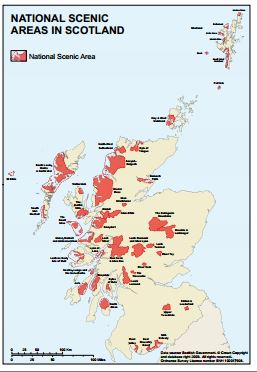
It is good to see that things are happening a bit in the Wind Farm debate Scottish National Heritage have published a statement and a National Scenic Areas of Scotland map. Various characters have commented in there Blogs and maybe the politicians are starting to listen, I wonder if it may be to late. Great scenic areas surrounded by Wind farms is that our future?


Andrew Bachell, SNH director of operations, said:
“Wild land is an incredibly valuable asset for Scotland. It makes an important contribution to our tourism industry and images of wild places also help support Scotland’s world wide reputation as a beautiful and impressive country. It makes a crucial contribution to our quality of life and we know that most Scots consider wild places to be important to them. Wild land also supports biodiversity and is often associated with our most impressive wildlife.
“Like all natural assets this resource must be managed sensitively if it is to be sustained. Our new map will enable planners and developers to take account of wild land, particularly in planning future windfarm and any other large scale developments. We wish to share this map as widely as possible with stakeholders, particularly in the context of the Scottish Government’s consultation on its third National Planning Framework and Scottish Planning Policy.”
The 43 areas, and their size in hectares, are:
1 Merrick 7,858.06
2 Talla – Hart Fells 9,170.58
3 Broad – Dollar – Black Laws 9,883.32
4 North Arran 11,751.05
5 Waterhead Moor – Muirshiel 4,670.10
6 Jura, Scarba Lunga and Garvellachs 28,420.57
7 Ben Lui – Beinn Ime 16,050.60
8 Ben More – Ben Ledi 24,247.20
9 Upper Almond 26,772.37
10 Loch Etive mountains 51,564.76
11 Breadalbane – Schiehallion 45,500.27
12 Lyon – Lochay 7,345.77
13 Ben Lawers 8,142.69
14 Rannoch – Nevis – Mamores – Alder 119,653.62
15 Cairngorms 157,996.16
16 Lochnagar – Mount Keen 57,211.78
17 Monadhliath 82,868.78
18 Moidart – Ardgour 39,918.13
19 Knoydart – Morar 81,231.17
20 Rum 4,229.91
21 Kinlochhourn – Glen Quoich 24,319.19
22 Cuillin 17,132.05
23 Duirinish 4,505.89
24 Central Highlands 129,020.10
25 Applecross 11,934.43
26 Coulin & Ledgowan Forest 20,549.98
27 Flowerdale – Shieldaig – Torridon 31,745.86
28 Fisherfield – Letterewe – Fannichs 81,250.29
29 Rhiddoroch – Beinn Dearg – Ben Wyvis 91,529.68
30 Inverpolly – Glencanisp 20,544.22
31 Quinag 10,534.50
32 Reay – Cassley 57,179.99
33 Foinaven – Ben Hee 56,201.17
34 Cape Wrath 22,635.36
35 Ben Hope – Ben Loyal 21,652.25
36 Ben Klibreck – Armine Forest 53,154.50
37 Causeymire -Knockfin Flows 53,313.86
38 East Halladale Flows 15,898.88
39 Hoy 5,481.52
40 Ronas Hill & North Roe 5,235.74
41 Harris – Uig hills 44,221.41
42 Eishken 16,335.80
43 South Uist hills 10,164.53
Mountain Safety – How can we improve the Safety message? Lecture tonight Inverness!
Posted on May 2, 2013 by heavywhalley.MBE
When I retired from Mountain Rescue I thought that would be the end of Meetings but as I am still interested in Mountain Safety I attended a Communications Working Group. The main aim is to improve the Safety Message after a hard winter. The weather was pretty bleak as I drove down to Glenmore Lodge in the Cairngorms where the Meeting was held. It was a good and frank discussion and hopefully some good ideas will come out to communicate the Safety message in the future. Watch this space and it was time well spent, I feel as everyone does that every fatality is tragedy and anyway we can help keep these accidents down is well worth while. Communications and Technology is ever changing and we must look to the future to ensure that we make the mountains enjoyable and as safe as possible. We have a excellent Weather forecast and Avalanches Forecast all funded by the government which are free to all. There are also so many Blogs and information out there but maybe we are missing something? Mountaineering is a rare sport where the individual is still responsible for their actions this is very hard to explain in this risk free world and to the public in general as they try to understand our wonderful sport. Yet it gives us so many life-skills especially to the younger generation and is wonderful healthy option in this world of health, drug and alcohol dependency?
At the Meeting I met the British Mountaineering Councils new Hill Walking Development Officer who travelled up from Manchester for the Meeting. I have taken the piece below from the BMC website. It is good to see that the UK is working together for Mountain Safety!

It’s good news for hill walkers as the BMC has appointed its first ever dedicated BMC hill walking development officer.
The main aim of the new role is to provide information and advice to new hill walkers and to the many members for whom hill walking is their main activity.
This new position, funded by Sport England, will solidify the BMC’s support for hill walkers and comes in response to feedback from our members. In the latest BMC membership survey, 62% said hill walking was their primary mountain-related activity.
Carey Davies, previously assistant editor at one of Britain’s most popular and long-running hill walking magazines, The Great Outdoors (TGO), has navigated his way into the BMC office to take on the role.
Carey said: “It’s an exciting prospect to start a new job – particularly one which has never been done before! I’m the first BMC officer to be dedicated to developing and promoting the work the organisation does for hill walkers.” Good luck in your new job and I am glad that hill-walkers now have a voice a well overdue post.
We are very lucky in Scotland to have support from the Government and the work done by the Mountaineering Council Of Scotland and Mountain Rescue who do a huge amount for mountaineers with a limited budget. Any new ideas to improve the safety message may need additional funding this will be hard in this financial climate. Mountaineering brings in millions to the Scottish economy and there must be money around somewhere to improve the situation.
Maybe it is time for the huge companies who make massive profits from the Outdoors to assist by investing in the Safety message? Any takers?

photo Ian Sykes
IAN SYKES is a climber and mountaineer who is the founder of Nevis Range Ski Centre and co-founder of Nevisport.
Ian is giving a free talk about the background to his novel, Cry Argentina. All are welcome.
Thursday 2 May, 6pm at Waterstones
Eastgate Centre, Inverness
Cry Argentina tells the true story of the Argentinian invasion of South Georgia, the event which started the Falklands War. At this time – with the Falklands referendum, the death of Margaret Thatcher and the election of an Argentinian Pope – the novel is particularly relevant.
Book launch “Cry Argentina” lecture in Inverness – Winter golf at Ballindarroch – Millionaires Golf
Fri, 03 May 2013 05:20:53
Millionaires golf, all for £20
Yesterday I managed to change my winter tyres, winter is now officially over and I was playing golf at Ballindalloch Castle golf Course but it was so cold on this wonderful place overlooking Ben Rinnes not far from Aberlour. We had sleet and rain and a biting wind but what a place to be all for £20 “millionaires golf open to Joe – public”. I am glad I took a change of kit as I was pretty wet and cold after a 4 hour trog round the course. The river Avon follows part of the course and only in Scotland could you get such weather, but that what makes it so special. This piece is from there website:
” This magnificent Championship standard golf course was designed by Donald Steel and Tom Mackenzie, both internationally recognised golf course architects with courses in over fifteen countries.
They created a heady mix of challenging golf and aesthetic appeal, just as they have done at their other famous Scottish design, the Carnegie course at Skibo Castle. With its nine holes and eighteen tees, the course provides a fair test for golfers of all standards and is well placed to become known as the finest nine-hole course in Scotland.
The course is set on the banks of the River Avon, among 150 year old trees and with marvellous views of the surrounding purple heather-clad hills and native birch woods.
Ballindalloch Golf Course is the perfect place to find escape from an imperfect world. By the imaginative use of alternative tees, it has achieved the illusion of making nine holes into 18. Purists who scoff at the idea would be missing a treat if they passed it by. For natural beauty and golf played to the tune of the wind and river it is worth seeking out. Such days should never end.”
Winter is still with us and the forecast for the weekend especially in Scotland is not great with snow forecast. Please be aware that despite me taking off my winter tyres it is still winter on the mountains!
Photo – Spike book signing his book for Ray Sefton, a real blast from the past in RAF MRT some character.
I then went to Inverness to be at the book launch in Waterstones for Ian “Spike” Sykes book launch of “Cry Argentina” It was a great night with Spike giving a lecture on why he wrote the book and the stories of some of his incredible life in this part of the World. It was a unique hour and there were some incredible people in the audience. We had mountaineers, Polar explorers, Scottish nobility, a famous skier and many local characters including a great spread of real characters of ex RAF Kinloss MRT members Spike took us through the history of South Georgia to his trip to Antarctica with the dog teams and even a volcano exploding, sledging with dogs, mountaineering and no mail for a year! Imagine that! Add in to this his trip through South America and some incredible photos and Spikes laid back chat it was a wonderful hour amongst friends . If the book is half as good as the chat it will do very well. The only thing that was missing was a piece on the banjo at the end, maybe next time Spike! Book review on the way!
More on Wind – Farms – Keep updating First aid skills – you never know when you may need them?
Sat, 04 May 2013 08:11:20
This was a comment on my piece on wind farms. Thanks David Steane Scottish Government recently issued its National Planning Framework 3 ‘main issues report’ for consultation (as you say), and I’d urge anyone who thinks the same as you and I do about windfarms to respond. The questionnaire on which you can do so is at this link at the bottom (one questionnaire for NPF3 and one for SPP) http://www.scotland.gov.uk/Topics/Built-Environment/planning/NPF3-SPP-Review What they’re proposing is better than nothing. Now if they would just designate a 75 mile exclusion zone around each of the National Scenic Areas – that’s around about the distance I could see from the summit of Cairn Gorm of the beautiful crisp winters day I experienced in mid-January 2012 – and remove all wind-farms already without that zone, then they’d be getting somewhere. But somehow I don’t think that’s going to happen. In some ways, it is too late. But as I say, it’s better than nothing.
Two Mountain Rescue Greats, Johnnie Lees & John Hinde RIP!
I have still not been on the hills but played a charity game of golf with a local church on the lovely Moray Club. I had a wild day of golf started of in the sun and by hole 3 it was pouring and I was soaked and frozen again, it was as bad as being on the hills. One of the boys was feeling very poorly on the course so we took him off. A bit worrying as it was wild and wet and that was at sea – level, it was so cold. It is so easy to have a snag on the golf course and you can be a long way out from the main road. I must redo my First Aid again as it was a reminder that you may need these skills at any time. In the end we managed and we all got off, it was a worrying time for us all. I am sure all will be okay now after a visit to the doctor. I met some fantastic people yesterday one from John Hindes days at RAF Kinloss in the 60 -70’s when the RAF Kinloss Team was at times supported by the Army at Fort George, “The Jocks”. John Hinde was a legend in Mountain Rescue in Scotland and Team Leader of RAF Kinloss and Cyprus MRT. It is amazing who you meet. Watch the weather if up on the hills this weekend – it is very cold like winter at times.
From the MWIS Weather forecast
Summary for all mountain areas
“Upland gales persistent across Highland Scotland, and progressively less windy further south. Showers nearly all in Scotland, will become frequent on the western highlands, and may merge to give a couple of hours of constant rain, or on higher areas, snow – giving whiteout.” Take care.
SAIS = Scottish Avalanche Information Service – Trial in the North West.
Sun, 05 May 2013 06:03:30
A big thank you to the Scottish Avalanche Service for all their work over the winter. There photos and their blogs are really good and give a great understanding to a tricky subject. I am impressed by the photos on the blogs especially as they give a great idea to what is going on in the mountains. They have had a Seminar at Glenmore Lodge and it is worth reading their thought of this on the website and a few good points can be learned. To me Human behaviour is a huge factor and how this effects our decisions all interesting stuff. There is still plenty of snow about so please be aware. They have a budget of £160000 and this year they will do a trial in the North West which will be a great help to Mountaineers. I wish the service all the best for the new trial in the North West this winter and I am sure it will be a great asset. Well done Mark Diggins and his team helping people enjoy these wild places.
Seemingly Dunndonnell MRT had a busy night in the Mullardoch hills; one injured walker evacuated by HMCG 100; two other parties helped off the hill after being caught out by rising water levels in the burns!
SportsScotland
They are still running a weekend information Service and this the forecast for Lochaber.
“The snowpack will be thawing at all levels. Wet snow instabilities will be present mainly on steep North, North-East and East aspects above 900m. There will be an increasing hazard of cornice collapse and falling ice in the thaw conditions. The avalanche hazard will be Moderate.”
The sportscotland Avalanche Information Service publishes daily forecasts of the avalanche, snow, and mountain conditions at the five most popular areas of Scotland during the season.
SAIS has a budget this year of £160,000 which includes SAIS avalanche forecasting operation, contingency for forecast provision during prolonged winter conditions, a pilot avalanche forecast service for the Torridon area, North West of Scotland and commitment to avalanche education initiatives.
Twelve mountaineering organisations from across the UK are working together on making sure walkers and climbers have basic information on avalanches.
Eighteen snow slides triggered by human activity were recorded in Scotland’s mountains last winter. Sportscotland Avalanche Information Service (SAIS) said that while the number was fewer than the previous season there were eight fatalities.
Updated education messages are being developed ahead of next winter. The number of deaths caused by avalanches during the 2012-13 season was the highest in years. According to SAIS, there were none in 2011-12, one fatality in 2010-11 and five in 2009-10. While there is no suggestion those killed last season did not have avalanche awareness skills – some were described as experienced climbers – the organisations are eager to see all walkers and climbers having basic knowledge of the risk.
The Snow and Avalanche Foundation for Scotland (SAFOS) with assistance from SAIS brought the other groups together at Glenmore Lodge, near Aviemore, last month. Scottish Mountain Rescue, Mountaineering Council of Scotland, British Mountaineering Council, British Mountain Guides, Association of Mountaineering Instructors and British Association of Ski Patrollers sent representatives to the seminar.
1968 – Epic in Skye! RAF Kinloss MRT and the Royal Highland Fusiliers ! A tale few will know about!
Mon, 06 May 2013 07:48:55
I was playing golf on Friday and sat at the meal with a wonderful character who used to serve with the “Jocks” at Fort George in the 60’s. He asked me if I heard of John Hinde who was a legend in my early days in RAF Mountain Rescue. We had a long chat and Keith used to come out with the team as he and a few of the Jocks were lovers of the mountains and supported the team on a few occasions.
Keith said “Aye, at the time I was a young 23 yo Lieutenant in the Royal Highland Fusiliers and commanding the Reconnaissance Platoon stationed at Fort George. We had offered to back up and support the outstanding work the RAF Mountain Rescue teams were doing at the time.
I, along with Crispin Agnew, were the two main officers plus a group of about 20 Jocks in total who went out fairly regularly with your MRT teams on weekend trips and helped if required on specific call outs – I would hasten to add very much led and guided by your teams.”
Keith told me of a sad weekend when he was out in Skye and got involved in 2 huge callouts. I have done lots of work on the history of the RAF Kinloss Team which has now moved to RAF Lossiemouth and knew of this incident as it was in my selected top 50 callouts over the period from 1944 – 2011. There are some tales to tell. This is part of the story.
From that wonderful access for information, the Scottish Mountaineering Club Journal, the 1969 edition listed the Mountaineering Accidents of 1968 as it has done for many years. This provides a huge amount of information on mountain Accidents. There was no Data protection in these days and the Accident Recorder Ben Humble was a man of few words. It was his job to collate all the reports and list them, at times he made comments on the incidents?
This is from the SMC Journal Volume xx1x No 160 May 1969.
2 June 1968 – R Jones – London fell on Eastern Buttress leading the Direct Route on Eastern Buttress Sron na Ciche , cause unknown. Casualty hit the ground and was killed. Leader had climbed the route before and was quite experienced. Fatal
2 June 1968 T Gaunt (39) and friend from Leeds lost the proper route on Amphitheatre Buttress, the leader lost the proper route (very easy to do) and could not move up or down, The second tried to climb up to him but had to belay some distance below. The leader fell and when located had been killed instantly. The rope number 4 nylon had held the fall and a weight of 16 stone. Fatal.
Amphitheatre Buttress has a few routes from 600 -1000 feet it is a complicated place and easy to go off route.The whole Buttress is on a vast scale and it is easy to go off route with several types of features, rakes, walls slabs etc. It is easy to stray from a route and many variations are possible on this Alpine face.
I have a copy of the RAF MRT reports and it gives a bit bigger story. The team was in Skye over the weekend and were called out to an incident on Eastern Buttress on Coire Lagan. The team had been climbing and ridge walking. Pete Thomas the local guide was on scene and the climber was 100 feet on a ledge. He had fallen 80 feet and had fatal injuries.
More from Keith “We had warm sunny weather on Saturday and most of the day on Sunday – on Saturday the party I was with did part of the main Cuillin ridge – if I recall Bruach Na Frithe, Am Basteir , Sgurr nan Gillean etc.
On Sunday we did Bla Bheinn arriving back at Glen Brittle pretty knackered and ready to pack up and head home at about 4.30/5pm – a wet Haar had started coming in when we got the call out for the first accident up in Coire Lagan. This I think was a school master with a party of teenagers up from London being introduced to rock climbing – the party were all pretty shaken.
We grabbed the stretcher and then made our way up the glen as quickly as we could – while we were strapping the first dead casualty on the stretcher we actually heard the fall and accident on the Western Buttress . My party helped with the stretcher bearing – the complex rescue work which I remember vividly was done by Pete Thomas and the RAF lads and as described in the report was hairy and technically very difficult – both the climbing access to the dead casualty, then the recovery of both his body and the badly shaken”
The team lowered the casualty and started a carry off to Glen Brittle. As they were in the process of the evacuation when another accident occurred. Six of the team under Cpl Ballantyne proceeded to the second accident.
It was found that the climber was suspended by his climbing rope on the rock face, his second was calling for help. The weight of the fallen climber was slowly “strangling” the second by the weight of the leader fall and the his belay point. He was situated on a small ledge and was unable to extricate himself from the taught rope. SAC McIntyre who was one of the most competent rock climbers in the MRT party and a civilian climber climbed up to the leader who was dead. They then climbed up what was considered “Very Severe” ground to reach the second man. McIntyre then tied him to his rope and then the rest of the team removed the fatal casualty. The second man was taken to the assisted of the rock face by climbing to the summit ridge and then down by an easier route.
Modern Rescue in Skye.
The remainder of the team with Cpl Ballantyne and Pete Thomas, the local guide, carried out a 4 pitch stretcher lower 600 feet to the bottom of the rock face. The casualty was then carried to the ambulance at Glen Brittle. SAC McIntyre was a member of the RAF Kinloss Team prior being posted to RAF Sharjah in the Gulf. He was home on leave at the time of the incident and was on leave to join the Kinloss Team for the Whit Grant! This must have been a hard few hours for the team and a difficult incident. It was a really hard look at how the Mountain Rescue has progressed in 2013. The Helicopters can make a huge difference as can modern gear and communications, changed days. There was a comment that team members used privately owned pitons, for belays and to safeguard themselves and other during the lowering of the stretcher down the cliff face. Nowadays the equipment has moved on so much we live in very different times. The report finishes that the team acted in the manner which reflected great credit to the RAF MRT. A bit of understatement there was also a wee note saying how incredible Pete Thomas was on the incident! What a man who rarely spoke of the rescues he was involved in. A final piece from Keith
“Pete Thomas played a vital part in this rescue and was very impressive throughout.
We were very happy to play a minor but supportive role.
Driving back to Fort George much later that evening I remember the Jocks being unusually subdued and thoughtful – throughout this and our other work with the MRT’s we built up immense respect for all the terrific work that you and all your colleagues did and continue to do – it certainly curtailed our Brylcreem jokes !!”
Pete Thomas was a local guide who sadly passed away, he was a lovely man with so much knowledge of the Skye Ridge and a great friend of mine. He ran a bunk house at Carbost, I was very lucky as Pete took me out a few times and showed me a few secrets of the ridge, he also let me and my family stay at his flat when I was the Team Leader at RAF Kinloss. I will never forget his kindness and his help as he was a very well-known man in the mountaineering circles at the time. His wife Jean is a wonderful artist and a special lady with such talent and knowledge of Skye a special place.
Established by local artist Jean Thomas in 1983, the Loch Harport Gallery is situated on the west coast of Scotland’s beautiful Isle of Skye at Portnalong, overlooking Loch Harport.
The Gallery exhibits a wide range of etchings, prints and watercolours by Jean, including subjects inspired by the Cuillin mountains, the varied and spectacular landscapes of Skye and the local flora / fauna.
Of particular interest to walkers and mountain climbers as well as visitors and lovers of the Isle of Skye, Jean’s art is available by Telephone or Mail Order, as well as at the Gallery in person.
Also featured in the Loch Harport Gallery are a number of works by selected invited artists, all of whom have strong connections with the Isle of Skye.
Skye MRT BASE LOGO
Skye MRT was then a sub unit of RAF Kinloss in these days! What a legacy these guys gave us, we are so lucky! Skye now-days has a powerful team and they have without doubt the hardest area in Scotland to operate especially with the resurgence of winter climbing in Skye over the years. I have so many friends on the Island and it is great to see Gerry and the Skye MR team going from strength to strength!
W.H.Murray and his comments on the wild in 1969! – RAF Mountain Rescue 70 th Reunion Celebrations – 6 July 2013 Tue, 07 May 2013 07:09:42
Many thanks for all the comments on the Blog an Skye I did yesterday, there are so many Mountain Rescue Stories out there and many with a happy ending. The SMC Journal 1969 that cover that year makes interesting reading and very different from today.
1968 – Total Incidents ; 20 (4) involving climbers and 36 (2) involving walkers Total incidents 56 (6) Fatalities. It mentions a high proportion of under 25 years old casualties. 28 concerned English parties from south of the border. Also included the fact that helicopters are being increasingly used most spectacularly in Loch Avon and high on Ben Nevis. A bit of difference from today?
I am looking for any stories where a bothy has helped in a rescue, I have the Cairngorm disaster and the Corrour epic if you have any thought it would be a great help get in touch please!
Wild Coruisk this December a prime example of wilderness that many fought to save. The only way in is by foot or boat!
Also in this Journal is an article by the late W .H. Murray about the building of a road to Camusunary on Skye. The initial intention was to assist Mountain Rescue access to Coruisk a wild area on the Isle of Skye, where access is still only by boat or foot. It is a prime example of a wilderness area. He states ” The need of many is occasional recourse to wild landscape , free of man’s engineering works, where they can enjoy quite, or adventure, or both.” I wonder what he would say today about the wind farms and roads that support them? Thanks for the legacy you left us W. H. Murray not only in great climbs or literature but in your fight for the wild. We owe you and those who fought for the wilderness so much!
70th Reunion – Change of Location There will be a reunion on 6th July 2013 to celebrate the 70th Anniversary of the formation of the MRS.
As the new owners of the Swallow Hotel have decided to refurbish the property it will be closed until August. This meant that Terry Tomlinson, our Reunion Organiser, had to find a new venue in the same locality to hold the reunion. Fortunately the Best Western Park Hall Hotel at Preston has been able to accommodate us.
It is also necessary to rebook your rooms with the Hotel. The number is 01257-455-000 and quote RAFMRA, or RAF Mountain Rescue Service, a deposit is required at the time of booking. The hotel has 140 hotel rooms, 3 bars, Free WiFi, Spa/ beauty salon, 2 restaurants, Indoor swimming pools – lane swimming and lagoon, Extensive computerised gymnasium, Whirlpool spas (adults only & family). Website: http://www.bestwestern.co.uk/hotels/park-hall-hotel-preston-83735/hotel-info/default.aspx
The accommodation charges will be £50.00 Single/£56.00 Double or Twin on a Bed & Breakfast basis per room.
Or £65 Single/£72.00 Double/Twin on a Dinner, Bed & Breakfast basis per room, it is the same rate for Fri/Sat/Sun. If you book D/B/B for 2 or 3 nights, on the Sat you will pay the B/B rate as you will be paying for your meal in the evening.
Directions to the hotel If you are travelling North then come off the M6 at Charnock Richard services, and turn up the road that says emergency vehicles only to the main road and turn right for about quarter of a mile and the turning for hotel is on the right. If you are coming south same again off at the services and follow the emergency vehicles only to the main road and turn right and its just over the quarter mile. The menu remains the same. If you have not already ordered please contact Terry with a Cheque payable to RAF MRA and sent to me Terry Tomlinson. By the 1st June 2013, to 3 Lower Row, Southfield, Burnley BB10 3RH
Skye and the Dubhs Ridge! What to do if lightening strikes! Wed, 08 May 2013 05:15:11
A Day with the Giant and Bob in Skye on The Dubhs Ridge “Doing The Dubhs”
“Said Maylard to Solly one day in Glenbrittle,
All serious climbing, I vote is a bore,
Just for once, I Dubh Beag you’ll agree to do little,
And, as less we can’t do, let’s go straight to Dubh Mhor,
So now when they seek but a days relaxation,
With no thought in the world but of viewing the views,
And regarding the mountains in mute adoration,
They call it not climbing but “Doing The Dubhs”
One of the best mountaineering days in Scotland is the “Dubhs Ridge” in Skye. I am very lucky to have done this route on many occasions. This route starts at the shore of Loch Coruisk and follows the East Ridge of Sgurr Dubh Beag for nearly 3000 feet up boiler-plated slabs to the summit, where an exciting abseil down West face leads to the main ridge and one of the finest hills in Scotland, Sgurr Dubh Mor.
At Start of the Dubhs! Big Kev – The Giant
As I had been in the Falklands for 4 months, I was happy to find the team on Skye for the August Grant a few years ago when I returned. When you are away, you dream of such places as Skye, I was very excited as I am on every trip to this wonderful Island. Our Team Leader Dan had just returned from Pakistan and the successful ascent of Gasherbrum 1 an 8,000 metre peak. He wanted everyone on the ridge and long days were the order! You can’t argue with a Himalayan Hero! My fitness is not so good so I grabbed one of the new troops, to carry a rope, and set off to “Do The Dubhs”, tradition in the team ensures you start from the Youth Hostel at Glenbrittle to the summit of Sgurr Na Bannadich then you drop down the Coruisk slide off the ridge to sea-level and up to the Dubhs, a long 10-12 hours, just what you need. The team had a joint exercise with Stafford MRT and the Giant[1] who was with them wanted to come with us. Now he is HUGE!! Eight feet tall and size 15 feet!! His stride is massive and he is very, very fit. He was instructed not to rush in front and to take it easy, or he would get battered. Well the day began well, even the long drag up the main ridge and on to Beallach Na Bannadich was easy, with Bob talking the whole way. We did it in under two hours, the weather was magnificent and we dropped down into the magnificent Coruisk, and we only saw one other party, Scotland at it’s best. The descent to Coruisk is fairly easy and we were soon at the Loch, again tradition states you must swim in the Loch, so in we went, what a great day! Crystal clear water and not too cold, Bob told us he was an ex-channel swimmer and we spent nearly one hour enjoying the sun, and listening to Bob.
Dubhs Abseil
The weather forecast had promised a wee bit of thunder for late afternoon so reluctantly we wandered on. From the Loch you can see the Ridge which starts more or less straight from the Loch, it is a marvellous sight and our new man Bob was suitably impressed, back from sea-level to 3,000 feet. Now Bob, amongst other things, is a photographer by trade, and as he was in the most impressive part of Scotland, you would have expected him to bring a camera, but he didn’t – lucky I did. You can follow any line up the slabs and the “Giant” who was by now a recently qualified Team Leader and just been on a rock-climbing course started up the steepest part with limited holds, even for him it was hard, and he was soon following the “old man” up an easier line.
Scrambling, (easy rock-climbing without a rope), where it’s easier to die, and to satisfy our Lords and Masters you must wear a helmet. As the great W.H. Murray stated “apart from the initial trouble in climbing a ridge, one may proceed unroped up broad acres of boiler-plated slabs, whose rock is the roughest gabbro in all the Cullin.” In other words, it is so rough and reliable that only the grossest negligence could bring a man to harm.” (Don’t tell the troops that). Bob was impressed and soon was enjoying the rock, under the eagle eyes of the Giant, who now realises the paperwork involved in a troop falling off! The “Old Man” was taking the photos which could be used in the event of an enquiry. Giant was revelling in his new responsibility and the rock was warm and dry & the views magnificent. Our man Bob was going well but slowing down and he had stopped talking!, which made a pleasant change. We had a few stops on the way and all to soon reached the top of Sgurr Dubh Beag, ready for the abseil. Our man Bob was trying to get his training book signed up, but due to the storm clouds above poor Bob, did not get to set up to abseil. Lucky for him as the rope got stuck on a loose flake on the way down and it took loads of cursing and blood to free by me. Our Bob was impressed when his turn to abseil came and saw blood everywhere, but he did cope.
A big peel of thunder rang out and the hairs on our heads started sticking up, time to go! If you have read where not to be when thunder and lightning are about, this is it. The lightning was flicking along the ridge like you see on a film, it was surreal. Nature is so powerful and we mere mortals. We felt so small and vulnerable, the power of nature in such a place is awesome. Keep calm and get off as quick as possible, now the descent from this hill is not recommended. A descent in the late forties by W. H. Murray described it as one of the most serious mountaineering descents in Scotland! The An Grabh Coire is rarely visited and is a huge Corrie of wildness and worth a visit on its own. Not advised even for a man of Giants ability. This is a real area of wildness saved by people like W. H. Murray for future generations to enjoy, this is a really special place for those who love the wilderness. It is also not a place to make a mistake, the phone does not work in this area and any help is along way off, add to that the seriousness of where we were. This was not the place to be.
The Giant wanted us to wait for the storm to pass, which I vetoed as it was like being next to a lightening conductor! He is that big I was brave and went off ahead to find the way off and to conduct “any lightning”. Bob said little, by now it was pouring with rain and rivers were running down the slabs making life worse. It was that wet that foam was building up on the slabs and the Corrie was just one great waterfall. We managed though and after one dodgy abseil and two hours later we were down through the slabs and soon we were on the ground amongst the huge boulder field in the corrie. There are no paths here just massive boulders all slippery and wet. The radio was dead as all the other troops had fled the hill at the first peel of thunder and we were on our own for miles away from anywhere. Being old I remembered doing a similar walk out over twenty years before and it was hell. How do we tell Bob that the only way back is round by Coruisk to Glenbrittle a walk to remember? It does not look that bad on the map but there is no path for eight kilometres. Eventually we hit a good path after we passed Gars Bheinn and followed the mud into Glen Brittle, it was 23.30, the troops were waiting and they had a good laugh at the state of us, a good meal and nearly a joint decision to hand in our kit!
The wildest part of Skye a place of great beauty and saved by those who love the wild places in the late 60’s.
A month later we were back in action, carrying a walker, who had spent two nights on the ridge with a broken ankle near Dubh Ridge off the hill. Thank god for those heroes of 202 Sqn Sea King who saved a massive walk-out once we got into the Coire? The weather was awful and we could have had to walk out by Coruisk.
There is no fool, like an old fool!
That day one person was killed on the hills by lightening, nature takes no prisoners so be aware if lightening forecast do not be on a tight sharp ridge!
Summary –Staying safe
Stay off ridges & summits, and away from single trees.
Walls can be protective but keep more than 1m away.
All metal objects (karabiners, crampons, ice-axe, ski poles, etc) should be stored safely.
Move quickly away from wire ropes & iron ladders.
Lightning currents can travel along wet ropes.
Crouch immediately if there is a sensation of hair “standing on end”.
Crackling noises or a visible glow indicate imminent lightning strike.
Airborne helicopters can be struck.
Prevention of problems
Check weather forecast.
Seek shelter as soon as hear thunder. Don’t wait until you see the lightning.
Lightning can travel 10 miles in front of storm clouds. 10% strikes occur when blue sky is visible.
A storm can travel at 25 mph.
Most common time for injuries are before the storm or at the apparent end of the storm.
30-30 rule
Danger of being struck is when flash to thunder time less than 30 seconds (approximately 10 km away).
Don’t climb for 30 minutes after last thunder & seeing last lightning.
NO PLACE OUTSIDE IS SAFE DURING LIGHTNING –AVOID THESE:
Small, open huts, caves & overhangs (increase risk from side flashes).
Sheltering under small outcrop or overhang may increase risk of injury, as lightning that has hit a hill literally “drips” onto the person with the rain as it arcs over the ground.
Water or wet stream beds.
Near the tallest structure in the area e.g. single tree.
Tents not protective (metal tent poles act as lightning rods).
Stay away from high ground (ridges and summits).
Power lines
Ski lifts
Metal objects
Stay safe!
SKYE – We who have been go again, and again advise you to go, you will not be disappointed.
Big Mountaineering Days – The Kinloss Mountain Rescue 60 (Part 1.) Thu, 09 May 2013
This is an unfinished piece of work that myself and a few other tried to finish before the 60th Anniversary of RAF Kinloss Mountain Rescue Team in 2004, unfortunately it was never proof read or checked. Many promised and no one took it on. I would love someone to re look at it, spell-check and update. Many are well-known routes others are real journeys in the mountains of Scotland. Any takers – remember it is easy to promise?
RAF Kinloss is now an Army Barracks but the MRT team lives on at RAF Lossiemouth and these big hill days are a huge part of the RAF Mountain Rescue ethic. On some of these huge days you find hidden resources that you may never think you have and that when times get hard on big callouts or big mountains you tap hidden reserves. Enjoy, argue, read and go and have a bash at some or all of these days. A bottle of the finest for the won who completes the 60! Look after your body though,. you need it for later years.
RAF Kinloss Mountain Rescue Team’s ~ Sixty finest quality mountain days in Scotland
Known as ‘The Kinloss sixty’.
The following list was collated in celebration of the sixtieth anniversary of the Royal Air Force Kinloss Mountain Rescue Team and is a selection of quality mountaineering and climbing days that can be experienced in Scottish mountains and are considered to be testing and exhilarating single day achievements.
Team members both past and present agreed this selection of quality ‘outings’ through consensus. Team members have historically completed all the ventures in the past and although not necessarily of the highest technical standards they do represent many of the finest achievements that are attainable in the space of a single day. None of the celebrated ‘Big Walks’ such as trans – country multiple mountain traverses are represented here, these achievements are comprehensively documented elsewhere in their own right.
Hopefully this listing will provide an inspiration, incentive and objective for future generations of RAF Mountain Rescue personnel and indeed other mountaineers to participate in their completion maybe as form of ‘tick’ list of quality things to do in the Scottish mountains. Let the fun begin …….
1. The Greater traverse of the Black Cuillins, Isle of Skye (including the standard ridge and also the Blaven-Clach Glas traverse with cross country walk between.
The direction of travel is optional but the main ridge is probably best and easiest done from Ghars Bheinn to Sgurr nan Gillean and should include the ridge direct as much as possible including the Thearlaich Dubh gap, King’s Chimney, Inaccessible Pinnacle and Naismith’s Route on Am Bastier.
Teallach and Heavy after the Lochaber Traverse a big day! Completed at the 3rd attempt.
Seven to twelve hours should be allowed for the traverse of the main ridge with a further twelve hours reckoned for to complete the Greater traverse. The main ridge has short sections of climbing at very difficult standard (V. Diff rock grade). In all this is a very demanding undertaking although exhilarating and possibly offers the finest of mountaineering adventure available in Scotland and indeed the British Isles.
2. The Dubh Ridge (doing the Dubhs as they say) of Sgur Dubh Mor on the Black Cuillins of Skye.
Traditionally the route is started in Glen Brittle then onto Sgurr na Banadich summit where a to descent to Loch Coruisk is made for a quick ‘dip’ in this magnificent sea-loch. Once suitably ‘watered’ an ascent is made back onto Sgurr Dubh Mor via the Dubh Ridge, an interesting but testing, ‘easier’ graded climb that leads to the summit where a return can be made to Glen Brittle. A competent and fit party should expect to spend a full day on this splendid venture !
3. The Pinnacle Ridge Circuit
| 3 | Skye – Pinnacle Ridge – Naismiths Route (Am Basteir, Bruach na Frithe) Great mountaineering day Naismiths follows an improbable line for VD, how bold were these guys? | Isle of Skye | Pinnacle Ridge – Sgurr nan Gillean – Am Basteir – Bruach na Frithe |
| 4 | Foinaven /Arkle Traverse Big hill day in a remote area. | N/W Sutherland | Foinaven – Arkle. |
| 5 | Elphin Traverse a big day in the wee hills. Lots of height gained, wonderful views of the hills and the sea. | Pentland Firth | Traverse of Stac Pollaidh, Cul Mhor – Cul Beag |
| 6 | The Fannaichs Beginner’s introduction to a big hill day. | The Fannaichs | An Coileachan, Meall Gorm, Sgurr Mor, Beinn Liath Mor Fannaich, Meall a’Chrasgaidh, Sgurr nan Clach Geala, Sgurr nan Each, Sgurr Breac, A’Chailleach |
| 7 | The Shenavall Six/ Summer/winter Superlative hills in great country, the pull back up on the way home clears the mind. Magnificent, a must for everyone! Really brave people do 7 + 8 together | Fisherfield Hills | Beinn a’ Chlaidheimh, Sgurr Ban, Mullach Coire Mhic Fhearchair, Ben Tarsuinn, A’Mhaighdean, Ruadh Stac Mor |
| 8 | An Teallach (winter)*** Grade 2 If taken direct Best hill in Scotland, do not miss the complete traverse for the best views. | Dundonnell | Sail Liath – Sgurr Fiona – Sgurr Creag an Eich – Bidean a Ghlas Thuill |
| 9 | Beinn Dearg Six. The drop to Am Faochagach is one to remember | Ullapool | Eididh nan Clach Geala, Meall nan Ceapraichean, Cona Mheall, Beinn Dearg, Seana Breagh. Am Faochagach |
| 10 | The Torridon Trilogy. Ben Alligin – Liathach – Beinn Eighe One of Scotland’s finest, two beleachs of pain to enjoy. The West Coast at its best. Big Boys and girls only in winter | Torridon | Tom na Gruagaich – Sgurr Mor, Mullach an Rathain – Spidean a’ Choire Leith -Connich Mhor – Ruadh – Stac Mor – Black Carlins – Kinlochewe. |
| 11 | “The Knoydart Three” A very isolated area, worth doing just for the situation. | Knoydart | Ladhar Bheinn, Luinne Bheinn, Meall Bhuidhe |
| 12 | Glendessary Five. Another gem of the West coast, a long day and either a long walk in or out, time to contemplate. | Garich – Sgurr Mor – Sgurr na Coireachan – Garb Choire Mhor – Sgurr na Ciche | |
| 13 | South Cluanie Ridge “A great starter day, training for big hill days” Best way to do it is by the Forcan ridge. | Glen Shiel | The Saddle, Sgurr Na Sgine, Creag nan Damh Sgurr an Lochain, Sgurr an Doire Leathain, Maol Chinn- Dearg, Aonach air Chrith, Sgurr an Doire Leathain, Sgurr an Lochain, Druim Shionnach Creag a Mhaim |
| 14 | Glen Affric Traverse- Toll Creaghach – Mullach na Dheiragain A very big day, and a “Long walk back” | Glen Affric | Toll Creagach – Tom a Choinich – Carn Eighe – Beinn Fionnlaidh – Mam Sodhail – An Sochach – Sgurr nan Ceathreamhnan – Mullach na Dheiragain – Affric |
| 15 | Ben Alder Horse Shoe “Cycle in to Culra” and maybe spend the night to saviour the atmosphere. | Loch Ericht | Carn Dearg – Geal Charn – Aonach Beag – Beinn Eibhinn – Ben Alder – Beinn Bheoil |
| 16 | Cairngorms – The Big Seven “The drop into the Larig Gru is when the mind games start. | The Cairngorms | Cairn gorm, Ben Macdui, Carn a’ Mhaim, The Devil’s Point, Carn Toul, Sgor an Lochain Uaine, Braeriach |
| 17 | Eagle Ridge Plus 5 munros, munro baggers only “A busy day” involving a fair bit of fitness. | Lochnagar | Severe *** 650ft Lochnagar – Carn a choire Bhoidheach – Carn an t – Sagairt – Mor – Carn Bannoch – Broad Cairn |
| 18 | “Adverikie” Wall plus 3 Munros Scotland finest Severe and three good hills, a bike would be helpful and a place to dump the gear. | 350 ft HS *** Creag Pitridh – Geal Charn – Beinn a Chlachair. | |
| 19 | The Big Four “A wonderland of views, lots of area knowledge for the big callout.” | Ben Nevis | Aonach Mor, Aonach Beag, Carn Mor Dearg, Ben Nevis |
| 20 | The Mamores “An early test for Munro baggers” | The Mamores | Sgurr Eilde Mor, Binnein Beag, Binnien Mor, Na Gruagaichean, An Gearanach, Stob Choire a’ Chairn, Am Bodach, Sgurr a’ Mhaim, Stob Ban, Mullach nan Coirean |
To be continued!
Big Mountaineering Days – RAF Kinloss MRT 60 – Part 2. Fri, 10 May 2013 04:45:51
| 21 | Both Sides of Glencoe Buachille – Aonach Eag “A lot harder than you think, no stopping for a pint” | Glencoe | Buachille Etive Mor – Buachille Etive Beag- Stob Coire Sgreamhach – Bidean nam Bian – Sgorr nam Fiannaidh – Meall Dearg.Blyth WrightRIP a pioneer of the Scottish Avalanche Forecast – Blyth was a pioneer of big Scottish hills days along with Philip Tranter of the Corriemunzie Club. |
| 22 | Aonach Eagach Ridge winter/summer with Clachaig Gully 1500 ft Severe *** “Some take all day in the gully, a great Scottish experience for severe climbers” | Glencoe | Clachaig Gully -, – Sgorr nam Fiannaidh – Meall Dearg |
| 23 | Etive Traverse This is a really long and difficult day, some skilful route finding needed. | Glen Etive Hills | Ben Starav – Beinn nan Aighenan – Bheinn Mhor – Stob Coire Albannaich – Meall nan – Eun – Stob a Bhruaich Leith – Stob Ghabhar – Stob Choire Odhair – Clach Leathad – Creise – Meal a Bhuirdh |
| 24 | Ben More Seven Hard hills for Leuchars area, do not forget to stop at Elmas after the day in Crainlarich | Crainlarich | Ben More, Stob Binnein – Cruach Ardrain – Beinn Tulaichean – Beinn a’ Chroin – An Casteal – Beinn Chabhair |
| 25 | Ben Lawyers Seven (winter) Normal Leuchars Day | Killin | Meall nan Tarmachan – Meall Corranach – Meal a Choire Leith – Ben Lawyers -An Stuc – Meall Garbh – Meall Greigh |
| 26 | Arran Ridge “Fantastic day, Scotland in miniature, wonderful mountaineering a long walk back if completing the Traverse” | Isle of Arran | Goatfell – Cir Mhor – Caistel Abhail – Ceum na Caillich – Beinn Tarsuinn – Beinn Nuis – Beinn Bharrain – Mullach Buidhe. Greater Traverse |
| 27 | The Old Man of Hoy Book left on top by Scotty KMRT. Ian Clough on first ascent ex Kinloss. Do not bivy on top. | Isle of Hoy (Orkney) | E1 5b 460ft *** |
| 28 | The Old Man of Stoer Brilliant especially when tide is in, who swims the channel? | Lochinver | VS *** 4c 180 ft |
| 29 | Visit Stron Ulladale (The Scoop) “A sore neck day” | Isle of Harris | “Look and Learn” 300 VS 4b |
| 30 | The Cioch Nose “Patey’s finest, finish by the ridge. | Applecross | V Diff *** 450 ft |
| 31 | Northern Rock – Dragon/Gob One of Scotland’s finest crags and area, bike again handy and a wee bottle for the bothy. VD men head for Beinn Lair. | Carnmore crag | 340 ft HVS *** 5a/ 420 VS 4c *** |
| 32 | Skye Rock – *** Wonderful, day on great rock, no fingertips left at the days end! Sun in Coire A Ghrunda then over Sron Na Ciche a long day. | Isle of Skye | Coire A Ghrunda White Slab 600 ft Severe then Sron Na Ciche – Cioch Direct 500 Severe *** Arrow Route 120 VD *** Integrity Severe 250 |
| 33 | The Great Prow Blaven Clach Glas Traverse. The easiest route in Hard rock finished by a superb mountain day. | Isle of Skye | The Great Prow VS 4c/, Clach Glas, Blaven |
| 34 | Cairngorm rock – The Needle Great views on clean Cairngorm rock. | (Cairngorms) Loch Avon | 840 ft E1 *** |
| 35 | Talisman/Clean Sweep Two fine routes, Clean Sweep one of Robin Smiths finest | Coire Etchacan -Hell’s Lum Crag (Cairngorms) | HS 500ft *** HS 350 ft *** |
| 36 | Mitre Ridge “Cumming Crofton Route ” Squareface best VD in Scotland Long walk in/out, watch the loose rock on Mitre Ridge | Beinn a’ Bhuird (Cairngorms) | 550ft, H Severe *** 150ft VD *** |
| 37 | Savage Slit (summer) Fallout Corner Impressive lines, great rock | Coire an Lochain (Cairngorms) | Severe *** 180ft 180 ft VS 4c |
| 38 | The Brute/ King Bee Kinloss route – Dougal Hastons & the Squirrels crag a crag for the bold VS leaders. | Creag Du Newtonmore | 200 VS 5a ***/ 180 ft HVS 4c *** |
| 39 | Ben Nevis “Five Ridges In a Day” Take a camera; if you achieve this you are now nearly a mountaineer. | Ben Nevis | N/E Buttress, Observatory, Tower Ridge, Castle Ridge. Ledge Route |
| 40 | Centurion Minus One Magnificent rock climbing on the Big Bad Ben These are all part of an unfinished project to celebrate 50 years of RAF Kinloss MRT in 2004. Any errors additions are welcome! See yesterdays Blog! To be continued! | Carn Dearg Buttress – Minus Buttress (Ben Nevis) | 540 HVS 5a *** 860 ft HVS ***5a |
RAF Kinloss big mountain Days Part 3.RAF Kinloss Mountain Rescue Team’s ~ Sixty finest quality mountain days in Scotland ~ Known as ‘The Kinloss sixty’.
Sat, 11 May 2013 08:27:34
RAF Kinloss MRT MacRae’s Barn, Glenbrittle.
Sorry but having problems with the typos on this article, will try to sort it for tomorrow! The gist is there though!
| 41 | The Moruisg Hills Stop at Beardies bothy on the long walk out. | Achnashelleach | Moruisg – Sgurr nan Ceanaichean – Sgurr Connich – Sgurr Connich – Sgurr a Chaorachan – Maoile Lunndaidh – Bidean a Choire Sheasgaich – Lurg Mor |
| 42 | Kinloss Corner/Agags Groove January Jigsaw Scottish traditional rock, steeped in history | Buachaille Etive Mor | 330 VD ***/360 VD***330 VD *** |
| 43 | The Chasm An unforgettable experience, especially the top pitches one for the crag rat. | Buachaille Etive Mor | Severe *** 1500ft |
| 44 | The Etive Trilogy A big Idwal slabs, bold routes impressive rock. Watch the descent and the midges | Glen Etive Slabs | Hammer 500 HVS ***/ Spartan Slab 400 ***/ Swastika 500 E1 5b *** |
| 45 | Cobbler Rock – Bold middle range rock on a traditional crag. | The Cobbler (Arrochar) | Recess Route, Punster’s Crack, Ardgarten Arete. Whether Wall V Diff *** 250ft, Severe *** 160ft, Severe *** 200ft |
| 46 | Arran Rock – Got to be done by everyone, Labyrinth different type of route | Isle of Arran | Cir Mhor Labyrinth 250 Severe, *** Sou’wester Slabs 350 VD *** |
| 47 | Arran Rock – South Ridge Direct/ The Sickle Another classic that gets better with age. | Isle of Arran | VS *** 395m 5a/b |
| 47 | WWinter climbs Cairngorms Coire An Lochan – The Vent -Western Route Two differing routes in a busy Corrie. | Coire an Lochan | 350 ft Grade 3***/400 ft Grade 4/5*** |
| 48 | Deep Cut Chimney. Should go in most conditions wild move out of chimney! | Hell’s Lum Crag (Cairngorms) | 560 ft Grade 4 *** |
| 50 | Fluted Buttress/ Hidden Chimney/ Alladdin’s Buttress. Winter Course tick lists | Coire an’t -Sneachda | 350 ft Grade 4**/ 300 ft Grade 2/3** /350 ft Grade 4/5 *** |
| 51 | Creag Meagaidh Ice – Smiths Route/ Staghorn Gully Big long, serious routes with a long walk out. Good navigation a must> | Creag Meagaidh | 550 ft Grade 5 *** 1200 Grade 3 *** |
| 52 | Ben Nevis Ice – Point Five Gully (winter) Kinloss involved in first ascent Ian Clough and mates.5-6 days! | Observatory Buttress (Ben Nevis) | Grade 5/5 **** 1000ft |
| 52 | Smiths Route/ The Curtain How did they climb these routes cutting steps | The Ben | 400 ft Grade 5 *** 250 ft Grade 4/5 *** |
| 53 | Tower Ridge (winter) Scotland finest winter route, read Murray’s account in Undiscovered Scotland. | Ben Nevis | Grade 3 ****Magic winter day. |
| 55 | Observatory Ridge Very tricky route, not to be underestimated. | The Ben | 1000ft Grade 3/4 **** |
| 56 | Aonach Mor – The Twins winter Left Twin/ Right Twin. Watch the descent gully, | Aonach Mhor | 300 ft Grade 3 *** 250 Grade 2 *** |
| 57 | Beinn Udlaidh Ice – Special place for introduction to steep ice. | Beinn Udlaidh | Quartvein Scoop/ South Gully Of Black wall/ Peter Pan.300 ft Grade 4/4*** 250 ft 4/4** 250ft 5/5** |
| 58 | Very Big hill days – Lochaber Traverse. Mamores – Grey Corries and The Big Four 19 Munros in 24 hrs. A test of stamina and mind should be done on the longest day. | Lochaber | Mamores Mullach nan Coirean – Sgurr Eilde Mor- Stob Ban – Stob Choire Claurigh, Stob Coire Eain, Sgurr Chonnich Mor, Aonach Beag, Aonach Mor, Carn Mor Dearg, Ben Nevis. |
| 59 | “Kintail Traverse” South Clunnie Ridge – North Clunnie 17 Munros in 24 hrs. Mind-blowing drop to the Clunnie Inn, do not stop in keep going, you are half way there. | Kintail | The Saddle – Sgurr Na Sgine – Creag nan Damh – Sgurr an Lochan – Maol Chinn – Dearg – Aonach a Chrith – Druim Shionnach – Creag a Mhain – A Chralaig – Mullach Fraoch – coire – Ciste Dubh – Aonach Meadhoin – Sgurr a Bhealaich Dheirg – Salieag – Sgurr na Ciste Duibhe – Sgurr na Carnach – Sgurr Fhuaran. |
| 60 | The Skye Ridge Winter This two-day expedition involving a bivouac on the ridge. To this date (2005) no RAF MR Troop has completed Britain’s finest winter route. Any Takers for the Greater Traverse in winter? The complete mountaineer will achieve this in his CV. | The following list was collated in celebration of the sixtieth anniversary of the Royal Air Force Kinloss Mountain Rescue Team and is a selection of quality mountaineering and climbing days that can be experienced in Scottish mountains and are considered to be testing and exhilarating single day achievements. Team members both past and present agreed this selection of quality ‘outings’ through consensus. Team members have historically completed all the ventures in the past and although not necessarily of the highest technical standards they do represent many of the finest achievements that are attainable in the space of a single day. None of the celebrated ‘Big Walks’ such as trans country multiple mountain traverses are represented here, these achievements are comprehensively documented elsewhere in their own right Hopefully this listing will provide an inspiration, incentive and objective for future generations of RAF Mountain Rescue personnel and indeed other mountaineers to participate in their completion maybe as form of ‘tick’ list of quality things to do in the Scottish mountains. Let the fun begin ……. Skye | Gars Bleinn – Sgurr Na Gillean Grade 4 *** to include the Thearlaich Dubh Gap – Kings Chimney – In Pin on Sgurr Dearg – Naismith’s Route on Am Basteir. The greater Traverse includes Blaven |
Moy bolted Crag and Strathconon before the rain came. Harness checks/Loose rocks!
Sun, 12 May 2013 07:04:22
At last I managed to get out for a day with two friends one John who is very (old and bold and) like me is not really into Sport Climbing but I had been a couple of times to a local crag Moy Rock. John wanted to see it, he lives in Inverness and we decided to spend the morning there. It is only a short drive from Inverness and the crag catches the sun and is an easy walk and the views of Strathconon wonderful. The crag was hidden for many years by trees but they have been cleared and as you drive North this is such a compelling place to be. It is always busy with all the top climbers but it is a great addition to the area and is well looked after by local climbers. The only worry is you are climbing on conglomerate rock, which has fixed bolts as protection. This must have been a labour of love and expense for those involved.Conglomerate – its variable composition makes it a rock of unreliable physical strength and durability. That means scary to me! Park beside forest entrance keeping vehicular access free. The UK Climbing forum says “Please keep to main tracks being created by local worthies including the Old Man of Moy who can be seen occasionally with a spade when the conditions are right. Be careful as he can be a grumpy old sod!” The area can be a nesting cliff for some birds and notices will advise of any areas to stay clear off. We all have to live together and share the space.
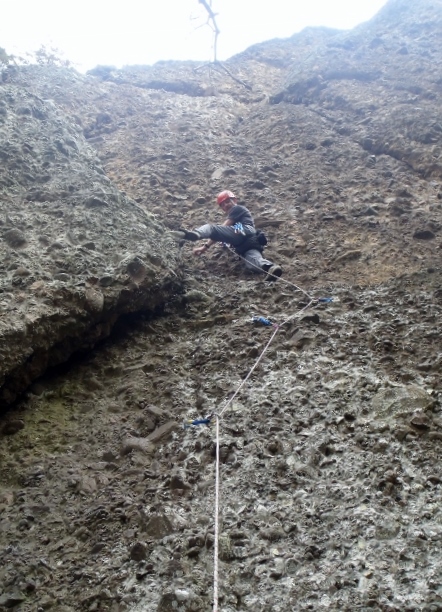
John enjoying Moy crag!
Itis a conglomerate south-facing crag, north of Inverness. Currently there are a number of trad routes for those with a death wish and sport routes that have been fully equipped and climbed. In the area that has been developed, the nature of the rock and the lack of any protection lends itself well to an ideal sport climbing venue. There is also potential for bouldering on the crag and some boulders below with the traverses recorded in the SMC Guides which also have the trad routes.
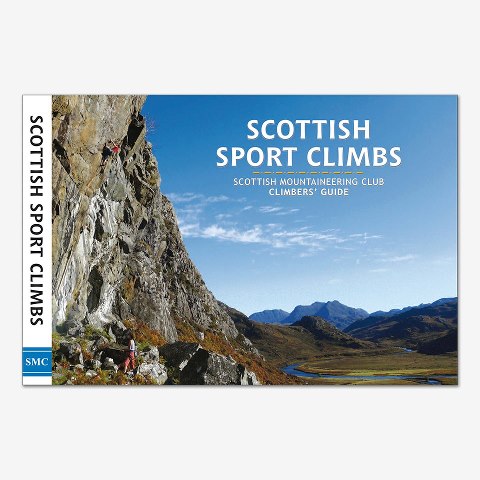
For all your Sports Climbs – out soon!
We had a great couple of hours with no one else at the crag and time to hone our skills on a sports crag, John in his mid 60’s and loved it, he was in his element and eventually we got to grips with it. You have still to be careful and check the bolts it is a different type of climbing and is very physical and a great work out. We had a shower of rain and the crag gets very slippy Then we had another friend arrive Mark – John’s brother-in-law who had only climbed once before. He enjoyed his bit of fun and then two other climbers arrived one Martin Moran a local guide and we left them to it as the black clouds came in. Martin runs one of Britain’s most experienced mountain guiding businesses, established in 1985, offering courses, holidays and expeditions in the north-west of Scotland and all over the world. He is a world-class mountaineer and a man of incredible ability and humility. He is also a member of the Torridon Mountain Rescue Team a handy man to have about.
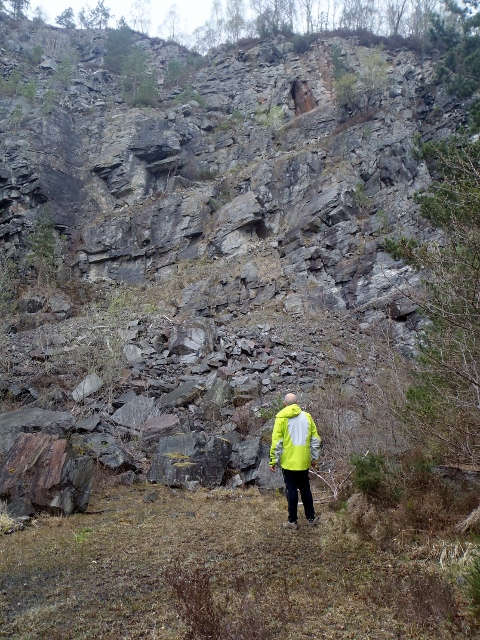
Be careful in Quarries loose rock especially after the hard winter. You must always be aware!
You never stop learning in this game and as we came back to car Mark wanted to show us a possible new climbing venue near our next objective Strathconon it was an old quarry. It was roadside and raining and we were having a laugh. We wandered up to look at the crag there looked some reasonable rock higher up. I had been here before in winter as there was some ice but it was very loose and thin! I went to look at the crag from another area one of the guys was above and as I did a huge block of rock fell. If we had been near it would have been curtains for us? We were so lucky and how simple an accident can happen, why did I decide to go a different way? A real reminder for us all. We were lucky one bruised leg/ego and a bit of a reminder. There was another to come at the end of the day. The plan was to go to the Glen for all seasons Strathconon just down the road. It is a great area, rarely visited and so beautiful.
Scatwell Upper Slabs – Ross & Cromarty – Strathconon. 16 Climbs – Rock type – Schist – Altitude – 110m a.s.l – Faces SE
Crag features. – Granulitic Schist Outcrop, 30 metres in Height. Just off the Loch Achilty to Strathconon road. Park in the lay-by below the crag, the crag is approximately 5/10 minutes walk. After our wee scare we had a coffee at Marks house and then set off to have a look at some crags nearby. The crag was pretty wet after a long winter but it was great to go to a new crag and we climbed one route and abseiled off. In the rush to get off in the rain we forgot to check harness’ at the crag and one had nearly come off by the time we abseiled. Basic checks are so important and no matter who you climb with it, mistakes are easy to make. I was so used to checking the Mountain Rescue youngsters and we always checked each other no matter who you climbed with. It is so easy to switch off and make a mistake, especially after a long day or rescue. Now I have retired you forget and can switch off you forget these checks. When you check friends harness’s sometimes they think you are an idiot. When you climb as badly as me and even as I climb as infrequently as I do now we must keep up these simple actions. It is far better to be safe than hurt. It is so easy to make a mistake as we get older when the mind is not so sharp. The thing is to look after each other no mater how experienced you are! Well worth remembering!
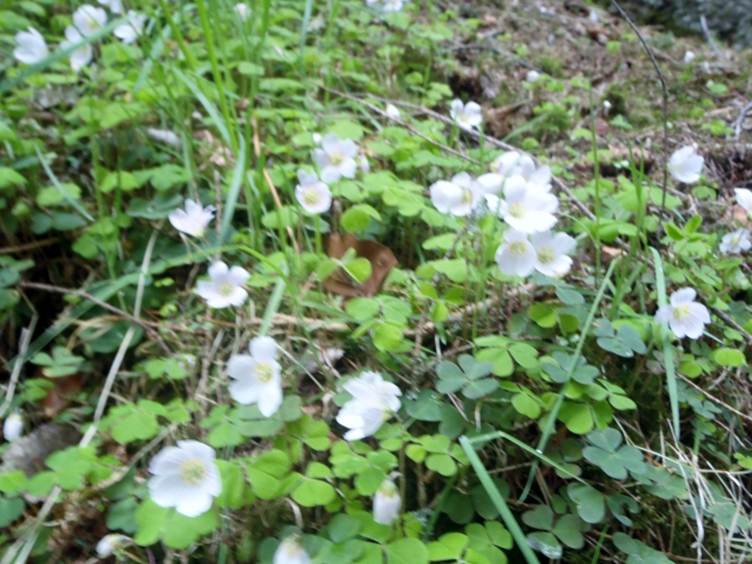
Beauty in the forest.
There are a lot of Ticks about – watch out.Mon, 13 May 2013 07:15:35
Tick bites
As I was walking up to the crag on Friday it reminds me of the annual problem we have with ticks. They love the heather, long grass and ferns and at times during the height of summer I have found several ticks on me after a day out on the hills. I am glad they are now acknowledge as another problem for the hillwalker and mountaineers. It is worth reading the information below and doing a bit of research on these wee beasties that can cause you a lot of trouble.
With the arrival of spring, now is a good time to brush up on your knowledge of ticks; what they are, where they live, the diseases they can carry, and how to minimise your risk of infection.
Being out in the countryside or even town parks and gardens where wildlife is present may put you and your pets at risk from tick bites?
Around 3,000 people in the UK contract Lyme disease (Borreliosis) from a tick bite each year?Recent research suggests that the prevalence of Lyme disease bacteria in the UK tick population is considerably higher than previously thought?
The most important tick prevention behaviour is regular checking of your body, particularly the skin folds, and prompt removal of any ticks found. It is important to try and remove ticks within 24 hours of attaching.
The following measure can also help to prevent tick bites.
Use of repellent on skin (DEET) and/or permethrin on clothing
Avoiding contact with tall vegetation where ticks are likely to be questing
Walk on the paths or centre of tracks where possible rather than in the long grass or verges
Wearing light coloured clothing to easily see ticks and brush them off before they attach to skin
Tuck trousers into socks or shoes to minimise ticks under clothing
Regular checks for ticks on clothing
Regular use of tick treatment on companion animals and regular checking and removal of ticks from pets. Different tick species are found in different habitats, but the ticks most commonly found on humans or their pets are found in woodland, heathland, upland or moorland pastures and grassland. Ticks are particularly abundant in ecotones, the transition zone between two vegetation communities, such as woodland and meadow or shrub communities, which permit a wider range of potential hosts.
Removing a tick safely
If you are bitten, follow these simple steps to safely remove ticks
Remove the tick as soon as possible using fine tipped tweezers or a tick-removal tool.
Grasp the tick head parts as close to the skin as possible,
Pull upwards firmly and steadily, without jerking or twisting (twisting is not recommended as this increases the chance of the mouthparts breaking off, thereby remaining in the skin and increasing the chance of a secondary localised infection).
Don’t squeeze or crush the tick’s body as this could increase the risk of infection by prompting the tick to regurgitate saliva into the bite wound.
After removal of the tick, apply an antiseptic to the bite site.
Don’t use petroleum jelly, liquid solutions, freeze or burn the tick.
After the tick has been removed, continue to check the bite site over the subsequent month, looking for signs of increased redness or rash.
Consult your doctor if any symptoms develop.
More on ticksMon, 13 May 2013 16:03:55
A bit more on ticks
You can buy tick removers in many pet shops, they are like a little wire or plastic V shape, that you draw a skin level towards the tick, it removes them instantly by the mouth, not the body. No repeated attacks or bits left in the skin. Used these many times, just as good for people as dogs. Only 3 so far this year, but probably a late start due to the longer winter. Depending where you live, ticks often carry Tick-borne encephalitis, which is far worse than Lyme disease. Sometimes in high risk areas, it’s better to just sweat it out and now wear shorts etc. Many European countries have online maps you can look at to see the risk level. http://www.tickalert.org/latest-risk-news.html
Latest risk news – Tick Alert
www.tickalert.org
Tick Alert – Travel Health Advice to Avoid tick disease in the UK and Europe
TICK REMOVER
Compact tweezers for the safe removal of ticks.
The Life Systems Stainless Steel Tick Remover are erganomically designed tweezers to allow the removal of ticks without leaving the head of the pest behind. To prevent disease or infection it’s essential that the head of the tick is not left under the skin making this a essential piece of kit for backpacking or camping holidays or anywhere that ticks may be lurking in the grass.
Cape Wrath – MOD Withdraws option to buy more land, sense at last!
Tue, 14 May 2013 12:26:04
Great new in these days of Defence Cuts only the MOD could need to buy more land? Thank goodness they have now withdrawn their bid – sense at last by MOD! From the BBC Website “The Ministry of Defence has dramatically withdrawn its bid to extend its biggest UK bombing range at Cape Wrath, the most north-westerly point on the British mainland.
Its decision follows a fierce public campaign against the proposed expansion, eight months after it was revealed that the MoD was trying to acquire the last remaining part of the Sutherland headland it does not already own. The ministry’s withdrawal was yesterday hailed a “victory” for the local community, which had opposed the move. It also paves the way for locals to acquire the parcel of land themselves. Dick Balharry, president of Ramblers Scotland, had recently called on the MoD to abandon its plans to take over the entire peninsula.
The MoD owns most of the headland, home to a NATO bombing range, apart from 58 acres belonging to the Northern Lighthouse Board at Cape Wrath lighthouse. Negotiations between the two bodies to purchase this last remaining slice of ground were put on hold after the community of Durness registered an interest under land reform legislation. Highland MSP Rob Gibson revealed the news that the MoD had beaten a retreat. “They have withdrawn their bid and this is a victory for the campaign mounted by local people,” said Gibson, who is also convener of Holyrood’s rural affairs, climate change and environment committee. “I am delighted. The military should never have tried this land grab in the first place. “I now hope that the local community goes ahead and buys the land and turns it into something that benefits the local area and economy.” Kevin Crowe, chairman of Durness Community Council, said: “We are also delighted that the military is no longer interested in owning the remaining land at Cape Wrath. I was telephoned by a representative to tell me of the decision. We now look forward to working with the military to ensure continued access.” The MoD’s original expansion plan had drawn widespread criticism. Mountaineer and television presenter Cameron McNeish had said: “If Westminster and the MoD get their way then precious jobs will be lost and one of Scotland’s most iconic landmarks will become private. “Closures of the Cape Wrath peninsula would affect walkers completing the Cape Wrath Trail, the newly opened Scottish National Trail and the many hundreds who walk between Sandwood Bay and Cape Wrath every year.” McNeish had also urged: “I would call on everyone who has visited this amazing part of Scotland to oppose the MoD’s plans and support Durness Community Council in its buy-out.”
Kedar Dome India – part 2 – The summit – helicopter evacuation and home!Wed, 15 May 2013 06:05:21
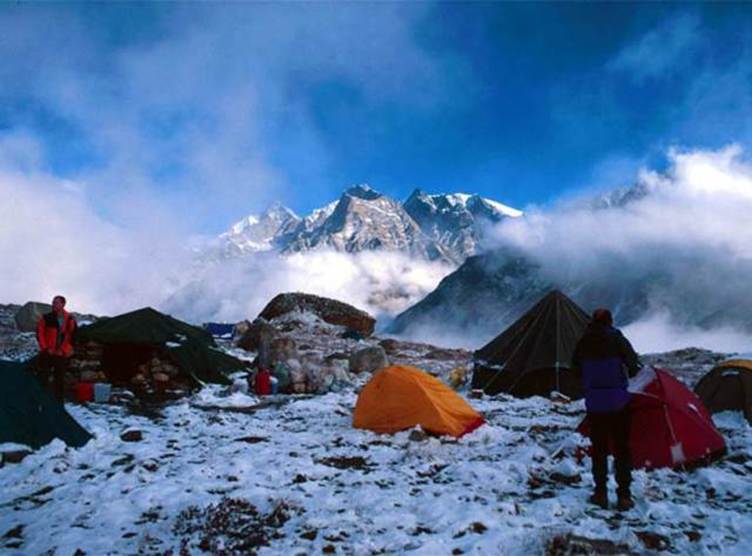
snowy base camp India
It snowed fairly heavy during the night and I slept okay for our first night at altitude. In the morning I was amazed by the amount of snow. I found on a huge boulder a wee plaque to a climber Greg Hall who had been killed in Scotland by a loose rock whilst winter climbing. It was right by the tent, incredible. It was to Greg Hall who was an instructor at The Joint Service Mountaineering Centre at Kingussie in Scotland. I had met Greg lots of times whilst climbing in the Cairngorms, it was a sad reminder that mountains can be very dangerous. From here it is a rough walk to our Base Camp over a dry rough glacier with some steep loose sections. The Base Camp at over 4,000 metres was soon set up and we were still waiting for our Sirdar who was late back from another expedition.
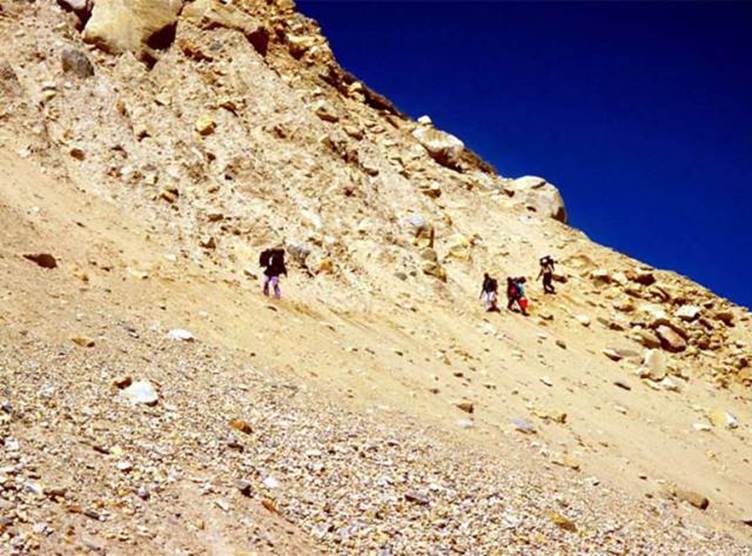
Some very loose ground we had to pass!
As we were on a short time scale, about 10 days, we had to keep moving and we were soon moving to our Camp 1 at 5,000 metres, just before the climb to the summit. This would be a huge day of over 1,800 metres at altitude. The journey to Camp 1 was across a long glacier and we had to make the plan up as we went. It was at this time we needed to have a plan and as we had a few very inexperience people and some who were suffering from the altitude, things fell into place. The only problem I was left with in the last group as the experienced leader but such is life and we needed some organisation at Base camp as the LO was not that great, it is all such a learning curve. Things went well we got the gear and camp established and the Sirdar eventually arrived, we needed his knowledge and advice for the summit day. He was some man, and had just summitted on Kamet and was very tired but still very powerful.
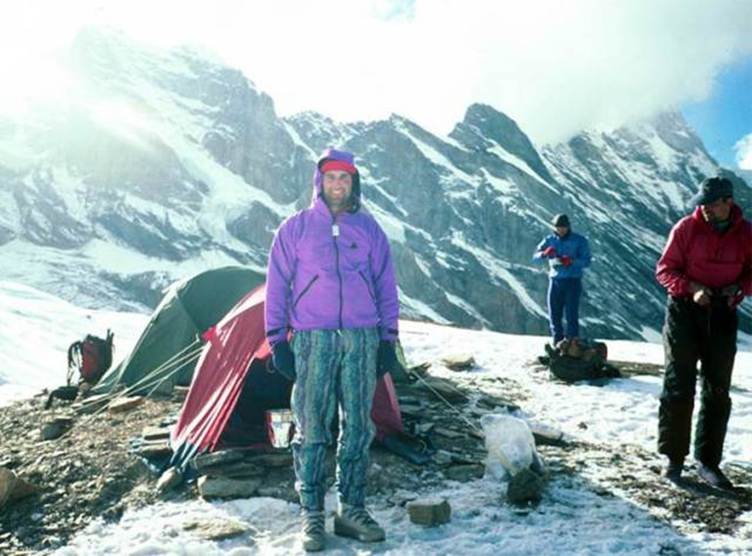
Ian Kelly at Camp 1
Five of the group went for the summit with the Sirdar and a few Sherpas but it was a huge journey nearly 2,000 metres at altitude up to nearly 7,000 metres. With hindsight maybe another camp would help. It was huge effort up the massive snow slope in deep snow but we got three to the summit Dave, Sandy & the Sirdar.
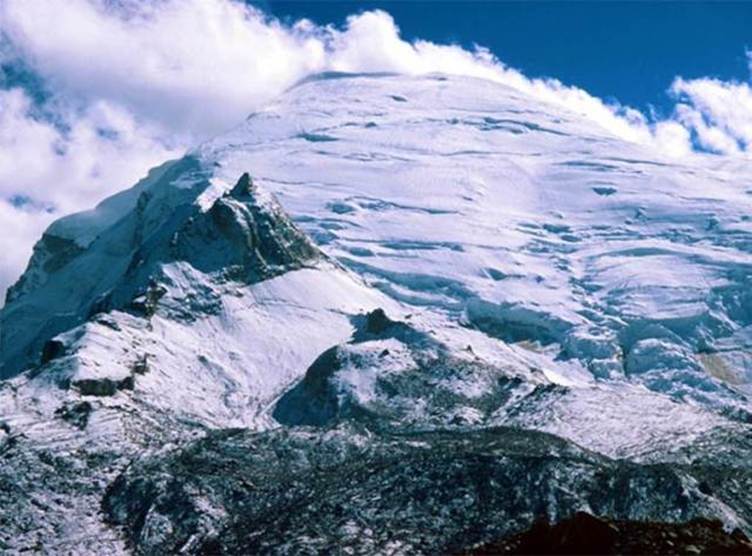
The huge Face of Kedar Dome – a long day – this mountain is now regularly skied!
It was bitter cold on the summit and a very long day. On the way down Dave realised he had frostbitten fingers and toes, these had been damaged in Alaska on a previous trip. Dave was in a bad way and Ian Kelly & Anne, Dave’s (wife) had a hard night looking after him. They got back to Camp 1 Dave was struggling and in pain and luckily we got a helicopter in to evacuate him, after this it was time to go and the rest never got a try for the summit. It sounds easy but it was not there was a lot of worry at the time It was time to pack up lick our wounds and get home.
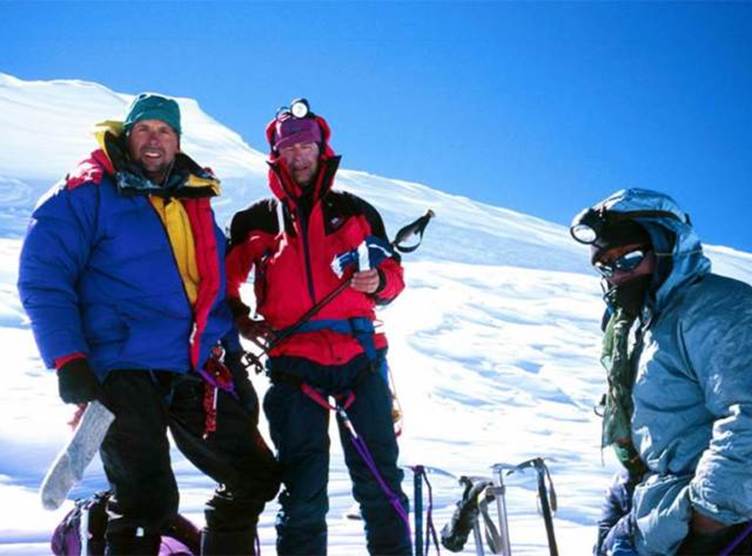
Summit India all 3
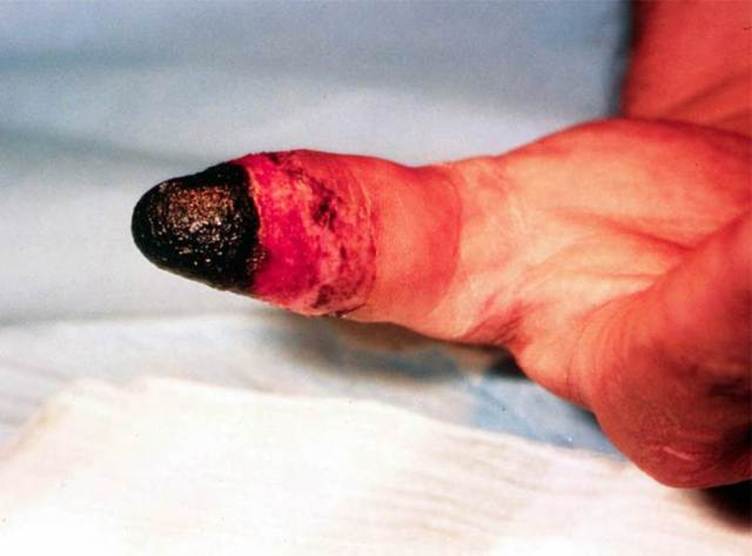
Photo Summit – day spot the harness problem? Life at altitude is very difficult, it is easy to make mistakes. Dave got flown off and made a recovery but lost part of his thumb and toes but was still out on Everest in 2001 where we met him again. It would have been a difficult recovery without the helicopter which operated at 5,000 metres. I learned so much from this trip that was to stand us in good stead for Everest in 2001. As for Dave he is living in New Zealand and flying helicopters, what a guy.
Frostbitten thumb – look after your fingers thumbs and toes!
We were so glad to get Dave safely off the hill and that was the end of the trip, lots of lessons learned and a long journey home. We were soon back on the road for an exciting bus trip to Delhi. By now most of us had Delhi belly but we still managed to see the sites and the poverty that abounds in India. It was a good trip but one that I learned so much on and vowed only to go with people I knew and had climbed with on future trips to the big mountains!
USAF Voodoo aircraft crash – Meall Odhar Ardgour May 1964 – 50 years on.
Thu, 16 May 2013 04:36:20
I was asked to check out an aircraft crash that occurred 50 years ago in the remote West Coast of Scotland. This was an American aircraft a Voodoo F -101 and involved a huge search on the West Coast of Scotland. This is a big incident in the history of the RAF Mountain Rescue and the search was a huge event at the time. This was the Cold War and much of the story was kept under wraps!
Originally, the Voodoo F-101 was intended as a long range escort fighter for the B-36 bombers. McDonnell F-101 Voodoos were operated by the USAF and later by the RCAF. At the time of the accident, the F-101C Voodoo featured here was on a training flight from its base at RAF Bentwaters in Suffolk, England. However, while flying over the Scottish highlands at 28,000ft as part of a 3 ship sortie the fighter 56-0013 exploded in mid-air. This was according to the other aircraft apparently without warning. The pilot had no opportunity to eject from his stricken aircraft. Wreckage from the fighter-bomber was strewn over a wide area in the vicinity of Maol Odhar (Creach Bheinn) in the Ardgour area of the Scottish Highlands, about 15 miles SW of Fort William. An extensive search was conducted by the USAF, RAF and mountain rescue teams. However, the crash site was not discovered until 10 days later.
This was a massive search that involved no less than eight Hercules aircraft from Prestwick; eight HC-54s (Skymasters), and eight C-47 (Skytrain / Dakotas), together with other aircraft and ground search teams. It was a huge search. As usual the Press reports speculated that live ammunition or nuclear bombs / warheads had exploded causing the crash. The airman who died in this accident was:
Capt. Morris H Reed (28). Pilot.
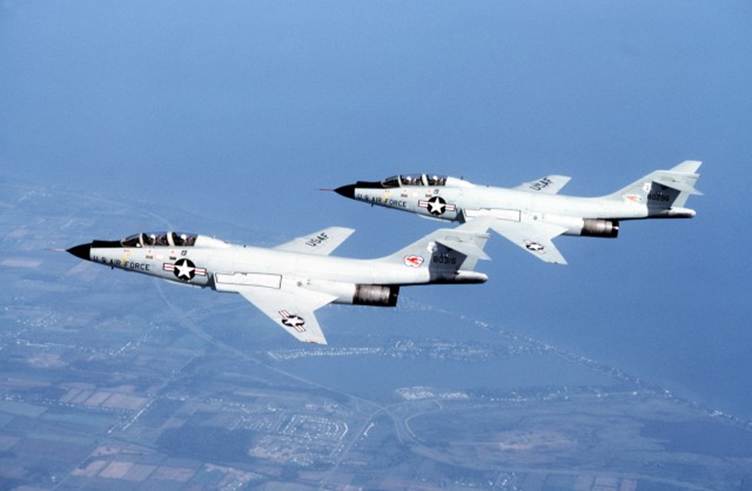
F – 101 Voodoo
This was before my time but my friends Ray Sefton & John Hinde were involved in the search planning. The search was 9 days long 7 May – 16 May. RAF Kinloss/ Leuchars/Leeming/ Valley/St Athan were involved, Glencoe & Lochaber Mountain Rescue Teams and Coastguards . This must have been a huge search to get the Southern RAF Mountain Rescue Teams up to assist, the pressure on the teams must have been immense!
John Hinde’s report states: “All mountain ridges and summits in allocated areas searched heavy mist and poor cloud base most days. Weather hail, rain but some summits clear.”
John mentions there was lack of direction from the search controllers for the first 2 days. Local reports meant the teams searched areas like Glenfinnan but it was another aircraft at a similar time. Eventually sightings and reports of a bang in the Loch Linne area and updates from the lead pilot of the sortie tied in with local reports. The aircraft was spotted by a USAF C47 on the 15 May. Next day RAF Kinloss MRT located the aircraft after a search of Meall Odhar, the point of impact was at 2,500 feet less than 30 feet below the corrie rim on very steep loose ground. The impact had made the area pretty dangerous and recovery would be a difficult and hazardous task. The USAF recovered the wreckage and remains and there is plenty of wreckage still within the area, much of it in the Corrie Floor below. One of the comments was the teams need more binoculars, there were only issued with 3 per team! Binoculars are still a great Search tool today!
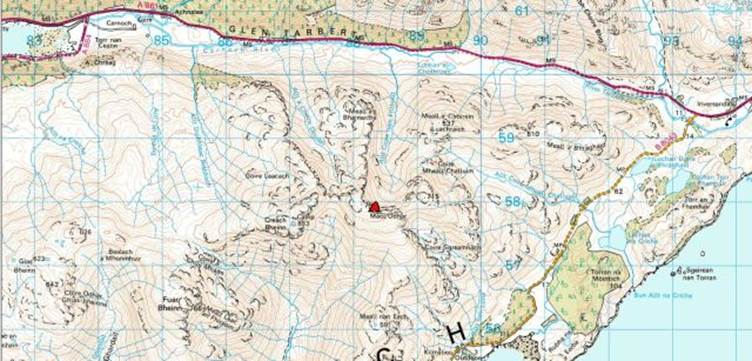
Voodoo Crash site
This wreck site is quite remote and little known, and the story deserves to be told. It lies in the hills of the Morvern peninsula on the west coast. The Voodoo jet fighter crashed near the 794m summit of Maol Odhar, about 1km east of Creach Bheinn. The wreck site is unusual in being a relatively recent military aircraft crash site that has never been cleared. I bet there are a few stories connected with this Search and recovery? I hope to visit these hills soon and pay my respects! Footnote In 2005 – On Ardgour, Erik Brunskill and Gavin Macfie added Voodoo Buttress (V,6) on Maol Odhar. Erik described this as one of his best days out in Scotland ever, praise indeed!
Ticks – A bit more please read!Wed, 15 May 2013 19:39:10
ttp://www.bada-uk.org/ is a cracking site for information and be aware a lot of GPs are unaware of complications and follow their guidelines which is for 2 weeks of antibiotics if the first blood test is positive. The first blood test is may throw up a false negative so be cautious and go armed with information to the GPs – they cant be experts on everything and 2 weeks treatment may not be enough, demand a second test and continue with the drugs ! Lyme is relatively new so research is limited but getting better, along with awareness and hopefully more will come out after a recent coming together in Inverness of professionals as it’s a dreadful thing to contract.
More on the Voodoo Crash in Ardgour – May 1964 – Ben Nevis Poem.
Fri, 17 May 2013 03:05:59
Voodoo website pk district
Many thanks for this more information on the Voodoo Crash. view-source:
http://www.peakdistrictaircrashes.co.uk/pages/scotland/scotland56-0013.htm
From another friend, a climber was killed on the mountain Meal Odhar at the crash site in 71/72 whilst looking for the crash of the Voodoo. Be aware that some of these crashes are in remote and steep ground and can be dangerous if not a mountaineer. I will look into this incident and get back when I return from Ben Nevis. From Ray Sefton who was on the crash. You told the story well. What started the search in the Glen Finnan area was a report of a jet belching flame and smoke disappearing into cloud on a hill adjacent to Loch Shiel. It took 3 days for a scimitar pilot to admit he was beating up the Glen Finnan viaduct.
Ray Sefton “My lasting memory of this call out was the absolute squalor that the troops lived in and still maintained their morale. Apart from the first night in the old shed the rest of the bases were in tents. We had little kit and usually stood astride the “bomb” (Hydra Burner) tunnel, until we were dry. On call outs, we were always on compo rations for the first three days and then went onto fresh rations, if we were lucky. Because this operation was of national importance our support from Pitreavie RCC, after the first day, was exceptional. The bonus in Glencoe was that big Ingrid, the wife of the Youth Hostel Warden, made us very welcome and dried out as much kit as she could”. (This lady became a friend of the team over many years.” Life was hard in these days – for the teams!”
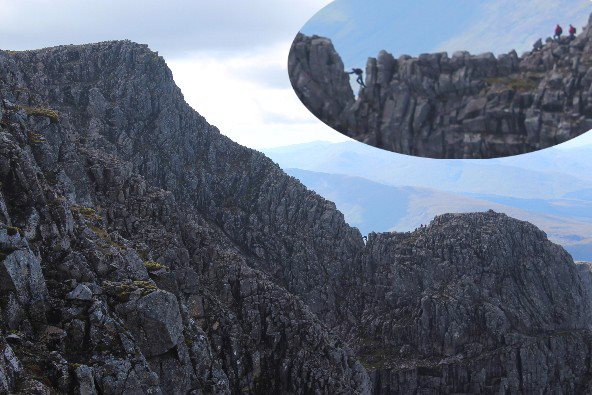
July Tower Ridge, a classic
I am taking some people on the hill, just the mountain path up Ben Nevis, they are driving through the night from down South. They want to start at 0500 as they are heading for Kintail on the west coast after the day on Ben Nevis. Mountaineers laugh at the Ben path but it is a long day for those who have never been on a mountain. I was lucky that I got taken by my father and mother and the school. Your first day out is special. The Ben was looking special today still plenty of snow and the forecast is not bad. It is a bit early but at least we will miss the crowds? I am now down enjoying the beauty of the West. What a magic drive down, every hill is special and the Laggan road goes through some marvellous scenery, I never take it for granted. We live in such a great land. I stopped for a coffee in Aviemore and had a quick chat with Bob Reid who has done so much for mountain access over the years. It was good to grab a minute with someone who has worked so hard for the wild. He, like me, and many others is worried by the spread of wind-farms and the roads all over these wonderful mountains. We are so lucky that many before us fought to preserve the wild, let’s keep up the fight and look after this great country.
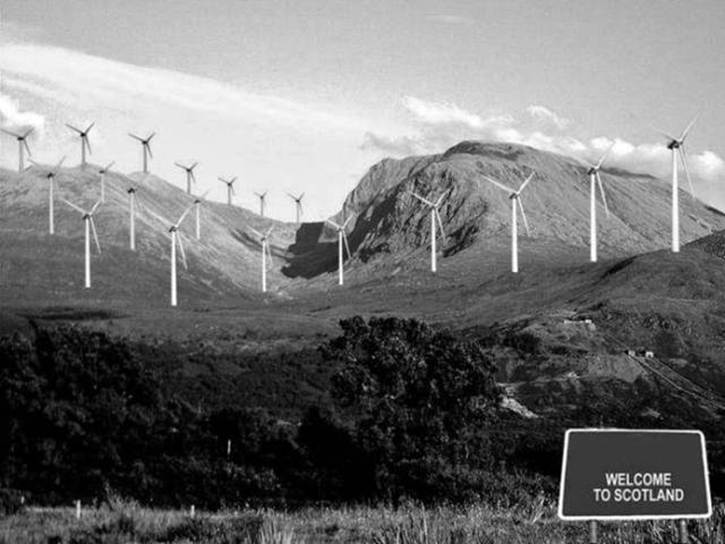
Windfarms on Ben Nevis[2]
The Ben – North Face, Memories,
H how many times have I walked that path?
Through forestry and muddy track.
Bag bulging, sweat pouring,
Then the great cliffs mourning, Watching?
Castle Ridge – you have to bridge
Its famous chimney!
The Douglas Boulder
Done when young but not when older.
Tower and it’s sweeping ridge, the gap too big to bridge!
In the mist, clouds, emerge, I see Observatory Ridge more a face than a ridge
The hardest by far.
North East, a feast of scrambling but in the winter!
The man trap beckons.
Near the top the summit reckons.
So many days, so many friends.
So much fun and memories, many happy, some sad.
Carries off in the dead of night,
Unknown people. Battered, bruised but glad to be alive,
Helped by unknown rescuers and fellow climbers.
This mountain Ben Nevis.
Heavy Jan 2007
Early Start for Ben Nevis – huge Cornices in May – Braveheart on Ben
Fri, 17 May 2013 23:12:10
I got a call a few days ago from an old friend “The Laird” who lives on the West Coast. As many do in the West he is a man with many hats. He asked if I could help him as he had a group of Americans wanting to climb Ben Nevis by the Mountain Path. I had not been out for a while so I said I would help but by the time it was organised they were wanting to go at 0500 in the morning!
Message to self get all the details before agreeing to anything!
I must have climbed the Ben so many times and to be honest the Mountain Path always hurts, it is a long way up and down on rocky ground. So many times in my youth I have run down it but not nowadays but I usually end up at least twice a year taking friends up by the mountain path. I used to be a bit of mountaineering snob and forget how much most of the 200,000 who annually enjoy their day on this great mountain, today was no different. I met my party in the Nevis Car Park and we were away for 0500! They had driven overnight from Cambridge and were trying to get the best out of a long weekend. They were bound for Kintail after the Ben via Loch Ness for some kayaking a busy group. It was a magnificent morning and my drive from Onich was one never to take for granted. Five of us set off but the journey with no sleep and the terrain proved to much and one of the group had to descend early on . I was lucky that Jock who was accompanying the group took her down and then caught us up on the summit, what a man. The great thing was we only saw one other person who was running ahead of us, we had the Ben to ourselves and the scenery was outstanding. The views of Glen Nevis, the new lambs, the primroses and birds singing helped take the pain away and we were soon at the Red Burn just before the Zig Zags. All were going well but after the third Zig Zag the ground was very icy and there was plenty of snow. We took lots of photos and met two others who were from Germany on the way to the summit.
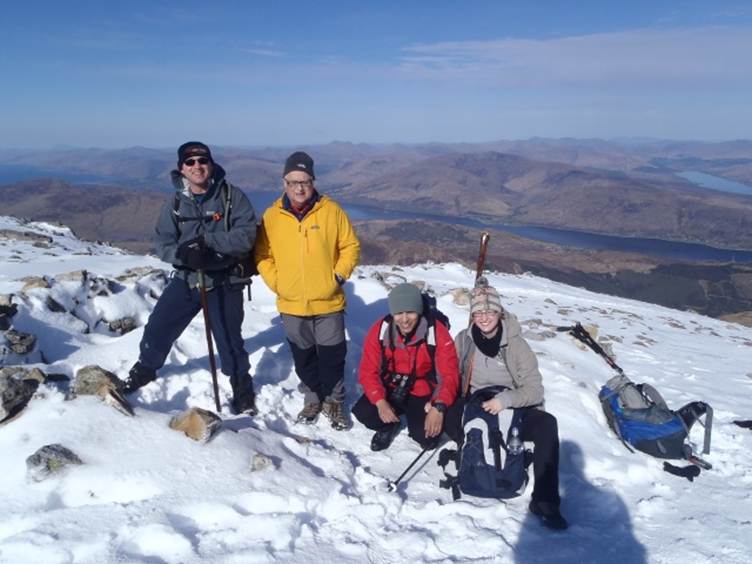
It was great to have a chat and I defy anyone to see what an ascent of this mountain means to many of those we met. We were soon amongst the snow fields and the huge Cornices on the cliffs were still massive. The views ever-changing, the sun out and the odd blast of wind making this a special place to be. We met our runner he was going well and on the way down – 2hrs to the top and full of life, yet he still had time for a chat.
Running Man, Ben Nevis
The views across to the Mamores with the Devils Ridge were outstanding and we were soon on the final summit plateau. The Cairns marking the way to the summit to me are a great addition and means that the walker can have some help with navigation when the weather gets wild. A few are against these cairns and call them an intrusion but I have spent a lot of time on this wild mountain on rescues and to me they are a necessary part of this great mountain. I often get slated for my views but I have picked up many casualties on these gullies and cliffs and anything that helps is good to me!
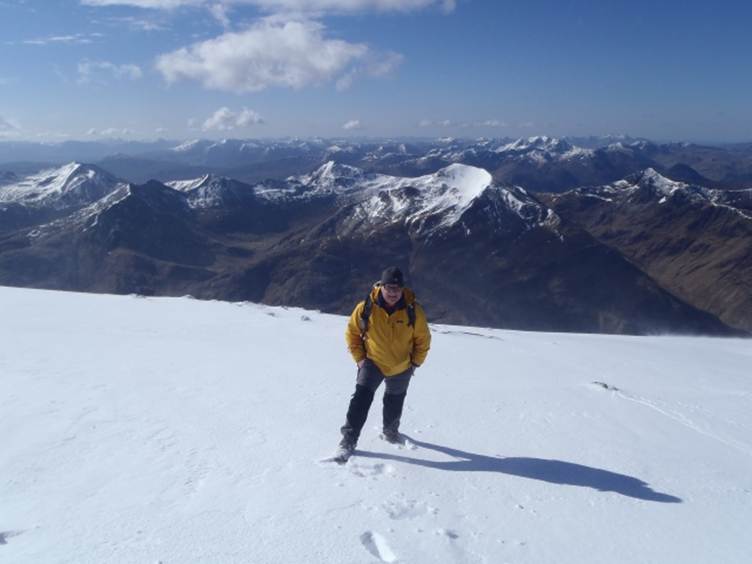
Great views of the Mamores and the Devil’s ridge.
We were soon at the summit with the odd piece of spindrift making the plateau look artic and this is mid – May. We met a pair who had just climbed Ledge Route on the North Face, they had left early and the summit was otherwise empty apart from the huge cornices that guarded the cliffs. There was no sign of the ruined Observatory, just the summit hut and tons of snow. There were no footprints at all heading off towards the great cliffs and the climbers, after a break they made there way down to the Carn Mor Dearg Arete. We took the usual photos and my group were very happy, it was a cold wind but so clear and the views outstanding. As we set off back Jock arrived running to the top. On the way down we must have met so many nationalities, Chinese, Dutch, French and so many all enjoying a great day, everyone was so happy and we chatted with most of them whilst enjoying the views on the way off. It was slippy in places and care had to be taken, it is still winter on the last 1,000 feet!
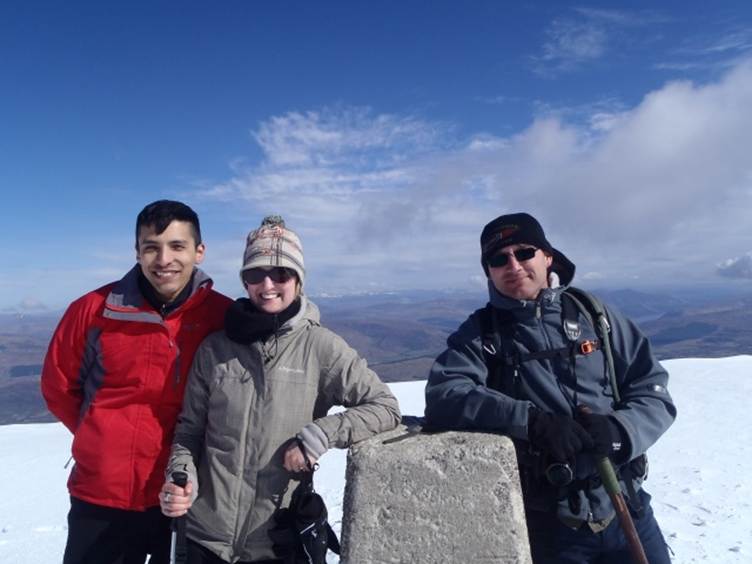
Three happy people on the summit – great people thanks for a fun day!
This was some day and the enjoyment on everyone’s faces reminds us all what a day in the mountains are all about. Many on the path may never climb a mountain again but all will have seen the mountain still with its winter cover. It is a special place however you climb it, we have experienced so much in these mountains it is great to share it with others?
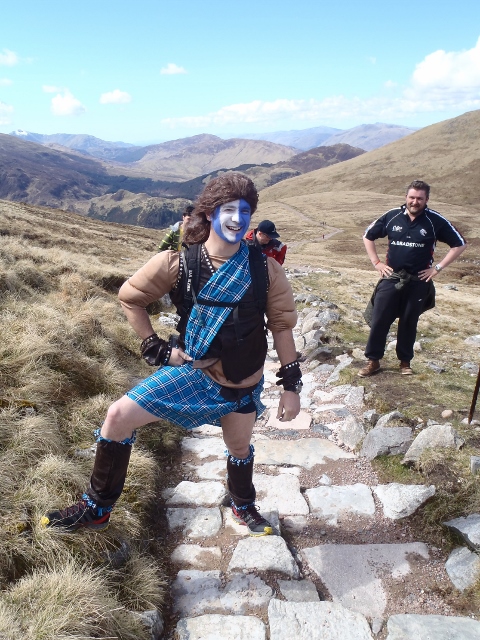
You meet some great people – this is Ben on his stag day – he made me laugh.
A great thing today there was very little litter on the mountain and it was nice to see how clean this mountain is just now how long will it last? The summer hordes will be with us soon but please look after this place for us all to enjoy. We were soon down back at the car park the knees and hips hurting and the faces sun burnt. After a wee break and a few goodbyes I was off. It was a wonderful day on the Ben and the drive back spectacular. I stopped and looked at the mountains a few times on the way home. The sun was out the hills looking great, The Grey corries outstanding but the body hurt a bit and I was needing some sleep but bring on the summer. To make it even better the fish and chip van was in the village and the fish was superb.
Can life get better?
John Muir Trust – Essential Wildness – Going to the Loo in the outdoors! Let’s talk about it!
Sun, 19 May 2013 06:03:16
The link above(no longer works BJC) is a great effort by the John Muir Trust (JMT) to explain the incredible work they do. Please take time to watch and share it with friends. I felt it explained very well the work they do. They have just won a huge battle to stop MOD purchasing some more land at Cape Wrath along with others concerned groups. We need the JMT so much nowadays please support them they are doing so much work for us. Why the MOD needs more land beats me? In these days of MOD cutbacks and huge redundancy’s maybe they need a re-think? The Mountaineering Council Of Scotland (MCOS) were prominent in this fight and to make MOD re-think was a great success. Cape Wrath is so worth a visit a wild place at the end of Scotland a place of great beauty and we still have access.
There is planning permission in for two wind – farms in Sutherland with 22 and 26 turbines planned for sites near Loch Shin and and Ben More Assynt. The MCOS is objecting as it believes the wind – farms would have a severe impact on precious and unspoilt land. The energy giant SSE which is behind the development of the Glencassey Wind farms said that its site has been carefully designed that no turbines will impact on the views of Ben More Assynt! A very bold statement in a wild landscape that make Assynt and Ciogach so special to us all. Wind – Farms are spreading all the time we need all the support we can.
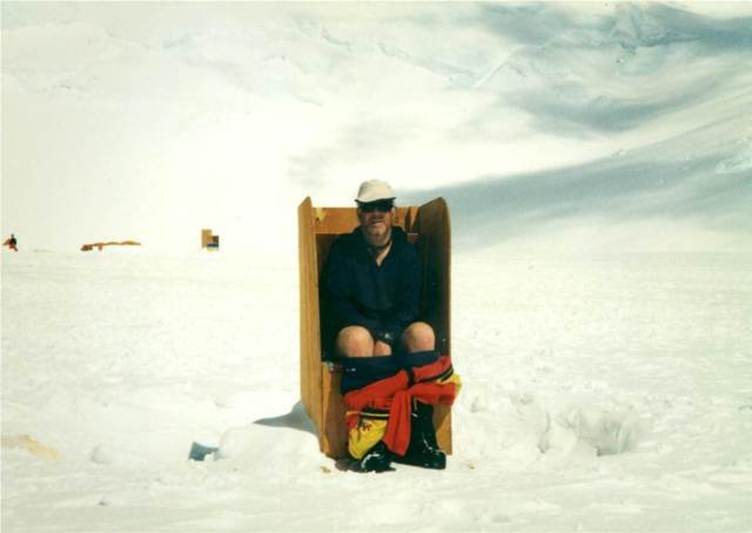
Throne room of the Mountain Gods – Alaska toilet at 14,000 feet – you have to go somewhere!
When you are out on the hills or wild many people find it a tricky subject to talk about where do you go if caught short! The MCOS have produced a wee booklet on what and where to do your business. For many years before Health & Safety we would carry out a clean up round bothies and huts. We were lucky as we used to get the Wessex/ Sea King helicopter to take us on training run when I was in the RAF Mountain Rescue. The mess left after the winter was awful and at times we took bags of rubbish and crap left after a winter. It was an awful job but we felt we were doing our bit to help keep these places tidy. Nowadays with new rules etc this is no longer done and it is up to us to look after the wild and keep it clean.
Where to go
Still talking about going to the loo, Heather Morning has now ‘lowered her sights’ to highlight another very real danger – taking a ‘comfort break’ in an inopportune place! In early summer the Scottish mountains hold snow long into the spring and early summer. These snow patches will often be hard and located high up on the shady, north side of the mountain. Many traditional mountain routes cross through such terrain and are the usual choice for Munro baggers. Hill walkers are advised to treat these old snow patches with caution, particularly if the ‘run out’ below is over steep ground. Route choice is really important and hill walkers should consider a ‘snow free’ alternative or simply turn around.
Heather Morning says ‘Ladies should be particularly careful regarding their choice of location to take a pee. A friend of mine; in a bid to search out somewhere discreet; out of the sight of the rest of the party, stepped onto an old patch of snow and headed off down the hill with her pants round her ankles! Fortunately, she only slid a few metres onto grass and the only thing that was hurt was her pride!’
Carey Davies, the British Mountaineering Council’s (BMC) hill walking officer, said: “When spring arrives a lot of people feel the pull of the mountains and want to get outdoors again. But sometimes people get caught out at this time of year. While it may feel like spring has sprung at low levels, up on the mountain tops it can be a very different story.
“Mountains in Scotland often hold areas or patches of snow well into summer. The higher mountains, like Ben Nevis, are never snow free. And because they’re further north and often higher they can have a lot more snow on them than the uplands of England and Wales.
“If you’re going into the hills remember you may encounter the white stuff – anything from the odd patch to large areas. So be prepared! “Toilet Paper and Sanitary Items. Both should be carried out as they can take a long time to breakdown, and animals may dig them up. This can be done hygienically and without smell using re-sealable bags or containers. Toilet Facilities Never miss an opportunity to use a proper toilet, and if a dry or composting toilet, it only functions if everyone follows the instructions. General Hygiene It is essential to clean your hands after going to the toilet, particularly before handling food. The best option is handwash gel that does not require water. Talk About It.
Discussing outdoor sanitation will increase awareness, and raise standards. The MCofS will update changes to this advice on our website and magazine, The Scottish Mountaineer.http://www.mcofs.org.uk/assets/access/where-to-go-leaflet.asp.pdf
A bit for the ladies – http://www.shepee.co.uk/about_shepee.html
The Big Lift remembering those who have and are giving their lives in Afghanistan.
Mon, 20 May 2013 05:28:41

The Big Lift Charity.
Whatever your views of the war in Afghanistan the loss of lives in all sides is tragic. As I was getting some bits and pieces in Tesco’s in Elgin before I went to Ben Nevis last week I met “The Big Lift” Ben Greer was in the store walking round with his huge rucksack containing 100 kilos in weight. I will leave him to tell you why. This is taken from his website
“My name is Ben Greer. I am Ex Royal Air Force having left 2 years ago. I was a Chinook helicopter crewman. I had the pleasure of serving alongside some of the best young men and women I have ever met. I completed 6 tours of Afghanistan during 2006-2010. During these tours one of our main jobs was to provide casualty evacuation from the front line using the Medical Emergency Response Team (MERT). We evacuated the bulk of both the civilian and military casualties for the area of Helmand. It has been my honour to have been involved in such an operation which I should also state is still ongoing.
Having been involved in a lot of the British casualty evacuations, many very successful but including those dead on arrival and those who have died later on, Afghanistan has not left yet me. Not because I am suffering from Post Traumatic Stress Disorder, but because whilst I sit at home in the comfort of my living room I am aware of the price paid for what we have here. So often taken for granted and so often not even considered.
For those who stayed behind and have lost loved ones Afghanistan will never leave.
That is why I am going to walk a mile for every British service person to have died in Afghanistan; currently sitting around 440. Each mile though will be done with the weight of a combat soldier, in fighting kit on my back to simulate evacuation from the battlefield. The weight will be 100kgs or 15.74 stone, 220 lb.” Please have a look at the website and if you feel you can donate. All these young lives lost and families changed forever.
Scottish Mountain Rescue the early days.Tue, 21 May 2013 04:53:44
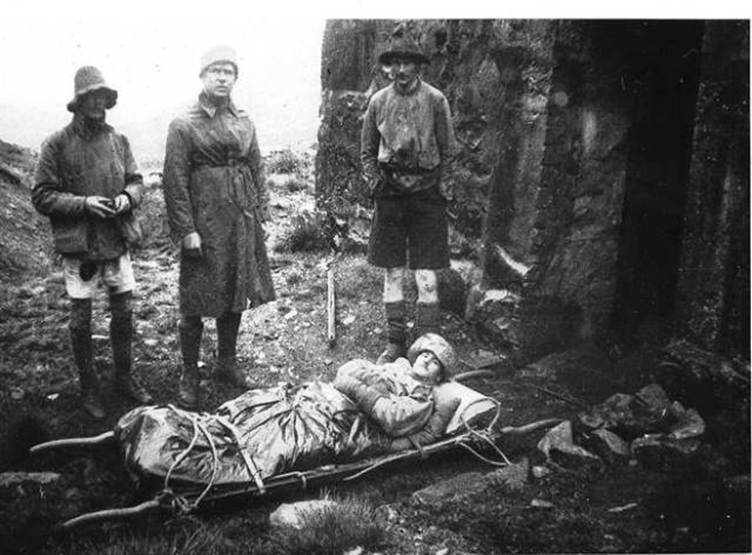
Early days at the CIC Hut – before Mountain Rescue.
When a climber or walker fell in the 30’s there was little that could be done and any assistance was carried out by fellow climbers and walkers with great help from local Police , Gillies, Keepers and locals. We take so much for granted nowadays with Mountain Rescue such an incredible service, If we have an accident on the hill we get rescued quickly but all this did not come easily. Rescues in the past were done by whoever was available and at times the Scottish Mountaineering Club were called from Glasgow and Edinburgh to assist in Glencoe and other areas. As mountaineering became more popular there was a rise in accidents and Rescue post were set up in many of the climbing areas. In the 1943 The RAF Mountain Rescue Service was formed and made a huge impact in Mountain Rescue after the War. It must be remembered that the Police were the ones climbers came to after an accident and it is the Police responsibility for Land Rescue. The early days of rescue have tales of very basic gear, long carry- off’s and steep learning curbs for all both the rescuers and the casualties. The following is extracts from a few Committee Meetings where they set up the start of the system we have today.
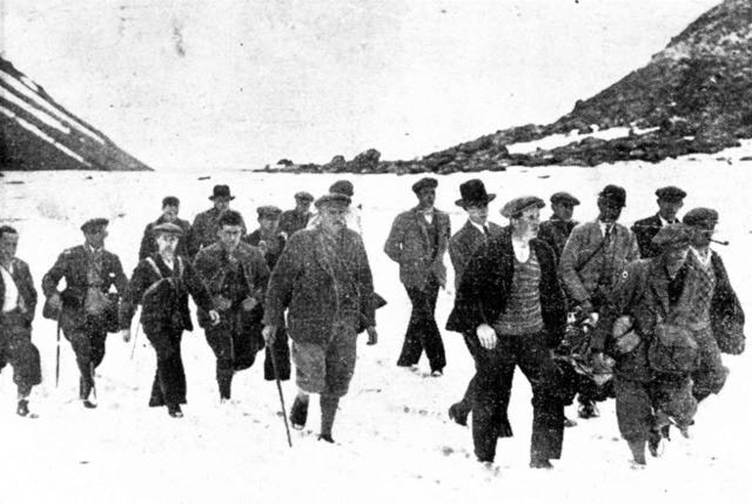
1928 Larig Gru Search – everyone helped in these days!
1951 – First Aid Committee, Convener’s Report. – The First Aid Committee met in January and decided that the Convener should prepare each year a list of Scottish hill accidents. (This is published in the SMC Journal.) It was decided to install First Aid Posts in Glen Clova and Lagangarbh (in that order). It should be pointed out to the Mountain Rescue Committee that no rescue equipment existed north of the Great Glen on the mainland. The Convener was asked to approach Colonel Arthur and discuss the generous offer of assistance from the Scottish Branch of the British Red Cross Society.
Report from Convener of First-aid Committee 1946 . With the equipping of a Stretcher Post at Brodick, Arran (at the Police Station), under the supervision of the Lomond Mountaineering Club, the number of fully equipped Posts in Scotland becomes twelve. Complete details of these, and Stretcher Posts in England and Wales, with advice regarding accidents, of which every climber should avail himself, are obtainable in a reprint from Barford’s “Climbing in Britain,” at a cost of 3d. each, plus postage. One of the rucksacks, but not the contents, used on Bidean nam Bian during a rescue in December 1946 was lost in wind and darkness. If it should be discovered it should be returned to Clachaig Inn. The First-aid Committee of Mountaineering Clubs, on which we are represented by Dr G. G. Macphee, has changed its name to the Mountain Rescue Committee of Great Britain. The B.B.C. have been good enough to co-operate with us in our attempts to reduce the number of accidents on the hills. Not only did they allow the Hon. President to give a warning talk at Easter, but they incorporated warning passages in the script of a series of dramatic broadcasts arranged by Mr Borthwick. It was agreed to apply to First Aid Committee with a view to establishing a stretcher post at Altnafeadh, Glencoe. 1946 – First Aid Committee’s Report. – Co-operation continues between the SMC and the Mountain Rescue Committee. The Club is contributing £5. 5s. annually until further notice to the Mountain Rescue Committee, and has agreed that its first-aid equipment be vested in the same body. The Scottish Committee of the British Red Cross Society has offered, subject to revision and limited to a generous total expenditure, to restock our First Aid Posts.
Lost to the Isles – Military aircraft accidents around the Scottish Islands.
Wed, 22 May 2013 06:20:30
As many know I have been interested in Aircraft Crashes and was involved in the Search & recovery of many. I also did a few on the Scottish Islands which were always difficult and mainly tragic affairs. The Islands of Scotland are incredible and they have there own weather which make flying difficult especially in the early days.
Some of the incidents I was involved in:
1975 – Isle of Mull missing aircraft located 7 years later. This happened over New Year period and we had as always amazing hospitality on the Island by the locals.
1978 – Isle of Colonsay French/ Dutch Military aircraft Atlantic crashed in the sea – wreckage washed ashore. – All the crew survived – we lived in a Cave one night and much of the wreckage washed ashore vanished in true Island Fashion. It was very difficult trying to get some of the sensitive items back! A bit of barter was called for
1982 – Skye – Stron Na Stri – USA F111 – both crew were killed. – This was an epic which I wrote about in my Blog this December. I was leading the party that found the crash site on a wild night in winter. I spent a week with the USA Board of Enquiry at the Broadford Hotel going into the crash site daily a big callout at the time.
1987- Barra – light aircraft crash. – We were flown in by Navy Sea King and poor weather meant we could only arrive in the mist at Castlebay. We stayed on the Island for three days with the recovery, great help from the locals.
1990 – Isle Of Harris RAF Shackleton all 9 crew killed. – Flown into this tragedy by RAF Sea King and were on scene within an hour. A very difficult callout and again superb assistance from the locals as happens on every disaster.
The Islands are a unique place and SAR in the early days would have been so hard. There is a new book about to be published covering the early years and looks an interesting read this book d and will tell tales of the early days of military flying. I have ordered it
Lost to the Isles, new book about aircraft crashes on and around Scottish islands.
A book `Lost to the Isles` Volume 1 1914-1941 should arrive from the printers at the end of the week 24th May, price inc postage to UK is £20
This can be sent by Paypal to my account using e-mail : dave@earl25.fsnet.co.uk Or of course UK cheques can be sent here to:
25 Hanover Street,
Stalybridge,
Cheshire,
SK15 1LR.
Many thanks for your interest and support.
Regards
Dave Earl
New Air Ambulance helicopter for Perth.Thu, 23 May 2013 04:37:19
There is a new helicopter planned by the Scottish Charity Air Ambulance for Perth. This will be a great addition to Scotland. That by my reckoning gives Scotland 3 Air Ambulances; Glasgow Inverness & Perth. Below is the piece of their website.
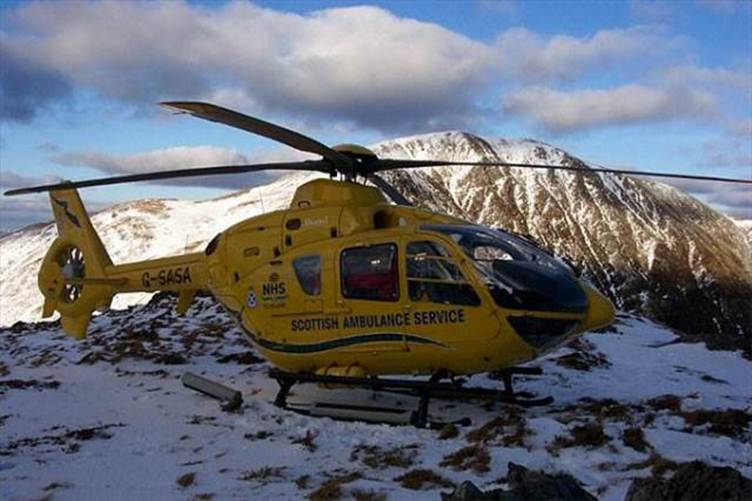
Air Ambulance
WHAT WE DO SCOTLAND’S CHARITY AIR AMBULANCE SAVES LIVES
Scotland’s Charity Air Ambulance was established in 2012 to save the lives of those in Scotland by supplementing the resources available to the Scottish Air Ambulance Service.
We will be providing, free of charge to the Scottish Air Ambulance Service, one MBB Bolkow 105 helicopter complete with pilot and paramedic crew. The cost is met through community fundraising across Scotland. There is no Government or NHS financial support.
We will be available to provide air ambulance and HEMS across the whole of Scotland from our base, at Perth Airfield. We will predominantly be servicing the East and Central areas of Scotland.
The helicopter will be fully integrated in to the Scottish Air Ambulance Service and will be routed as part of the 999 Emergency Medical Dispatch Centre.
OUR VISION & AIMS
Scotland’s Charity Air Ambulance vision is:
‘To deliver a clinically responsive, safe and flexible Air Ambulance Service to the whole of Scotland’
We have identified three core aims to deliver that vision:
Respond to appropriate 999 calls using helicopter Emergency Medical Service (HEMS) rules where helicopter air support would clinically benefit the patient
Respond to emergency, urgent and planned requests from NHS Scotland clinicians where air ambulance transport would clinically benefit the patient in remote, difficult to access, rural and island communities.
Respond to emergency, urgent and planned requests from Specialist Retrieval Services to transport teams to and from NHS facilities where air ambulance transport would clinically benefit the patient.
Scotland’s Charity Air Ambulance (SCAA) is a charitable company limited by guarantee. Registered with
OSCR in Scotland SC38496. Charity No. SC04184. Our registered office is: The Control Tower, Perth Airport, Scone, PH2 6PL.
Heading to Clydebank for a lecture tonight and will be down there for a couple of days.

DOING THINGS DIFFERENTLY!
Good night in Clydebank Beardmore Hotel and Conference Centre – Met some great people – Great journey down.Fri, 24 May 2013 05:19:30
It was an ever-changing day as I drove down to Clydebank for my talk last night, I started off in low cloud and sleet on the Dava Moor and fresh snow on the wee hills. The A93 Glenshee road was getting heavy snow according to the radio and the Tomintoul road was blocked – this was late May. I stopped to visit friend near Grantown who after years of mountains had a knee replacement and had just got out of hospital, he had been to same place I was giving my talk for his operation! The drive down also involved a quick stop at Onich to say hullo to the birthday girl and there still plenty of snow on the hills. Then down past Crainlarich to see Elma an old friend. On the way past Glencoe more sleet and wind and then down the A82 Loch Lomond with the harebells and primroses out and the trees looking so green and great. Ben Lomond was clear and looking good with a wee bit of snow near the top, the A82 was an interesting drive with its potholes but the views are wonderful. This is an incredible part of Scotland and the pleasure boats filled with tourists were out in the loch in the bracing weather.
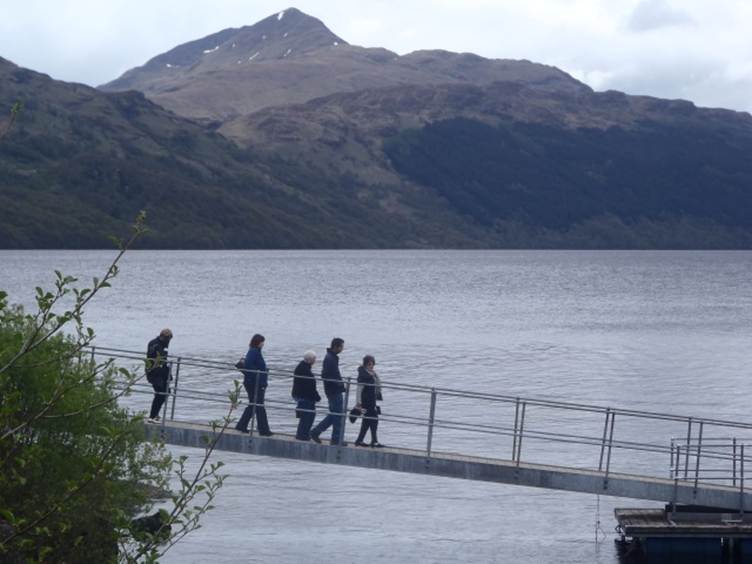
Ben Lomond
The road was busy as usual and I reached my destination at Clydebank as I was doing an After Dinner talk. I booked in and had a shower and time for a wee wander by the Clyde it was turning into a lovely night. The weather was great and it was great to get out and stretch the legs before the nights activities.
View of the Clyde and the big crane, a lot of history.
The chat after a lovely meal seemed to go well and the group hopefully enjoyed it. I met a lass from Lockerbie after my chat, you usually get a few people talking privately to you as you pack up. She was only 16 when the disaster happened. She remembers little (the minds way of coping I feel) but spoke very vividly of what her Mum, Dad and family friends did and how the family was involved. She remembers that they washed and ironed many items of personal clothing from the disaster victims and ensured that they were clean and returned to the families after the tragedy. I had forgotten that part of the story and how incredible the local Lockerbie people were. Her Mum also worked with WRVS who were incredible to us throughout our stay, ensuring we were fed all through the days and nights to come. Most were Mum’s and looked after us after we came in for a break, many of my team were given a cuddle and a few kind words by these great people. I also met a Policeman from Lockerbie who was one of the first people there, he said that period will live with him and many of his friends for ever. He was left for hours beside uncovered casualties. Scotland is such a small, beautiful place but we have so many good people about. After the Woolwich Murders it is still good to meet real people who are so passionate about how they care and look after their fellow-man. The world is not all full of hate and anger.
I stayed the night at the Beardmore Hotel. I did not know it is owned by the NHS and has the Golden Jubilee National Hospital attached to it. My friend, as I said, was in the hospital a few days previously for a knee replacement and he was singing the praises of this incredible facility. What a facility and a great idea a hospital with a hotel attached and the staff were so helpful. This is place to get your knees and hips done if your body is falling apart, it is impressive. I packed up and left every one enjoying the music and went to relax. It takes time for me to come down after a chat like that and the reminders about Lockerbie can be difficult but it is a part of my life and I do need to share the lessons from it. I relaxed by reading more Of Ian Sykes book “Cry Argentina” and I was soon away in a world of ice mountains and politics and soon fell asleep. Heavy is available for Lectures and after dinner talks see website for details!
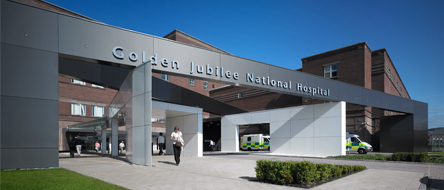
Golden Jubilee Hospital
Fast facts – Our fast facts are a quick guide to everything about the Golden Jubilee National Hospital.
General facts
A national resource for NHS Scotland
Centre of excellence in orthopaedics and heart and lung
Currently celebrating 10 years of excellence
Only NHS facility to have a conference centre and hotel on site
Pioneered the Enhanced Recovery Service for orthopaedics
First Scottish hospital to carry out a replacement heart valve through a vein in the leg – avoiding the need for open heart surgery.
First (and only) Scottish hospital to use a Ventricular Assist Device implant – also known as mechanical heart
Fast figures
3,000 procedures in first year, now 30,000 a year and a total of 300,000 by the end of 2012/13.
Carrying out 20% of Scotland’s hip and knee replacements (45% in the west)
All cardiac surgery performed in under nine weeks
Over 1400 staff
Over 100 volunteers and lay members
Above 97 per cent compliance with national hand hygiene audits
Above 90 per cent score on the National Cleaning Services Monitoring Tool
Facilities
Over 200 beds
Four cardiac catheterisation (cath) labs
16 theatres
State of the art diagnostic imaging suite
Single en-suite rooms for all inpatients
Cleaning teams report to Infection Control
The Beardmore Hotel and Conference Centre is a luxury hotel situated on the banks of the River Clyde. It offers stylish, modern bedrooms with iMac computers, and spa and leisure facilities. All of The Beardmore’s 4-star bedrooms offer free Wi-Fi, satellite TV, and 20-inch iMac computers with Freeview TV, CD/DVD playing capabilities, and free internet calls via Skype. Some rooms have stunning views of the River Clyde. Guests can also enjoy free use of the hotel’s leisure facilities, which include a heated indoor pool, steam room, and sauna. A modern, fully equipped gym is also available to guests. The Waterhouse Restaurant provides contemporary British cuisine made with locally sourced ingredients surrounded by stylish decor with scenic views. The b-Bar cafe offers light meals all day. The Beardmore offers free parking to guests. Glasgow is 20 minutes’ drive away, and Dalmuir Rail Station is a 10-minute walk.
Thanks for all your help with the IT and the friendliness shown a great place to stay.
Access from the Cairngorm Mountain Railway – Any Views?Sat, 25 May 2013 06:16:31
As a lover of wild places I am very interested in the views of others of the restricted access from the Ptarmigan station for the public in the Cairngorms. Over the years I have been very privileged to have used the railways access for Rescues and I also admit I used to use the chairlift for access to the plateau. I can see both sides of the argument and the safety and wild life and other issues that may occur and of course the effect to the Rescue Teams. There is also the fact that this gives access to a sensitive area well documented and loved by many. Many mountaineers and lovers of the wild can be very elitist and want this solace for them and only for those who are fit enough to walk all the way up. Is this right ? This is great ideology and I would love there to be no more desecration than there is of the mountains and wild places, no more new roads etc. The Cairngorm Ski Centre has been there for years and in summer is not a beautiful place to me but to others it is. The damage to the area was done many years ago but so many get enjoyment out of this area and many take their first adventure in a wild environment. It has being tidied up and walks to and from the area are attracting more walkers and mountain bikers. Too me it is great to see people getting enjoyment summer and winter and so many local jobs rely on it. It is now part of the history of the Cairngorms.
I took and old friend up in the train to the Ptarmigan in summer – he was dying of cancer and had loved the mountains over along life. He just wanted a wander around and away from the cafe and people, we were not allowed because of the restricted access. Of course I could have pushed it but it was not the time or the place to do it. I know there are now guided walks and you are even allowed restricted use a mountain bike on the railway and enjoy the journey down the track. To me as a lover of the Cairngorms this is a step in the right direction. There are many pros and cons I wonder what your views are? See below a letter in the Press & Journal in support of the freedom of access by a friend who lives and works in the area. Is he right or wrong?
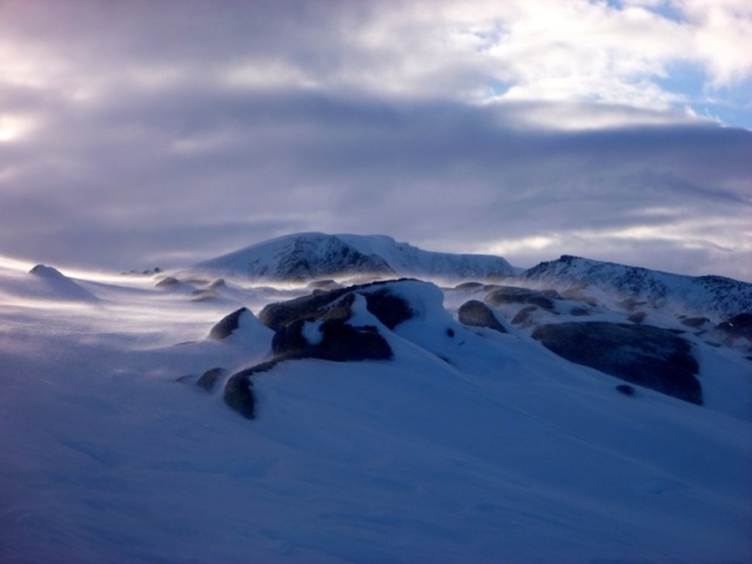
The Cairngorm Plateau – still very wintry even in late May. Please be aware – should we allow access from the railway to this incredible place? Your views?
Cairngorm Mountain Railway
Reference the article “Green light for summit walks”. (P&J 16th May). I am quite sure that coach tourists and others with insufficient time will be delighted that guided walks to the summit of Cairngorm can continue, while they remain locked up in a £26 million prison paid for by the taxpayer.
It was refreshing to see the comments of Councillor Bill Lobban emphasising how ludicrous the restrictions are. What is interesting is that all the decision makers are paid for by the taxpayer so there is no incentive to remove the summer restrictions. Some MSPs have also commented before, such as John Swinney MSP and Fergus Ewing MSP has said that the “closed system” runs contrary to the Land Reform (Scotland) Act 2003 (the Act), but even they don’t seem powerful enough to have the restrictions removed. The land surrounding the Cairngorm Mountain Railway
Reference the article “Green light for summit walks”. (P&J 16th May). I am quite sure that coach tourists and others with insufficient time will be delighted that guided walks to the summit of Cairngorm can continue, while they remain locked up in a £26 million prison paid for by the taxpayer. It was refreshing to see the comments of Councillor Bill Lobban emphasising how ludicrous the restrictions are. What is interesting is that all the decision makers are paid for by the taxpayer so there is no incentive to remove the summer restrictions.
Some MSPs have also commented before, such as John Swinney MSP and Fergus Ewing MSP has said that the “closed system” runs contrary to the Land Reform (Scotland) Act 2003 (the Act), but even they don’t seem powerful enough to have the restrictions removed. The land surrounding the Ptarmigan station is land that has a statutory right of responsible access under the Act.
Whilst passengers do not have a right of access to the funicular railway I believe they have a right to leave the station at the top, under the Act. However, notices and barriers deter people from leaving, which is against the spirit of the Act. It is not unlawful to leave the Ptarmigan station. The Cairngorms National Park Authority (CNPA), as the access authority, should be insisting that these restrictions are removed.
However, they are hiding behind some weak legal advice that has not been challenged. To emphasise how ludicrous the restrictions that are in place to protect the Cairngorm Plateau under EU Law, the Cairngorm Plateau actually has the same EU designations as the Tain bombing range. In conclusion, whilst these restrictions remain in place this potentially excellent tourist attraction will remain mediocre and a rip off to some people in summer. is land that has a statutory right of responsible access under the Act.
Whilst passengers do not have a right of access to the funicular railway I believe they have a right to leave the station at the top, under the Act. However, notices and barriers deter people from leaving, which is against the spirit of the Act. It is not unlawful to leave the Ptarmigan station. The Cairngorms National Park Authority (CNPA), as the access authority, should be insisting that these restrictions are removed.
However, they are hiding behind some weak legal advice that has not been challenged. To emphasise how ludicrous the restrictions that are in place to protect the Cairngorm Plateau under EU Law, the Cairngorm Plateau actually has the same EU designations as the Tain bombing range. In conclusion, whilst these restrictions remain in place this potentially excellent tourist attraction will remain mediocre and a rip off to some people in summer.
Any thoughts ?
Missing a great day on the hills? The incredible achievement Everest – Lhotse and Nuptse.
Sun, 26 May 2013 05:07:59
I felt a bit guilty today, I was invited out climbing the forecast was amazing yet I decided not to go. My mate Pete had called me as I travelled back yesterday from Glasgow but in the end there were going to be 3 of us and I just did not fancy it. I was pretty tired after my two days on the road and I also feel a bit burnt out after a big lecture! I also find it hard to relax after a lecture especially if I get a bit of feedback afterwards as I did in Clydebank. I at times touch on some hard subjects like the effects of Lockerbie and some tragic call outs and at times it all comes back. It is hard to explain but as Heather Morning said “you do not always just carry the casualty off at times you also carry the burden with you for many years at times”
It was an easy day and the village had a wee garden flower sale on the Salmon Green Burghead it was a grand day with blue skies and the sun out. This must be summer coming? I was also waiting for a call about a possible lecture down South but it is not on just now such is life. Meanwhile some great news from Everest where a pair of mountaineers have set a new record for climbing Himalayan peaks. Kenton Cool and Dorje Gylgen have become the first people to climb Nuptse (7,861m), Everest (8,848m) and Lhotse (8,516m) in one continuous trip. The pair climbed the final peak in the early hours of Monday (UK time). They arrived back at base camp earlier.
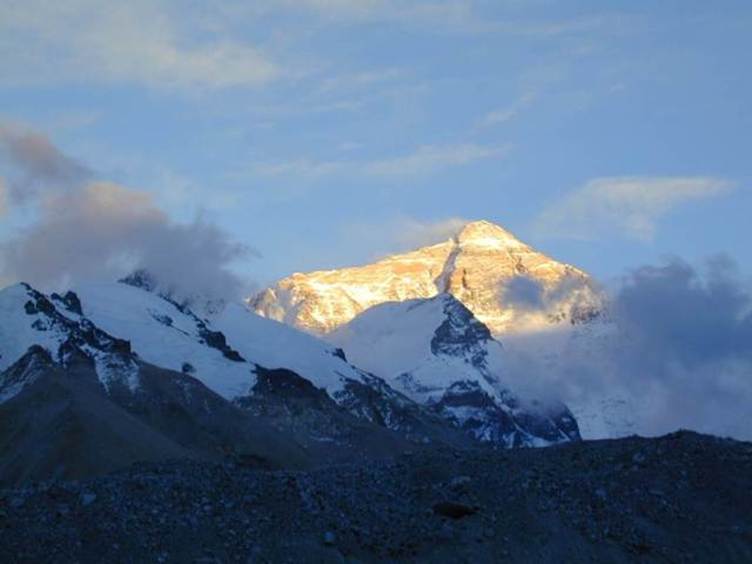
Everest Tibet
Just got this great information that – Nuptse, Everest and Lhotse have been climbed by Cool and Gylgen. This is from the UKC news.
Saturday:“The ultimate three peaks challenge has really begun. Nuptse has been done. I repeat Nuptse has been done a few hours ago. Now in the South Col. All comms out other than satphone. Planning to summit Everest tonight at 02h00 London time. Lhotse in early hours of Monday London time. Everything going well. Tell everyone thank you for their support”
Sunday:“02h00 local time: summited Everest for 11th time. Changed plan and went hard early, Dorje Gylgen and I took bare essentials and made it to roof of world in total darkness. We challenged each other all the way and can’t say who won. Disappointment of being early and not seeing sun rise made good with privilege of sitting alone in absolute silence with my friend just as I’ve always think Hilary and Tenzing did. Dorje and I laughed at the stupidity of our small head-torches beaming into nothing. This is half time only. Back in South Col. Lhotse is on for tonight. Nuptse and Everest are done. We’re feeling strong. We’re going for it”
Monday:“Lhotse has been summited. Descent hard. Now at camp 2 for the night. Three summits in three days. Nuptse, Everest, Lhotse. The finishing line of base camp is in sight.”
Loch Duntelchaig – near Inverness – A grand mornings climbing. A bit of history on the cliff.
Mon, 27 May 2013 06:52:12
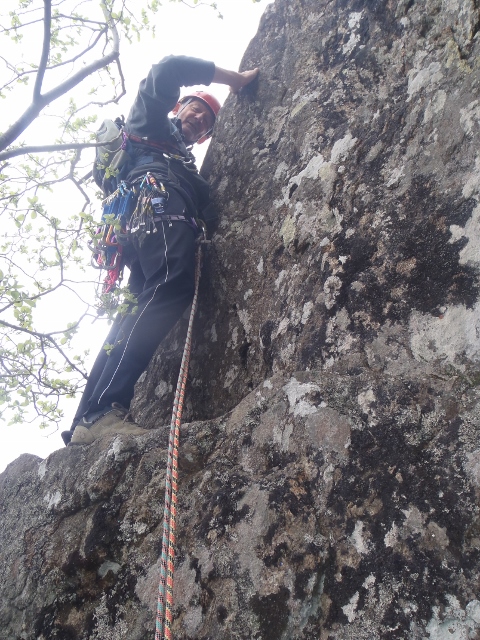
John on Drum at Duncheltaig in amongst the trees.
After yesterday’s easy day I got a call from two old friends right in the middle of the Champions League Final ( they both hate football). They wondered if I would fancy a mornings climbing at the local Duntelchaig which is very near Inverness. I climbed here a lot when I joined the RAF Kinloss Mountain Rescue Team in my early days in the 70’s. We had some great nights after work when this was a busy crag. We often got back pretty late coming off the crag at night through the huge boulders at the bottom of the crag. The crag is only a few minutes walk and is good quality gneiss which can produce a wide variation of technical climbing and routes. The cliff is in a magic spot with the trees and Loch and very few people about even on a bank holiday. Even though it is so near Inverness it is rarely busy and a real hidden gem of an area for a wander. The loch supplies some of Inverness’s water and is a place of great beauty. The crag has a bit of a reputation for midges and wet tricky rock after a rain shower but not today. The crag has been climbed for many years and the wee 200 foot v/d Drum was first climbed in 1937 by R Frere of Savage Slit fame in the Cairngorms. John had an RAF Kinloss MR Team team guide about mid 1960’s with some great information on it. It was full of some of the ex troops – John Hinde, Ian Sykes, Gordon Ballentyne and Jim Craig.
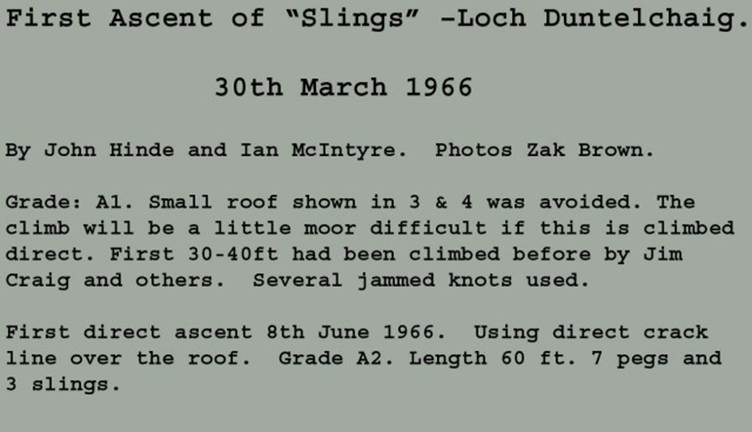
Write up on Slings at Duntelchaig 1966.
I remember artificial climbing on this crag many years ago. Many of the routes were put up by locals with Inverness Climbing Club and Glenmore Lodge prominent. It has some really hard modern routes but seems to be out of favour for the local bolted crags.
Old kit – still going strong after 25 years! Murray Hamilton Rucksack.
We had an adventure finding the route and wandering all over the crag, it was a bit wet and the boulders and caves were interesting. The route was a bit dirty and wet but still good fun and the body ached even after a short day on the crag. The views were magic across the Loch and to climb badly with no one else about on a Bank Holiday is special We savoured the views at the top enjoying the views of Ben Wyvis and the greenery of the trees at this time of year is superb. The morning finished with lunch at the lovely Dores Inn at Loch Ness, a magic meal in the sun and then home to listen to the Scottish cup final.
Scottish Mountaineering Trust Guide Book – Highland Outcrops covers the crag.
I found a few old photos of some of the old boys on the First ascent of Slings in 1966 – It is now a E1 – 5b climb with two stars! The late John Hinde is action a great man and sadly missed.
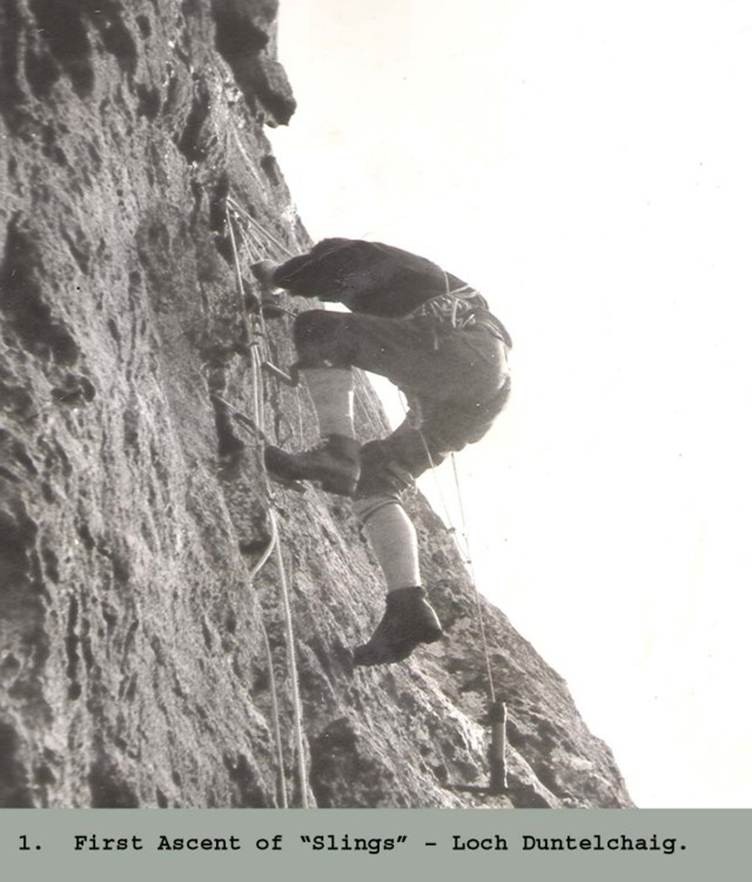
1966 John Hinde on the First ascent of slings at Loch Duntelchaig!
Assynt Anson Crash War Graves Commission work party on Mountain Memorial.
Tue, 28 May 2013 06:23:03
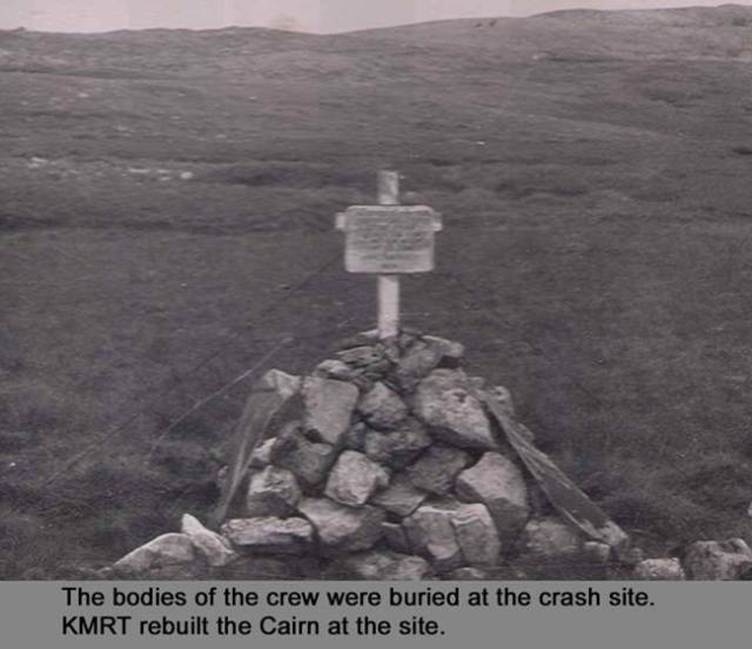
Original Memorial for the Assynt Anson aircraft crash on the hill above 2000 Feet.
My views are fairly well known on Mountain Memorials but this is very different. This memorial is also the grave of the crew of a Avro Anson. This is very unusual as this is the only site where the whole crew were buried at the site. On Sunday April 13th 1941, the crew of Anson N9857 XF-F from 19 OTU (Operational Training Unit) at RAF Kinloss on the North East coast of Scotland, were briefed for a cross-country training flight. The routing for the flight was to be:- RAF Kinloss – Inverness – Oban – Stornaway – Cape Wrath – Achnashellach Station – RAF Kinloss. At 1302 hrs, N9857 sent a message confirming their turning point at Cape Wrath. They indicated that they were attempting to climb over the bad weather. Approximately 10 minutes later, the Wireless Operator at RAF Stornoway picked up a very faint Morse message. “icing up………..lost power in port engine………..losing height……..descending through 3,000 feet …….” and then nothing more after that. This was indeed a dire situation for an aircraft to be in, flying as it was, with mountains of +3,000 feet all around. The aircraft crash landed on the plateau of the mountain Beinn an Fhurain approximately 3 miles east of Inchnadamph in Sutherland, Scotland at around 2,300 feet. On landing the starboard wing hit a rocky knoll and shattered which sent the aircraft cartwheeling. The fuel in the wing ignited and burnt out most of the wing and part of the foreword fuselage. The blizzard which swept the North West Highlands that day was ferocious; it was the most severe snow storm to have been recorded in the area in over 100 years. The same day that Anson N9857 and crew were lost three local shepherds in the Inchnadamph area perished less than half a mile from their homes while out attempting to gather their sheep in to shelter. At RAF Kinloss, Anson N9857 was recorded as being overdue, and as time passed, as missing. Extensive air searches over the next few days failed to find any trace of the aircraft and it was presumed lost at sea. The fate of N9857 and her crew was not discovered until 25th May 1941 when Mr Law, a local shepherd, came across the wreckage of the aircraft while he was out on Beinn an Fhurain. The bodies of five of the airmen were found inside the remains of the fuselage, wrapped in their parachutes. Evidently at least three of them had survived the crash landing but had died of exposure. The body of Sergeant Mitchell was discovered some half a mile away sheltering under a large boulder. It is believed that he had set out to get help but he too had succumbed to the cold. Due to the remoteness of the area and the difficulties involved in accessing the crash site, the airmen were buried side by side at the scene by police and Estate workers. A large cairn made with peat and rocks in a semi-circular shape was built over where the bodies lay.
Great effort by the War Graves Commission to sort out the site.
I have told the story a few times on this blog and have recently done some work with the War Graves Commission to ensure that this site is looked after as all War Graves despite its remote location. A new memorial will be flown after the work is completed and we have the job of preparing the site before hand. I am off to the North West on Wednesday for several days to work on the site. The reason I am so involved I promised the late Eric Hughes (an ex Mountain Rescue leader) who was one of the original work party on the war grave. That I would try to tidy up the old memorial and maybe and get something that would stand the weather better and need little maintenance. The War Graves Commission have been great and a new memorial is being made of Granite that will replace the old Iron Cross that is showing the worse for wear. It will be a hard few days but we have some help from The Estate, RAF Lossiemouth MRT, the local Assynt Mrt. National Heritage and a few locals. We meet on Thursday at 0930 at Inchnadampth car park – what will the weather bring? It is a two and a half hour walk in to the memorial, if you fancy some hard work at altitude give me a call.
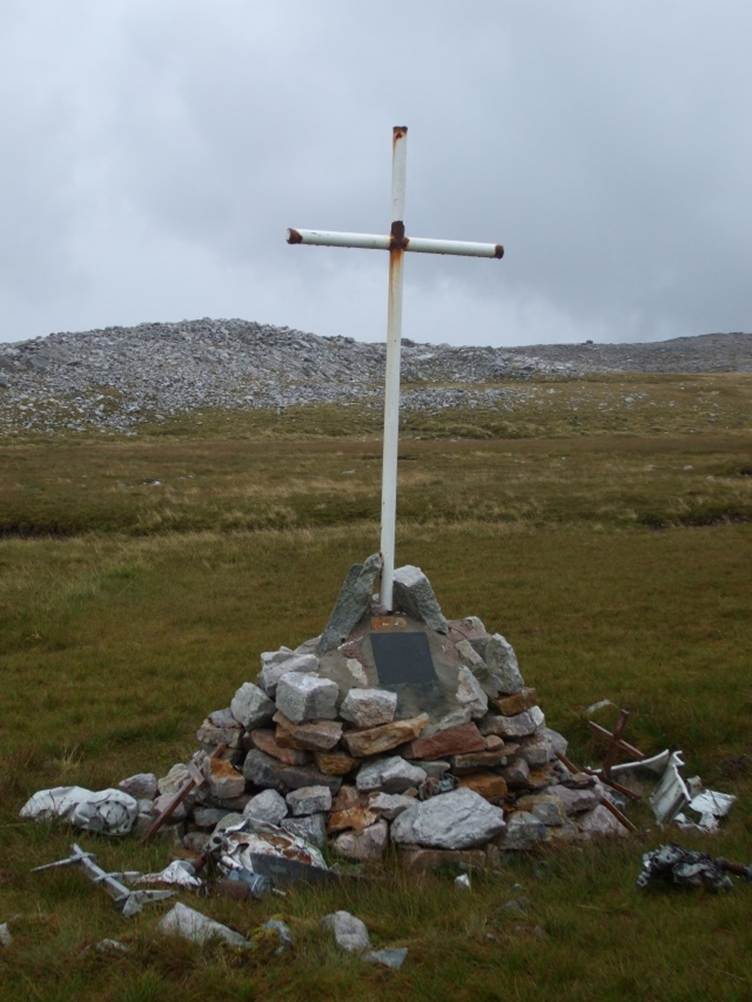
The old memorial that we will take down.
The weather for the North West looks not bad – I wonder how the midges will be, must pack the midgy gear!
Weather: Gradually improving, with light winds on the mountains, and generally only a few showers over the next few days and the weekend. Cloud will shroud particularly eastern mountains on Wednesday, but as the week goes on most summits will clear, most widely in the afternoons. Very little if any rain this weekend, although particularly western Scotland will turn wetter into next week.
The Mountain Bothies Association – MBA – Sheneval Work party- great people – Many thanks.
Wed, 29 May 2013 04:10:48
Over the years I have spent many nights in the Mountain Bothies from my very early days aged 12 at Back Hill of the Bush in Galloway – no longer open due to vandals. The bothies have been a great refuge to me after many special days in the mountains. I have enjoyed so many nights with great friends after a hard day on the hills in summer and winter and mat so many great characters of the mountains and wild places. I did a wee lecture for the North East Mountain Trust in Aberdeen and met some of these wonderful people who look after our Mountain Bothies. They are a great bunch of people and have done a brilliant job on a place so dear to my heat Sheneval bothy. It is in the North West and surrounded by so many great hills and memories, An Teallach, Beinn Dearg Mor and Beag and the great remote summits of the Fisherfield hills.
The bothy has been done up – by a work party recently – please have look at this wee video . Many of us use the bothies and never give anything back – why not join the MBA today and help them keep this heritage for others to use?
This is the wee note I got with the vidoe – No problem, we do it because it is what we enjoy doing !
See our work on
http://youtu.be/-qThYvkdJdw
The Mountain Bothies Association is a charity which maintains about 100 shelters in some of the remoter parts of the UK.
With the permission and support of the owners, these shelters are unlocked and are available for anyone to use. All of our maintenance activities are carried out by volunteers. We welcome new members who want to support our work, either by attending work parties or by contributing financially through subscriptions and donations. Most of the MBA bothies are in Scotland with others in England and Wales.
Sheneval work party – from the MBA website.
Make a Donation
The Mountain Bothies Association is a charity registered in Scotland no. SC008685. Except for bookkeeping and membership services, the association is entirely run by volunteers. This includes all bothy maintenance. Very few buildings in our care are less than a century old and the ravages of time make themselves apparent. The climate and the remoteness of bothies make maintenance a challenge. We rely on subscriptions from our members and donations from the public. If you would like to help the maintenance work of the MBA then perhaps you might consider making a donation? This would be used to further our aim of preserving a network of unlocked shelters, free and open to all.
Pete Greening at the bothy fire
If you would like to help us by giving a donation then you can do so by sending a cheque/postal order/CAF voucher payable to “Mountain Bothies Association” to: Mountain Bothies Association, Registered Office, Henderson, Black and Co, Edenbank House, 22 Crossgate, Cupar, KY15 5HW. . If you would like a donation to be used in respect of a particular bothy or work party, then you should also e-mail mba@hendersonblack.co.uk
mba logo
A wonderful drive to the North West – tragedy on Moruisk a sad day for the Rescue Teams.
Fri, 31 May 2013 15:03:29
What a great drive to Lochinver in the far North West of Scotland, where I am going to assist the War Graves Commission with the renewal of a new memorial of an aircraft crash in Assynt. I am staying at Lochinver till after the weekend as the task may take a few days. We have to dimantle the old cairn and memorial not an east task. The Memorial is at 2000 feet and is a 2-3 hour walk in, it is situated where the plane crashed in 1941 killing all the crew and took several months to locate. The hills were looking superb and the weather outstanding as I drove to Lochinver. It was a definite blue sky day. The hills had shed their snow and the sun was very hot. From Ben Wyvis, the Fannichs, Beinn Dearg and the majestic An Teallach all looked outstanding. There were cars in all the laybys and many were enjoying this spell of exceptional weather on the mountains. I passed the RAF Lossiemouth Team on their way home from what was a tragic callout on Moruisk . This Munro is near Achnashellach and the team were on a Search along with Torridon MRT and the Search & Rescue Dogs Association (SARDA) A walker was located after a search by the teams; she had been missing from the day previously. A first light search was carried out and supported by the Rescue helicopter from Stornoway and Rescue 137 from RAF Lossiemouth.
Some of the teams were dropped high on the mountain and the weather was excellent for a change. It was a sad task even in such great weather accidents can happen. Rescue 137 from RAF Lossiemouth collected the casualty and Brian and Stu from Lossiemouth MRT continued up to Lochinver to meet the 3 experts from the War Graves Commission. Hopefully the weather will hold as we have some work to do over the next few days. It was a lovely night as we planned the next few days and with the forecast good hopefully all will go well. It should be a long day today and I will enjoy the 2-3 hour walk to the crash site in summer weather.
The internet is very poor up here so I will see when I can post this.
[1] Kev Hewkin. BJC
[2] This looks like a fabricated photo, let’s hope it never happens. BJC