
Heavy’s Blog – May 2014
Curran Bothy in the Cairngorms and other things. Skye Trip from the past.
Posted on May 1, 2014 by heavywhalley.MBE
Thanks for all the information on the bothies in the Cairngorms cannot wait to get out and enjoy a night in a bothy. Incredible tales about bothies and remote shelters and great to see that the Mountain Bothy Association (MBA) is always hard at work and looking after these great places. Well worth supporting them as they rely on donations to keep up the good work. It is cold again so watch out on the hills this weekend, that wind is pretty raw. I am missing various trips to Rum and Skye but no point until I get my strength back. I lent a bit of kit, rope and Guide books and jealous of all the plans that friends have. Skye and Rum what places to be at this time of year and as a first trip these are places to savor and enjoy. Make sure if scrambling that you wear a helmet and learn from past mistakes, there is a lot of loose rock about at this time of year, after a big winter. I hope the weather holds for everyone and you have fun.
Time off the hill make you enjoy it when you get back on, hopefully soon.


The Curran bothy that used to be on the Cairngorm Plateau. Look at my previous blogs on the tales of this bothy in the past.
1997 – A Few Days in Skye with Granny and The Babes
Granny is sixty-odd, a farmers wifey, and a fit young lass. She had only six munros to do of which five were in Skye, I was called in to help as her son in law Mark a great personal friend who was getting her round the munroes, had been killed in a winter climbing accident in Lochnagar. Winter was not far away when Granny bags Corbets and puts up new ice routes in her back garden the Cairngorms, so we had to move quickly and get them done. Skye is famous for it magic rough rock which as W.H Murray said “Apart from the initial trouble in climbing on to the ridge, one may thereafter proceed up broad acres of boiler-plated slabs, whose rock is the roughest gabbro in all the Cullin.” In other words, it is so rough and reliable that only the grossest negligence could bring a man to harm. This great mountaineer could climb so as a bit of back up we asked Pete to help as he was a bit of a rock star in his day, and is very rich which is handy if the weather broke! Granny belongs to a famous band of Mountaineers called the Strathspey Mountain Club, this select invite-only club has half of its members as Munroists. There was no way she was not going to get them done, so three days were planned, Pete’s bothy at Portnalong booked, and a great weather forecast ordered.
Our plan was to meet in Skye after a day’s work, I was going to bring Sharon from my office who was really keen on the hill, Pete arriving on his new toy, a motorbike and the Aviemore gang of Granny, Issy and Black Douglas, (Grannies minder from home) were to meet in the pub at Portnalong.
The Pub is incredible, with a great mine-host who is a good character, soon we were having a few beers and the time flew. It was fairly late when we returned to the bothy and were immediately given a hard time by a young guide who told us ”he was on the ridge tomorrow”, Granny was not impressed and only timely intervention by Pete stopped a Young Guide not making it to an Old Guide. The plan was to climb Sgurr Mc Connich, Sgurr Dearg [for Sharon] and Sgurr na Bannadich. Before we left our Young Guide moaned to the bunkhouse owner about the noise, Pete Thomas one of the old guides who now owns the bunk house. Pete explained that we were a noisy lot so he had better get used to it! Anyway, on to the hill, the weather was as requested perfect, so with the Babes and Granny in shorts off we went. There was no stopping Granny she was up the hill like a rocket. We all enjoyed the walk into coire Lagan and up the screes below An Stac to the beleach and the main ridge onto Sgurr Mc Connich , which is a fairly easy scramble onto the summit. Loads of “possing” was done by the Babes and we were soon off to Sgurr Dearg and the In-Pin. Our man, the Guide was in action and immediately offered to take Sharon onto the top. We had a leisurely break watching the usual fun on the In-Pin and a wee thought of our friend” Cheeky” who would have loved this day with Granny.
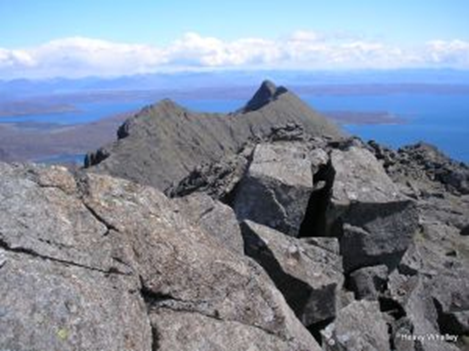
There was no stopping her-as soon as Sharon was down we were gone for Sgurr Na Bannadich and we were all enjoying the scrambling on to the top. A great day only spoiled by the descent down into the coire picked by me, which is not recommended. On returning to the bothy, I was impressed at the pre -dinner drinks rituals of the Strathspey club. Dinner is preceded by lots of whisky and brandy, what a system. After a good meal cooked by me, off we went to the pub, our man The Guide was now fairly relaxed and dare I say it enjoying the company. His client paying £150.00 daily was impressed especially as he was tired and Granny was like a young lamb “how did she do it?”, he kept asking! Another late night courtesy of our genial barman and we stumbled back in the wee small hours. Pete our rockstar had to leave due to work commitments and it was left to Douglas to look after us. The next day again the weather was magic, and the route planned was a fairly long one. Instead of the long walk in we went up the nose on Sgurr Nan Eag an excellent change with good route finding, the views of Loch Coruisk were magnificent. Douglas carried the rope (what a star) and did a great job of minding the Babes and Granny who was by now in her element As we left the summit who did we meet but The Guide and his man, we had left at the same time Granny was chuffed and I put my fees up to £5.00 a day! There was no stopping her now and we were soon off out to one of the best hills in Scotland, Sgurr Dubh Mhor. Its a fair hike out to the Munro, and I used the rope for a wee bit near the top much to Douglas’s amusement. It was easy going back along the ridge and we met a few Mountain Rescue heroes on the way .The descent down into Coire A’Grunda, was enjoyable and we were soon back at Glenbrittle after another great day. Douglas and Sharon headed back ,leaving Granny ,Issy and me to get in the last hill in Skye, Sgurr Allaister. Again we had a great night, after the ritual whisky and brandy, the whole bothy joined in and we all went off to the pub. What a night, and back to the bothy for a last night party, I think it ended at 03.00.

Have fun!
I really struggled up to Coire Lagan next day, goodness knows why I wanted to go this way up the Great Stone Shoot ! After a fairly long drag up the scree we reached the ridge and a good scramble saw us on Granny’s last Munro in Skye. Granny really enjoyed the descent (NOT) back into Laggan for a break, Granny was chuffed to bits and we motored down the path, a tidy up and then back to Aviemore to drop them off. What a great few days, magic hills, fantastic weather and a few hours sleep. How does she do it! She finished her last Munro a few weeks later at Blair Atholl with her friends.
Who says life begins at forty!
Lambing snow on the Cromdales and Cairngorms
Posted on May 2, 2014 by heavywhalley.MBE
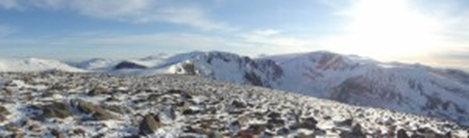
I had a Meeting in Aviemore about the project I am working on Avalanches and managed to tie it up with an early game of golf at Grantown On Spey. There was fresh snow on the Cromdales not good for the Lambs and the Cairngorms had a smattering as well. It was a bitter morning but great to be out with friends for a few hours. The Oyster catchers were busy and some nesting on the course and lots of wild life about. This is a busy time for nature with a brood of young ducks about 8 following Mum across the main road heading for water. After a fun game and some great soup at the Golf Course I headed for Aviemore the sun was out and the new snow on the plateau looking good and will give a few this holiday period that maybe winter is still about. The Scottish Mountain Rescue Stats are out for 2012 and it was a hard year and can be seen on their website and I will have a look at them at another date. I have been looking at Avalanches over the 30 year period from 1980 -2009 and looking into a paper I did in memory of a great friend Blyth Wright who was one of the founding fathers of the Scottish Avalanche Service. I have been getting some more information and looking into some of the incidents in more detail. More on the findings before next winter.


Thankfully, it looks like this year has been pretty good in relation to fatalities in Avalanches. With no fatalities reported for this winter. It was a wild winter on the hills with high winds and twice the normal amount of snow as usual and huge Cornices guarding routes and climbs. Maybe people are more aware after the tragedies of 2013 and are taking heed? I would always advise all back/wild country skiers and winter mountaineers to refresh their avalanche skills by taking a course and updating skills, it is well worth the time and money? The cold spell may have hardened any snow about and some of the great corries still have lots of snow and Cornices about so be aware. Also the rock routes in the big mountains will have a few remains of winter with loose rock about after a long winter be aware, always worth reminding folks.
Have a safe holiday on the hills and keep your eyes open there is so much wild life about!
Memories of the Island Of Rum – a special place.Posted on May 3, 2014 by heavywhalley.MBE
I have lots of friends taking advantage of the weather and they are of to the Islands for a few days. My club the Moray Mountaineering Club are over in Rum and I have a friends of to Skye, I am still feeling a bit under the weather so I am missing out but hopefully I will get out for a wee wander today. I went to a great lecture by Mick Tighe who has done a lot of new rock routes in Rum with his wife Cathy and friends and is was looking great and what a place to be, but not for me this month.
Anyway, if not out in the wild places enjoy the Blog and have fun.
1994 – Another Rum Callout .
The Mountain Rescue Weekend Training Exercise was planned for Skye, even though the weather was poor we had a good weekend on the wet rock in Corrie Lagan. Skye is hard work with sea level approaches making every summit or climb hard won. As we were leaving the bothy on Sunday night for the long 4 hour drive to RAF Kinloss a message came in to assist in a callout to the Island of Rum. This is a fairly remote area which was owned by the Nature Conservancy, access was by ferry and boat and in our case by Helicopter. The island has a population of less than one -hundred and a road which is one mile long! The hills are very rough with only a few paths and the terrain involves serious, remote, mountains although they are less than 3000 feet. It is a place to see nature in the wild and the annual nesting of the Manx Shearwaters is an incredible sight. It attracts lovers of the wild birdwatchers and the traverse of the Rum Ridge is a great day. Our primary goal is to traverse this ridge, which is one of Scotland’s finest rock-scrambling routes. Most walkers want to ascend the main peaks on this ridge, including the Norse named Corbetts of Askival and Ainshval, great hills and an incredible ridge walk as good as anything in the UK. The views of Skye and the Islands are incredible it is an unique place. The Mountain Rescue team had in the past had a few epic callouts in Rum, I had carried out a couple of these, involving long carry – offs in difficult terrain.. The team had only recently visited the Island to train with the local Coastguards and gain some area knowledge, hopefully this would help us! Bristows Helicopter arrived within 10 minutes and a party of nine were sent to assess the situation. High winds and severe turbulence would only allow the helicopter to drop our hill party at Kinloch near the Castle which was four miles away from the incident and unfortunately at sea – level.
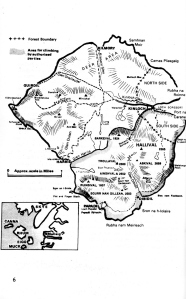

As the casualty had fallen at approximately midday and was just off the main ridge at two-thousand feet, we sent a few of the young stars off as the fast party, led by Kenny Kennworthy who had recently been involved in the team leaders course in North Wales and was needing a bit of real action.( Don’t ask Kenny about this Course as he had a bad time playing Callouts, after running real ones for many years.) This party carried all the First Aid Equipment, including Entonox, Oxygen and all the rest and there was little room for anything else. A few of the locals were about an hour ahead carrying a stretcher and rope , this group was made up of keepers, foresters, coastguards etc., who made great progress and were invaluable with their area knowledge the mountain, even leaving guides on the way into the casualty to assist the team. Fortunately the weather had improved by the time our first -aid party reached the casualty, who was suffering from shock, a deep head wound and a shoulder injury. His girlfriend had looked after him and administered basic First aid, kept him warm, whilst her father had gone for help and had come back up the hill to help the team! This is not bad for a gentleman of over Sixty. They had done everything correctly and hopefully the casualty would soon be recovering in Hospital.
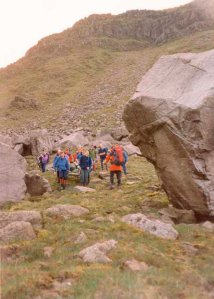
Due to the steepness of the ground it was decided to lower the casualty 500 feet, carrying him to an area where he could be evacuated by the helicopter. It takes a lot more than twelve people to carry a stretcher especially in such a remote area. The weather was changing and we requested the rest of the team to be flown in to assist in the carry-off. Another ten troops and the locals made all the difference and soon the casualty was at a suitable site for helicopter evacuation. The wild Atlantic Corrie is an incredible place and a place few visit, I went back a few times and it is so wild, pretty unique in Scotland. Bristows landed on, uplifted the casualty and was soon off to Fort William Hospital.

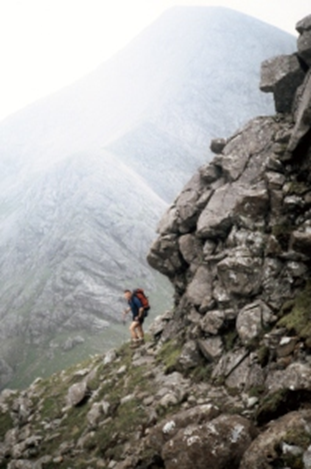
All that was left was a walk back to the Castle and hopefully a lift back to Skye with Bristows, otherwise it would be a long swim. Time was moving on and when we were back at the Castle it was nearly midnight. Bristows had managed to drop off some of the team and the rest were told to wait until the helicopter had refuelled. The midges were out in force and we had to find shelter as the helicopter would be away for over a couple of hours.
The locals were over the moon with our help and wanted to give us a small drink in appreciation. Mountain Rescue will never turn down an offer of a dram, and we had a wee drink with the locals before the helicopter came back for us at 02.00. The local Post Office was the bar, but that is another story. It was a quick trip back to Skye and a few hours sleep before returning to Kinloss in the morning.
This was a great call-out with an excellent result and good liaison between all concerned. It makes all the hassle of being in a team even after twenty-odd years, worthwhile. In the past call call-outs in these remote areas have, and still are fairly serious, but it was great to see the locals and the injured hill party trying to help themselves; this does not always happen. These call–outs are vital to give the team real training in remote areas to ensure we can react to any aircraft or mountaineering incident. An aircraft incident in this area would definitely make us think, and it will happen one day but at least the remoteness will keep the hassle factor down. Nowadays, things are very different but incidents in places like Rum can still prove difficult but Lochaber and Skye Mountain Rescue and the locals are well prepared. It is still worth remembering in these remoter areas to remember that you should always be as self-sufficient to cope with most situations when walking or climbing in these areas.
1957 Rum – Callout plans – Looking through my research of the RAF Kinloss Mountain Team I found some correspondence for assisting in a rescue if needed on the wonderful Island of Rum. The island was a Nature Reserve and climbers and walkers were starting to come to the Island. The warden was worried about an accident happening and had contacted the RAF Team at Kinloss to see if they could assist (remember this was 1957). It was around this time that Rum was purchased by the Nature Conservancy Council. It is nowadays a busy place especially when all the birdwatchers are about and there have been a few accidents in the past. The reply was that the RAF team could be used by the Police to assist in any rescues as long as the Team was not needed for RAF operations. The Police said they could commission a boat to take the team 15 troops from Mallaig and one ton of equipment. From here the island boat would transport the team to the Island harbour, The ferry in these days only operated on Wednesdays and Saturday. The plan was to have the boat stay off the Island until the Rescue was completed. The Team did go over and had a magic time what a place to climb and walk or even just enjoy the wildness. The early days of Rescue now a lot easier a phone call and a helicopter comes if the weather is okay failing that there will be support from the Skye/ Lochaber Team. The locals still help where they can I have done 3 great rescues in the past on this incredible Island my blog dated 4 th Aug 2013 for details. There is so much potential on the Island for walking and climbing and I love the place – must get back before I get to too old.
Rum is the largest of the Small Isles, and the fifteenth largest Scottish island, but is inhabited by only about thirty or so people, all of whom live in the village of Kinloch on the east coast. The island has been inhabited since the 8th millennium BC and provides some of the earliest known evidence of human occupation in Scotland. From the 12th to 13th centuries on, the island was held by various clans including the MacLeans of Coll. The population grew to over 400 by the late 18th century but was cleared of its indigenous population between 1826 and 1828. The island then became a sporting estate, the exotic Kinloch Castle being constructed by the Bulloughs in 1900.
Alongside the wonders of the natural environment, Rum’s community is undergoing a period of change. 2009 and 2010 saw the phased transfer of land and assets in and around Kinloch Village from Scottish Natural Heritage (SNH) to Isle of Rum Community Trust ownership. This is giving the community and individuals control over their own destinies and creating unique, exciting opportunities for locals and people who would like to come and live here.
So if you come to Rum for a day, a week or forever, there’s always great places to visit.
Have a look on the Rum website! It is well worth the visit!
How many Shearwaters – visit Rum? – Around a third of the entire world population of these splendid seabirds make their home on the Rum Cuillin every summer. There are so many birds (around 100,000 pairs) that their droppings have fertilised the hills and produced rich grasslands (‘shearwater greens’). Shearwaters are expertly kitted out for life at sea but they are wide open to attack on land. These specialized seabirds therefore only dare to be above ground at the colony on dark nights.
Visiting the colony – The noise, smell and activity as tens of thousands of Manx shearwaters make their night-time return to the high Cuillin is an amazing seabird experience. However, you should note that the colony is remote, high on the mountain, and will involve crossing difficult, wet and uneven ground in darkness. Please seek advice from a member of staff at the Reserve Office, or look on the notice boards to see when a staff-led trip is planned.
The Glacier of Coire an Lochan and a walk round the Northern Corries.
Posted on May 4, 2014 by heavywhalley.MBE
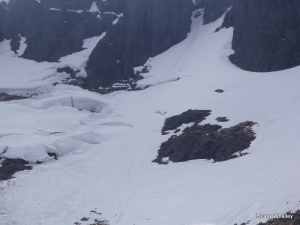
I was feeling a bit better and with everyone out I wanted to try a short walk and left early for the Cairngorms, it was a lovely day and the drive over was great. I always go through Grantown On Spey and then the back road to the Cairngorms, the views are far better and you miss Aviemore. The fresh snow was still on the tops just a little dusting but the views were stunning with the deep Corries of the Cairngorms still looking full of snow.

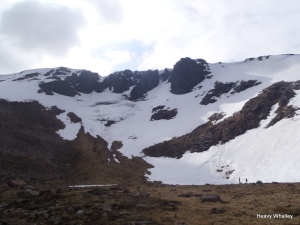
The car park was quiet and I wandered into Corrie and Lochan, there were a few people about heading out for Ben MacDui having an early start. The path is superb and even at my slow pace and coughing most of the way it was great to be out. The Ptarmigan were changing colours and the white feathers were everywhere as the molt is on. I wandered off the path as it goes up the ridge and into Lochan where there were a couple camping at the Lochan what a place to be. From here the views up to the hanging glacier on the Great Slab are incredible and the debris by the loch from the avalanches are a powerful reminder of nature. It is a place few visit most miss it but I enjoy a wander about and the great cliffs and the snow make this an impressive place to be. I could hear the odd rattle of stones and snow falling in the Corrie giving it a Alpine feel. I needed to stop regularly and enjoyed it, every view different and it is great to pick out the great climbing lines in this Corrie. Jeans Hut used to be here another Lost Bothy of the Cairngorms, that was taken down as it became a rubbish tip and the scene of many epics in the past.

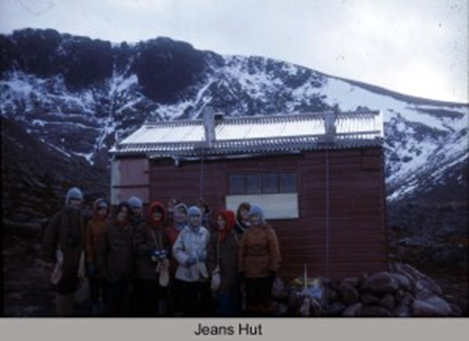
I knew Jean’s hut pretty well back in the 70s when I was a very young member of the RAF Mountain Rescue Team. I regularly used Jean’s hut as a break on Searches and for snow and ice climbing expeditions in the northern Cairngorms.
Jean’s hut was installed in Coire Cas, where the ski centre is now, in 1951, it was named after a lassie Jean, who was killed skiing in Core Cas (she tried to traverse a frozen ski slope, but her primitive post-war skis had no metal edges and she slipped to her death), it was moved to Coire an Lochan when the chairlift was built-in the early 60s.
Jean’s hut remained in Coire an Lochan until about 1984/85, when it was demolished by the ranger service, following a fatal accident when three university students lost their lives trying to find the hut in a blizzard. I was on that tragic event and have written about it in my Blog. I also used to clean out the rubbish that was left especially after the winter not a nice task at times. All that can be seen now are a few metal rings, used to tie the hut down. I cannot find any photos of Jean’s Hut and would appreciate a copy if anyone has one.
Thanks to the Guru of the Cairngorms Ray Sefton for his photo of Jean’s Hut
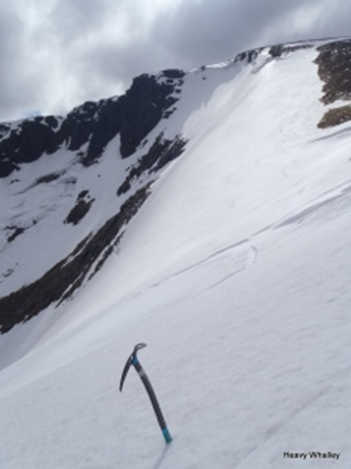
After enjoying the peace at the Lochan and another coughing bout I wonder what the campers thought? I wandered up the snow and was glad of my ice axe, the views of the Corrie opened up. There were even more heading over to Mac Dui but I followed the ridge looking into the Corrie and marveling at the depth of the snow and hanging cornices. I also met several ptarmigan and then a runner “Barry” from Aviemore bounding down the ridge. He was training for the Celtman in Torridon this July and going well. We had a chat and then I watched him bound down the hill effortlessly.
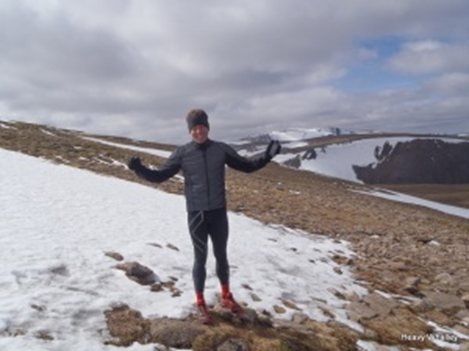
I was soon on the top of Corrie An Lochan and had lunch a spell in the sun and then a wander along the Northern Corries. This is always a great wander and lots to see especially today, this wild place was very friendly today with easy walking along the plateau in the sun.
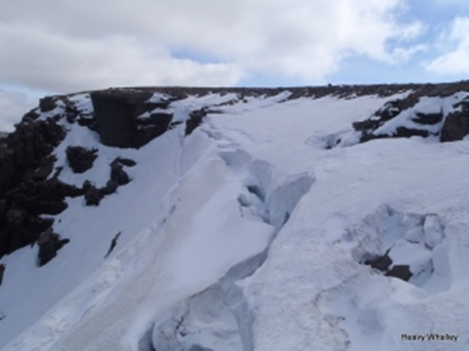
I enjoyed the walk and the Cairngorms was not too busy and the sun was enjoyable and the views as always top rated. I met a skier on the Goat Track who skied down effortlessly to the Corrie Floor in minutes and two climbers at the top of Pygmy Ridge in Corrie ant Sneachda – enjoying the final climb onto the plateau and saying there was a bit of loose rock on the route as it expected at this time of year. It was an easy walk down a bit of snow helping the knees and I was soon in the Ski area with a few brave souls out Skiing and the train running. The car park was busy and I felt pretty tired and enjoyed the slow drive back and then a shower some food and an early night. It was a great day and so good to be out, how I miss these hills I hope this is the start of feeling better. The hills are magic just now you have to get out. Be aware the sheep ticks are out and a few friends in the North West say keep your eyes open as they can cause serious problems!
Ticks – an annual hazard for those in the Outdoors
Posted on May 5, 2014 by heavywhalley.MBE
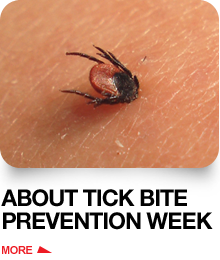

- As I was walking up to the crag yesterday it reminds me of the annual problem we have with ticks. They love the heather, long grass and ferns and at times during the height of summer I have found several ticks on me after a day out on the hills. I am glad they are now acknowledge as another problem for the hillwalker and mountaineers. It is worth reading the information below and doing a bit of research on these wee beasties that can cause you a lot of trouble.
- With the arrival of spring, now is a good time to brush up on your knowledge of ticks; what they are, where they live, the diseases they can carry, and how to minimise your risk of infection.
- With the arrival of spring, now is a good time to brush up on your knowledge of ticks; what they are, where they live, the diseases they can carry, and how to minimise your risk of infection.
- Being out in the countryside or even town parks and gardens where wildlife is present may put you and your pets at risk from tick bites?
- Around 3,000 people in the UK contract Lyme disease (Borreliosis) from a tick bite each year?Recent research suggests that the prevalence of Lyme disease bacteria in the UK tick population is considerably higher than previously thought?
The most important tick prevention behaviour is regular checking of your body, particularly the skin folds, and prompt removal of any ticks found. It is important to try and remove ticks within 24 hours of attaching.
The following measure can also help to prevent tick bites.
- Use of repellent on skin (DEET) and/or permethrin on clothing
- Avoiding contact with tall vegetation where ticks are likely to be questing
- Walk on the paths or centre of tracks where possible rather than in the long grass or verges
- Wearing light coloured clothing to easily see ticks and brush them off before they attach to skin
- Tuck trousers into socks or shoes to minimise ticks under clothing
- Regular checks for ticks on clothing
- Regular use of tick treatment on companion animals and regular checking and removal of ticks from pets. Different tick species are found in different habitats, but the ticks most commonly found on humans or their pets are found in woodland, heathland, upland or moorland pastures and grassland. Ticks are particularly abundant in ecotones, the transition zone between two vegetation communities, such as woodland and meadow or shrub communities, which permit a wider range of potential hosts.
Removing a tick safely
If you are bitten, follow these simple steps to safely remove ticks
- Removing a tick safely
If you are bitten, follow these simple steps to safely remove ticks
Remove the tick as soon as possible using fine-tipped tweezers or a tick-removal tool.
- Remove the tick as soon as possible using fine tipped tweezers or a tick-removal tool.
- Grasp the tick head parts as close to the skin as possible,
- Pull upwards firmly and steadily, without jerking or twisting (twisting is not recommended as this increases the chance of the mouthparts breaking off, thereby remaining in the skin and increasing the chance of a secondary localised infection).
- Don’t squeeze or crush the tick’s body as this could increase the risk of infection by prompting the tick to regurgitate saliva into the bite wound.
- After removal of the tick, apply an antiseptic to the bite site.
- Don’t use petroleum jelly, liquid solutions, freeze or burn the tick.
- After the tick has been removed, continue to check the bite site over the subsequent month, looking for signs of increased redness or rash.
- Consult your doctor if any symptoms develop.
Cairngorms Gemstones – wonderful things of beauty
Posted on May 6, 2014 by heavywhalley.MBE
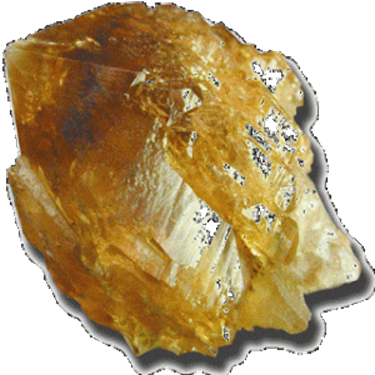
My wander across the Northern Corries in the Cairngorms got my mind wandering about a day in the early 70’s when I was taken looking for Gemstones on the Cairngorm Plateau. I was with the RAF Team Leader George Bruce and he had seen something whilst climbing in Coire An Sneachda. I was very young and given the 500 foot rope to carry and George and another abseiled down and tried to find the vein of rock. My memory is vague after many years and all I wanted was to go on the hill but was not really interested at the time. “Stupid boy” I wish I had listened as George had so many great tales about gem hunting and some of the characters. I was given a small rock crystal as my part but have no clue what happened to it over the years. Unfortunately George is no longer with us to get a reminder of these great tales. The Cairngorms have plenty of places where the gemstone hunter smashed up the rocks looking for these elusive crystals. The top of the Goat Track, Jacobs ladder, MacDui and Derry Cairngorm has places where the hunters were about. This was very popular in Victorian times and seemingly the Queen was a Crystal hunter and Breamar Castle has a great collection, that I would love to see one day.

From Cairngorm Blog “Early in the twentieth century the summits of both Ben Avon and Cairn Gorm were plundered for their gemstone crystals. Contraction fissures are usually found in a pegmatite vein, and good crystals are often associated with quantities of milky quartz. The milky quartz is highly visible as lines across the summit debris. Individual collectors and groups used these lines to locate veins of semi-precious stones below the surface.At one time collecting Cairngorms was a very popular past-time. Queen Victoria herself traveled to the summit of Ben a Bhuird in search of them.
It is incredible to note that that Glennmore Lodge used to run courses in gemstone hunting in the Cairngorm Mountains and there is a stretch of ground running to some twenty acres that has been excavated to a depth of over six feet by enthusiastic prospectors hoping to find the ultimate prize. Across some of the high tops are fields of broken white stones, smashed open by hammer wielding hunters seeking their fortunes. Nowdays I think the Cairngorms National Park Authority might not be the only agency to have a view on anyone trying to exploit the resources of the Park on such an industrial scale these days but some hill walker might just be lucky enough to find a reasonable stone washed out in a mountain stream or at the end of the winter avalanches by the recent spates we have seen. If you are looking for them please be careful as many of these areas are in special places.”
There are tales of climbers finding gem stones in these mountains and seemingly the Black Spout in Lochnagar was a popular place for those looking in the screes. Stag Rocks in the Loch Avon Basin has a grand wee climb aptly called ” Quartz Diggers Cave Route” a 80 meter Severe. I did this many years ago looking for the cave that was artificially carved out by gemstone hunters in the past! The gem stones were a prized find and a small industry was made out of it making rings, brooches and other ornate items. I saw a ring the other day with the Cairngorm Stone as its center point it was beautiful.
Loss of my mate Sammy the Alsation.
Posted on May 7, 2014 by heavywhalley.MBE
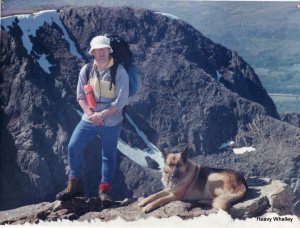
My wee house shares a back garden with my great neighbor Irving, he is a good mate in the true sense of the word and always helpful to me. When I moved into my wee house I became good friends with the family. They had a lovely dog Sammy his big Alasation and the double of my dog “Teallach” from many years ago we also became great pals. Every time I was in my kitchen or small yard Sammy would be there and every morning we would have a chat and Sammy would get a few dog biscuits. He would be there most days as I washed my dishes at night and we had some good fun. His barking at the sea gulls was funny at times but he was a big softie and always gave me a great welcome. At times he would wander in my house if the back door was open and be ensconced on my Sofa enjoying life. His tail knocking everything over in my wee house. Poor Sammy has not been looking well for a while, and was not looking well and unfortunately died at the weekend. The loss of a pet is a sad occasion and at least unlike humans we do not let them suffer when seriously ill as we can do with humans.

I will miss my mate and our daily chat’s. Unfortunately I do not have a photo of Sammy but I am working on it.
Observation Cars on the Railways – Making the best of this great place – Using the railways to travel?
Posted on May 8, 2014 by heavywhalley.MBE
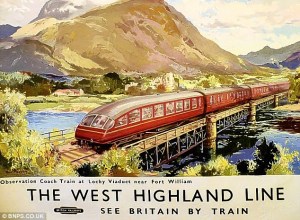

I was listening to the radio and a conversation came up about putting Observation cars on the trains that travel through some of the most wonderful scenery in Scotland. What a great idea, imagine travelling up through the mountains Crainlarich, Rannoch Moor, Ossian Aviemore and the great West Coast to Kyle and Mallaig in a train that you can enjoy the view better. As usual a few downbeats said all you will see is rain and cloud but what a simple idea. I traveled from Yosemite in the USA to Canada by train and they had these great Observation Cars and if you wanted a guide spoke about the area you were passing through. It was a magic journey, you saw so much and everyone enjoyed it.
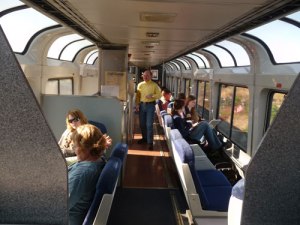
I see the A9 road so busy and deadly at times yet the railway that follows it is very quiet, we do not make the best of this great facility. Maybe this is due to the cost of travel by train is certainly not cheap. Just think of the environmental benefits and tourism it would bring in? I wonder how a budget Inverness – Glasgow/ Edinburgh service would run like Ryan Air I am sure it would be full. Is there no one out there with some vision? Yes I know I can get an over 55 ticket for a few weeks but it is sad to see the trains running half empty.

Food for thought – your comments are as always appreciated.
Simon Says “My knowledge here is sketchy, but I believe the safety standards demanded on our railways would make this difficult to achieve. The UK rolling stock like the BR Mk3 and Mk4 carriages are very strong and crash worthy – trying to make a carriage as strong while incorporating so much open space would not be easy.”
Ramsay’s Round
Posted on May 9, 2014 by heavywhalley.MBE
From: Hartree, Mark
Sent: 06 May 2014 12:40

Hi, it’s been a while, but I thought you could maybe help either with sponsorship or using your network of contacts for the RAF MRT Members and X members.
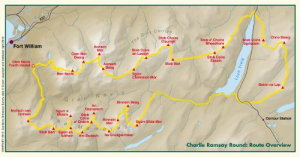
Molly, named in the poster, is the daughter of one of the X Leuchars MRT troops and a great friend of mine, whose situation has finally motivated me to do Ramsay’s Round. There are details in short form and longer form with info on the schedule etc for friends and supporters. If you could circulate, promote, put on websites, or help in any other way this would be great for this cause which is of course just one of many.
Other info on: http://www.justgiving.com/mark-hartree
Best regards,
Mark / 2ba
X Leuchars MRT and Valley MRT, small but perfectly formed!
Mark Hartree
| 24 Munro summits in 24 hours | |||
| Spinal Muscular Atrophy Support UK (formerly The Jennifer Trust) provides: Outreach home visits When families are newly diagnosed, one of our Outreach workers can visit the family at home to provide personalised information and support. Emotional Support To all those in the wider family who have been affected by SMA. This includes support for families who are bereaved by SMA. Multisensory Toypacks For babies newly diagnosed with SMA Type 1. Peer Support Volunteers, who all have personal experience and understanding of SMA, provide peer support to bereaved families. Social Activities For families affected by all types of SMA and their siblings, and for parents to meet, chat and make new friendships. Information and Research We fund the Patient Registry, provide information leaflets and web based advice. We are joint funding research for Professor Tom Gillingwater’s project into glial cells. | Molly was 18 months old when diagnosed with SMA in April 2014 changing her life and those around her. To raise funds for SMA, I will run a route known as ‘Ramsay’s Round’ in June or July 2014 (weather dependent). This equates to ~56 miles running and 28,000ft of climbing (not quite Everest from sea level) in less than a day. This is not a trivial undertaking with 74 completions since first done in 1978. My run will be supported by the Carnethy Hill Running Club and mountaineering friends. Any support is welcomed before or on the day. Hopefully, you’ll be able to track me real time by GPS tracker via the web. Detailed route information is at the link below and proposed route schedule is attached. Please donate. | ||
| For more information: www.smasupportuk.org.uk http://www.ramsaysround.com/ | Mark, training on the Grey Corries | To donate or support: www.justgiving.com/mark-hartree Mark Hartree 0780 171 4032 Mark.hartree@selex-es.com | |
Ramsay Round Schedule
Mark Hartree
14 – 15th or 21 – 22nd June 2014(subject to weather etc)
| Glen Nevis YH | 00:00 | 08:00 | 0 | Supporters | ||
| 1 | Ben Nevis | 01:25 | 09:25 | 01:25 | ||
| 2 | Carn Mor Dearg | 00:36 | 10:01 | 02:01 | ||
| 3 | Aonach Mor | 00:45 | 10:46 | 02:46 | ||
| 4 | Aonach Beag | 00:18 | 11:04 | Fast | 03:04 | |
| 5 | Sgurr Choinnich Mor | 00:55 | 11:59 | 1 | support runner(s) | 03:59 |
| 6 | Stob Coire an Laoigh | 00:30 | 12:29 | or | 04:29 | |
| 7 | Stob Choire Claurigh | 00:33 | 13:02 | hill top meeters | 05:02 | |
| 8 | Stob Ban | 00:30 | 13:32 | 05:32 | ||
| 9 | Stob Coire Easain | 01:20 | 14:52 | 06:52 | ||
| 10 | Stob a’Choire Mheadhoin | 00:18 | 15:10 | 07:10 | ||
| Loch Treig Dam | 00:50 | 16:00 | 2 | Static support | 08:00 | |
| Leave Loch Treig Dam | 00:10 | 16:10 | food/clothes | 08:10 | ||
| 11 | Stob Coire Sgriodain | 01:05 | 17:15 | Support runners | 09:15 | |
| 12 | Chno Dearg | 00:35 | 17:50 | 3 | or | 09:50 |
| 13 | Beinn na Lap | 01:10 | 19:00 | hill top meeters | 11:00 | |
| Loch Eilde Mor | 02:45 | 21:45 | 4 | Static support | 13:45 | |
| Leave Loch Eilde Mor | 00:10 | 21:55 | food/clothes | 13:55 | ||
| 14 | Sgurr Eilde Mor | 01:00 | 22:55 | 14:55 | ||
| 15 | Binnein Beag | 01:00 | 23:55 | 15:55 | ||
| 16 | Binnein Mor | 00:50 | 00:45 | 16:45 | ||
| 17 | Na Gruagaichean | 00:28 | 01:13 | 5 | Support runners | 17:13 |
| 18 | An Gearanach | 01:00 | 02:13 | Overnight | 18:13 | |
| 19 | Stob Coire a’Chairn | 00:30 | 02:43 | or | 18:43 | |
| 20 | Am Bodach | 00:35 | 03:18 | hill top meeters | 19:18 | |
| 21 | Sgorr an lubhair | 00:25 | 03:43 | 19:43 | ||
| 22 | Sgurr a’ Mhaim | 00:30 | 04:13 | 20:13 | ||
| 23 | Stob Ban | 01:00 | 05:13 | 21:13 | ||
| 24 | Mullach nan Coirean | 00:40 | 05:53 | 21:53 | ||
| Glen Nevis YH | 01:17 | 07:10 | 6 | Supporters | 23:10 |
Acknowledgements:
Route overview map courtesy of Harvey Maps
Schedule: based on Graham Nash
Route idea: Charlie Ramsay and http://carnethy.com/

Spring Flowers
Posted on May 10, 2014 by heavywhalley.MBE
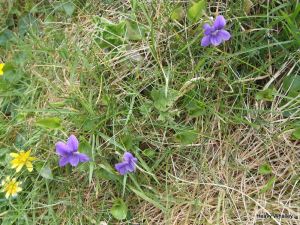
I am not getting out on the hills due much but feeling a lot better, “health is wealth” My latest snag a hernia but it still allows me to wander about and see the amazing flowers that are all over locally at this special time of year. The Moray Way is right in my village and the walkers have been so lucky the dolphins have been out most days , and the Gannets diving and fishing. This walk seems to be getting more popular with so many enjoying this fun walk.

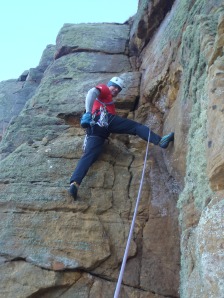
The local Cummingston sea cliffs twenty minutes from my house have been very busy with over 40 there yesterday. All seem to be enjoying this fun place and the caves and small sea – stacks make it a place of adventure. Most were top – roping but a few were leading care has to be taken as the sandstone can be pretty soft and at times protection that safeguards the leader can pull through after a fall, you need as always to climb with care. I cannot wait to take my grand-daughter on an wander at Cummingston to see the rock pools and scramble about.

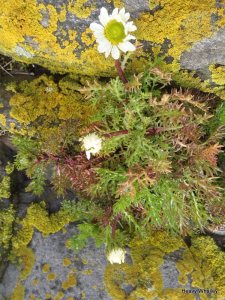
This was on the nearby sea cliffs when we tried to climb in the rain last Sunday, the lovely orange lichen was lethal in the wet. We tried to climb but it was too slippy so we had a great walk after I floundered to try a route. This area is wonderful for wild life seals, dolphins and sea birds so it was as ever not a wasted day. I am missing the hills but playing a bit of golf, I was at Newtonmore yesterday and enjoyed a bacon roll accompanied music by a wonderful harpist at Laurry’s house, what an incredible start to a day. The golf courses are looking great and nature abounds lots of Oyster Catchers about and the river by the course made my trip to Newtonmore a fun day. We had all types of weather but it was great to be out again even if I took a golf buggy.

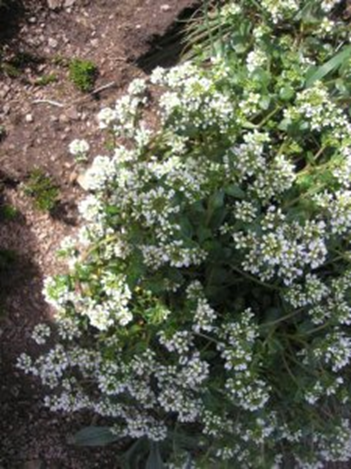
Be aware that the river crossings are tricky just now. Training for Ramsay’s Round.
Posted on May 11, 2014 by heavywhalley.MBE
I was supposed to go over to Ballater yesterday and go to Ben A’ Bhuird but the forecast and my fitness put me off. My friend is over for a week and had an early start from his holiday cottage. He called me after a hard day off wild rivers, heavy showers, sleet. strong winds and no views. He said he had to take care with the rivers as they were in spate and pretty tricky. Please be aware that river crossing is serious and most years there are a few accidents in rivers. I have been lucky on a few occasions and I know of a few where the rivers were so high that hill parties have spent the night on the hill and to let the river calm down! The big mountains are still shedding lots of snow as melt water add to that heavy rain and you can have a problem, so please be aware of the power of nature and the effect on a mere human.
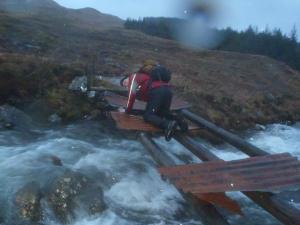
On our winter walk West – East in 1978 in November/ December near the end of a huge 4 days where the A9 was closed we were trying to make Braemar after a huge 13 hour day , it was full on winter. The last problem was the river Dee after a crazy day on these remote Munros Carn an Fhidhleir and An Sgarsoch. it had been a terrible trip and we were completely exhausted. The navigation was very hard and the snow deep, ploughing through deep snow all day . At the end of the day we had to cross the river Dee near the Chest of Dee when Jim fell in the frozen river. He was very lucky to get out and was incredibly cold, there was no way he could change and just wrung out his gear and headed out. We had a bit of an epic getting to Linn Of Dee. I was sent to the Keepers house where the kindly keeper took us in for the night. We could not make the road walk to Braemar so knackered we were.

The BMC have some good info on the net worth a look .
Avoidance is the key – careful planning of a trip and good observation should almost eliminate the chances of a difficult crossing. However, local flooding is not always predictable and occasionally a wet crossing is necessary, particularly in remote parts of Scotland. Fast moving water can be powerful and difficult to exit from. The water will be cold and the river bed slippery and awkward. Downstream obstacles such as trees, waterfalls and boulder chokes may prove killers if anybody is swept away. Mountaineering equipment is not designed with swift water in mind and will generally hinder rather than help. And if things go wrong during a stream or river crossing there can be many potentially serious problems to deal with, such as a split party, communication difficulties, immersion hypothermia, loss of equipment, injury etc. Ski poles are very hand as well and have helped me and others on many occasions.
My friend Mark Hartree was out training on Friday night for his attempt at the Ramsay Round this is from his Facebook Page.
“So, just caught up on a bit of sleep from last night. Did the south side hills of Ramsay’s Round overnight from Corrour, over the Mamores to Glen Nevis. Out for 13.5 hrs covering 29 miles and over 2800m climbing. Not quite to the pace needed at the end but had rain with mist, fog, clag above 750m so had to take care with route finding and foot placement. Good to have done this bit in the bad. It confirms the need for a clear night to speed things up.” Well done wee man if you had done more walking in the RAF Rescue you would know the way! I got lost on my first attempt at “Tranters” on this part of the run with the late Keith Powell. Oh to be young again. Mark is looking for sponsorship so have a look at yesterday’s blog for more information.
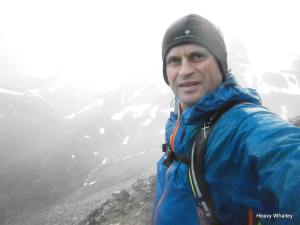

Mark working hard this weekend – the weather shows in the pain in his face – well done wee man. Photo Mark Hatree.
The Wellington Crash on Ben Rinnes a fine Corbett in any weather
Posted on May 12, 2014 by heavywhalley.MBE
I had Cabin fever this weekend and did not fancy another day in the house, the weather was still poor with heavy rain and cloud forecast again. I still needed to get out and my local Corbett Ben Rinnes is always a nice short wander for a old guy like me. My friend John who is over in Ballater for a week had a hard day yesterday on Beinn A’ Bhuird in the Cairngorms it was a wild day. He did not want anymore river crossings and an easy day. I suggested Ben Rinnes so he drove over and we met in the Cafe the “Coffee Pot” at Dufftown with brew and a lovely bacon roll. John was enthusiastic about the drive over the Lecht road it was full of black grouse and hares. He had never been on this road before and was impressed with the road and its incredible bridges. After a brew in Dufftown we were off to Ben Rinnes . This hill is a favourite off mine and I have often introduced lots of friends and work mates to hill – walking on this mountain. The guide book tells you that if you climb it from outside Dufftown by its shortest route it takes you one hour and forty minutes to the summit. If you want a longer day if you continue along the ridge to the Bridge of Avon and have transport there. It is a grand looking hill with great views over the Moray Firth to Ross and Cromarty and of course the Cairngorms. The easiest way is to follow the B9009 about 5 k from Dufftown and take the minor road to Edinville. Parking can be tight with room for only about 8 cars and it can be a busy hill. Even though the weather was poor today we met several runners and a few walkers all out on the hill. The path is good and maintained by The Friends Of Ben Rinnes a great bunch of people who look after this wee hill. We saw a few young deer and hares and then the weather came in and we were in the mist all day. The wind was pretty cold and I was glad to be wearing most of my winter kit again from the start of the walk. Normally the views are great but not today and we were soon at the summit of Ben Rinnes (The Headland Hill) at 840 metres where we got some shelter. It was an enjoyable break amongst the granite Tors that make up the summit with its trig point and viewpoint. It is such a lovely summit with such a panorama normally.
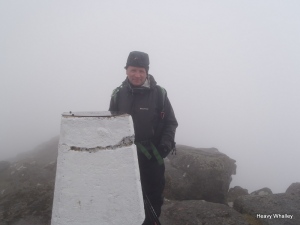
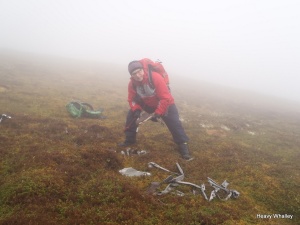
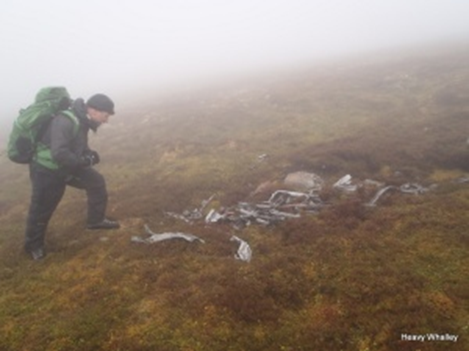
John works with Aircraft and was part of the RAF Mountain Rescue is very interested like me in aircraft crash sites in the mountains and had never visited Ben Rinnes before. He was amazed when I told him that there was the remains of a Wellington Bomber on the hill near the summit. There is little left of the aircraft but I had a rough grid reference and had visited it many years ago with a group from work. We had plenty of time so off we went into the mist on a compass bearing and after about 250 metres we found some wreckage at 783 metres and spent some time looking about. It was amazing how much we found. Part of John’s job is involved with aircraft crash investigation and archaeology and was a mine of information.

This is from the Friends of Ben Rinnes Website Ben Rinnes was the scene of a terrible plane crash on 14th November 1943.
A Wellington Bomber HF746 of No20 Operational Training Unit, based at Lossiemouth, crashed into Ben Rinnes whilst on a navigational exercise. Both the crew were killed.
A former member of the ground crew who went to the site on the hill shortly after the crash described it as “the most complete burn-out he had ever seen”.
The outline of this crash site is still clearly visible from the north side of the Ben where the ground was scarred so badly that nothing will grow there even today
“A Wellington Bomber crash in 1943 John has dropped us an email giving his recollections of that event. John and his family lived in Edinvillie at the time of the crash, he still has relatives living in Edinvillie today.
John writes:-
It was on a Saturday night after 10 o’clock.It was snowing very heavily and myself, my brother & a friend, Geordie Davidson, were outside with our father and a neighbour when we heard the plane go over.We could tell it was in trouble by the sound of the engines. We then heard a thump so we knew it had crashed. There was not any fire, just the wreckage covered a large area. It was about 200 yards .straight down from the top of the Ben, My brother Peter told me nothing is growing on the crash site still. ( it has plenty of wreckage now much covered in vegetation) May 2014.
Both the crew sadly were killed in the crash and their remains were amongst the wreckage.”

Of the two crew a Sgt Grove who is buried in Evesham cemetery. The other crew member Sgt Rennie was taken to Glasgow. The aircraft got caught in a violent snowstorm and crashed whilst on a night Exercise from RAF Lossiemouth.
Lest We Forget.
We soon wandered back down cutting back onto the ridge the ground was steep but lovely lush walking and were soon back on the normal path. As we descended the weather cleared and we enjoyed a view. The hares were running about again and we were soon back at the car, meeting a few others going out on this very popular hill. It was back to Dufftown to the cafe again for a cup of tea and cake and then home.
It was a short day but well worth the trip maybe Lexi’s first hill?
Aircraft Wrecks – The Walkers Guide. For those wanting more information on Aircraft Crashes in the mountain this book is worth a look. Unfortunately the details of the Ben Rinnes Crash is not in this book though. If you want information on the Wellington on Rinnes contact me. They make an interesting navigational exercise but please treat these sites with respect as young men died in these places.
This book aims to give readers access to the tangible remains of hundreds of historic aircraft that still lie at crash sites on the moors and mountains of the British Isles, all of which can be visited. It covers almost 500 selected sites, with emphasis given to those on open access land and including; accurate verified grid references, up-to-date site descriptions and recent photographs. Arranged geographically, the areas covered include: board and the circumstances of the loss.
South-west Moors – 15 entries. ~ Wales – 93 entries. ~ Peak District – 82 entries.
Pennines – 76 Entries. ~ Lake District – 32 entries. ~ North Yorkshire Moors – 23 entries.
Isle of Man – 18 entries. ~ Scotland: Lowlands – 47 entries. ~ Highlands and Islands – 85 entries. ~ Ireland – 19 entries.
Representing the main upland areas of the British Isles, each of these sections is introduced with a brief narrative describing its geographical characteristics and aviation background, discussing the factors and trends lying behind the concentration of losses within each area and noting any especially significant incidents. Individual site entries include precise location details including, where required, additional references for scattered major items of wreckage and any relevant notes to aid finding or interpreting the crash site, together with details of the aircraft, names and fates of those on board and the circumstances of the loss.
Remote places – Soay – St Kilda – Aircraft Crash – Possible Wellington aircraft.
Posted on May 13, 2014 by heavywhalley.MBE
I am hoping to try to visit St Kilda again this year, I am lucky and have been before but last year we tried for 3 days to sail to the Island. The weather made it impossible and if nature says no then that is it in this wild place. Nearby is Soay is a 0.97 km ² large, uninhabited island in the Scottish St Kilda archipelago, the most isolated group of islands in the UK. This archipelago is located in the Atlantic Ocean and the Outer Hebrides are adjacent. This was the scene of an attempt by RAF Kinloss Mountain Rescue Team in 1978 to try to locate a crash site that was reputed to be on the small inaccessible Island. The team had a few epics including and overnight stay in wild weather, where tents were smashed by the winds in the exposed cliffs. This was all done by Sea Kings helicopters and there are a few tales of these trips. You can never take the weather for granted in this area and I pray for good weather this year for me. The islands hill on Soay is a prize Marliyn for you secret hill bashers! You may have to climb to get on the Island.
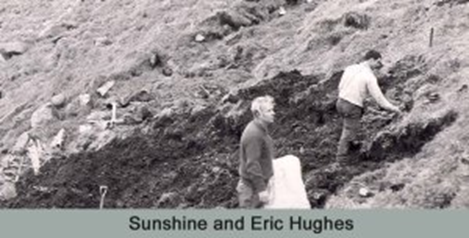
Ray Sefton and the late Eric Hughes were heavily involved in the investigation as were the team. It was steep ground and hard work and some is still a mystery, various items were located and I wonder nowadays with modern DNA and aircraft archaeology if maybe we may find out exactly what aircraft it was and who was the crew that perished in this lonely place.
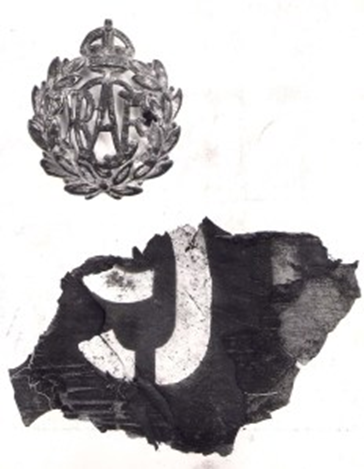
St Kilda and Rockall were all part of navigational training sorties in these days of very primitive navigational aids and many aircraft were lost in this area. St Kilda has a few aircraft wrecks on the Island and I hope to visit them if we manage to land this year. Unfortunately Soay will not be on possible, I wonder if anyone has visited this place recently?
Soay is located approximately two kilometers north-west of the main island of Hirtaa and is considered the most westerly point Of Scotland . Here, the significantly further west is Rockall Between Hirta and Soay are the Stacs Soay Stac (61 meters high) and the 73 meter high Stac Biorach .
The name Soay is Norse origin and means “Sheep Island”. In fact, Soay houses the original population of bears her Soay Sheep.

The island is of volcanic origin and not very accessible. In earlier times it was occasionally visited by residents of the main island of Hirta, to hunt on Soay sheep


Thanks to Ray Sefton for the information and photos, This has arrived by email from Keith Bryers.
Hi Heavy –” the aircraft was almost certainly Wellington Mk.VIII LA995 from 303 Ferry Training Unit, Stornoway, which was lost on 23 February 1943 with a crew of 6 whilst on a navex/fuel consumption test. The rear gunner was washed up at Europie on 2 March 1943 and is buried in Essex, the others (I have all the names) lie on the site in an unmarked grave. The wreck was known about in 1944 but wartime priorities seem to have prevented a visit to search for remains until the RAF’s visit in 1980; certainly, the wreck was reported by Morton Boyd of the Nature Conservancy Council as long ago as 1952. I visited the site in 1979. A rather foreboding location, truly ‘on the edge of the world’.”
Keith Bryers
More info from the blog
The aircraft could also be Wellington HX448, Lost Sep 28 1942, which also had Canadians onboard and was also in the area. The magazine After The Battle No30 has the story of the investigation conducted to find out the identity of the crashed plane on Soay, However no definitive proof (i.e id tags engine numbers etc) was found either way hence most websites giving both aircraft numbers.It would seem unlikely that further searches would be possible due to the remoteness and difficulty of access, changeable weather etc, Also as the wreckage or what is left is most likely to have been covered by scree falls and or rolling or being blown down the cliff
The book, Aircraft Wrecks, the walkers guide is a good source of info regarding the two planes on the main island of Hirta.
I have just been to the island again and hoped to have a look at the crash site on Connachair (Beaufighter) but low cloud stymied this.
The Church building on Hirta(St Kilda) has a small plaque commemorating the losses and carries the names of the casualties for the two planes on the main island, but for the Soay crash this section has been left blank of names. (until the mystery is solved???)
Aircraft Crashes on the Cairngorms – Part 1- Ben a’ Bhuird – The Oxford
Posted on May 14, 2014 by heavywhalley.MBE
This weekend I was planning to go and visit a couple of plane crashes in the Cairngorms, these are fairly remote on the massive mountain that is Ben a’ Bhuird. On this great hill are two aircraft crashes from the Second World War. As many have read I was heavily involved in aircraft crashes during my long service with the RAF Mountain Rescue, which was formed to recover aircrew from mountains and remote sites during World War Two. I had visited both sites on past travels in the mountains and using these remote crash sites for training in navigation and area knowledge in the past for newer team members. These were a big hill day for most people and I know will have to take it easy as the body slows down. The weather was not up to it so I will put it on hold till later in the summer. How many visit these great mountains and do not know these aircraft are there? They are well worth a visit and one must remember these were the scenes of tragedy at times and the stories are worth remembering for the future generations. They are also War Graves and should be treated with respect that these young men died for us and we must never forget.
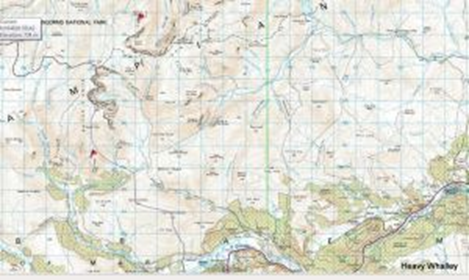
It is a long walk in to the mountain and a mountain bike would be a great advantage, I think I would like to get the weather right and stay a night on the tops. My pal John visited the crash site yesterday and got great weather it was along walk in and out over 30 kilometers and I will update the photos on the blog soon. Done 22/5/2014

My first visit was in 1972 on a huge winter walk over Ben Avon and Beinn a’ Bhuird in February with Tuech Brewer. I remember being dragged out at the end of a long day to the site which was completely covered in snow, we found the engines. Then it was a huge walk to the Hutchison Memorial Hut hut for the night

The first crash site is to an Airspeed Oxford Mk! PH4o 04: No 311 Sqn RAF – The aircraft had taken of from RAF Tain in the Highlands and had failed to arrive at RAF Hornchurch near London on the 10 Jan 1945. It was located by two walkers at NJ111026 AT 3500 feet on 19 th August 1945.

The men who unwittingly found the aircraft were Dr James Bain, a teacher in Elgin, and Flight Lieutenant Archie Pennie who was in the RAF but who was at the time taking a few days leave at his mothers in Elgin. Long time friends and both keen hill walkers, they had decided to spend their Sunday climbing two mountains in the Cairngorms, namely Beinn a Bhuird (3924 ft / 1196 m) and neighboring Ben Avon (3843 ft / 1171 m).
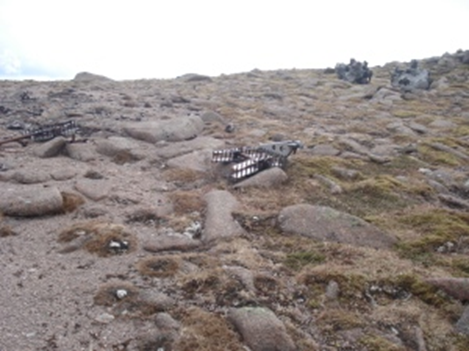
They set out at mid morning from Inchrory, and on approaching the summit of Beinn a Bhuird they found some aircraft debris and soon afterwards part of a wing. Finally, they discovered the remains of the wreck of the Oxford PH404, and alarmingly the bodies of five airmen. That must have been an awful event for both men, but we were at war and it was a time of great tragedy.


The cockpit and tail section were reasonably intact. The engines were relatively undamaged, perhaps because the aircraft had fallen on snow. The yellow paint work on the aircraft suggested that it had been a training aircraft. The bodies of two airmen were located in the cockpit, and two others lay outside amongst the debris. The saddest discovery of all was that of the body of the fifth airman. It was found inside the remains of the fuselage, and it was clear that he had initially survived the crash. He was wearing several layers of clothing that he must have removed from his dead crew – mates in an effort to combat the cold. He appeared to have suffered a serious head injury and had made himself a make-shift bandage for his head wound using a towel.

It was clear to Dr Bain and Flt Lt Pennie that the crash had occurred some months previously owing to the condition of the bodies. They made a note of the aircraft’s number and location and after descending the mountain went to Tomintoul and reported their discovery to the local police. They also reported the details to the local police in Elgin when they returned home.
The following day, Monday 20th August, a recovery team including Police Officers and members of the RAF Mountain Rescue Team from RAF Dyce made their way from Tomintoul towards Beinn a Bhuird to attempt a recovery of the airmen. Local assistance in locating the crash site was provided by Captain D McNiven, proprietor of the Richmond Arms in Tomintoul, and Mr William Stewart, a farmer from Clashnoir, Glenlivet.
A base for the recovery operation was set up near Inchrory. The Ambulance and transport wagons also waited at Inchrory as they were unable to travel any nearer the mountain due to the rough terrain. It was a long effort bringing the casualties off the hill and it was hoped that the crew could be buried on site. This did not happen and the RAF refused this request and eventually the bodies were brought down after several days of hard work.
To assist in bringing the bodies down mules from an Indian regiment based at Braemar were transported by road to Inchrory. It took ten days to complete the recovery operation with the recovery team working in a very remote location on steep, uneven and boulder strewn ground.
The Mountain Rescue Team burnt the remains of the wreckage at the crash site to avoid it being mistaken for any other lost aircraft in the future. Only the engines and a few other small parts of the aircraft were not burnt. It was a grueling operation for all the men involved.

The bodies of the five airmen recovered from Oxford PH404 were taken by road to an Aberdeen mortuary and placed in coffins. From here they were taken by train to Brookwood Military Cemetery near Woking in Surrey.

They were buried there on September 3rd 1945 in the Czechoslovak section of the cemetery. The memorial was places on the site in 200
http://www.archieraf.co.uk/scs/oxfordph404.html
Cairngorm Memorial Project
Memorial plaque placed at PH404 crashsite
On Sunday 18th September 2005, a granite memorial plaque was unveiled, and a service of dedication was held, at the location on Beinn a’ Bhuird where Oxford PH404 crashed in January 1945 killing all onboard.
The instigator behind this memorial was Squadron Leader Sandy Reid, RAFVR Rtd, who is Chairman of Aberdeen and North East Scotland Wing of the Air Training Corps.
His attention had been drawn to the remains of the Oxford aircraft on Beinn a’ Bhuird by a friend and, having flown Oxfords during his own RAF training at Dalcross it struck a chord with him.
S/Ldr Reid decided that finding out more about the crashed Oxford and the story behind it would be a worthwhile project for some of the Air Cadets in the area, and passed what information he had on to the Cadets of 1298 Huntly Squadron.
The Cadets contacted me via this website for more details about the loss as I had already carried out some research into the circumstances and the crew onboard with the cooperation of a Czech Aviation Historian, Pavel Vancata. They also made valuable contact with the Free Czechoslovakian Air Force Association in London, and in particular with Lt Col Arnost Polak who is Secretary of the Association. Lt Col Polak had himself served with 311 Squadron and had known personally the members of the crew who perished in the Oxford on Beinn a’ Bhuird.
The idea to place a commemorative plaque at the crash site of Oxford PH404 to commemorate the loss of the many airmen killed in the Cairngorms during the war and subsequent years was agreed on. All relevant agencies, landowners etc were approached and a weekend expedition planned in order to carry out the necessary ground work and ultimate placing, unveiling and dedicating of the plaque.
Funding for the project was greatly assisted by contributions from The Lottery, Veterans Reunited, The Royal British Legion and The McRoberts Trust.
Cadets from several Squadrons in the Wing volunteered to take part in the weekend expedition which was planned by F/Lt Bruce Lumsden, F/O Donna Greig, P/O Leanne Campbell, civilian instructors Alisdair Brooks, David Birch and John Strange.
The expedition took place over the weekend of Friday 16th September with the ceremony on the mountain being carried out on Sunday 18th once all preparations were completed.
A helicopter from 202 Air Sea Rescue Squadron was able to assist with transporting the plaque and equipment required to the top of the mountain during a training exercise.
After a busy weekend of logistics, planning and organising in the field, the Cadets had everything in place for the services and ceremonies to take place. Some camped overnight at the foot of the mountain ready for an early morning start to be on location for the unveiling.
On Sunday 18th September 2005, a ‘Base Camp’ was set up on the Invercauld Estate. A civilian helicopter on hire from HJS Helicopters arrived and transported the Rev James Wood – Wing Chaplain, F/Lt Philip Dawson RAF Rtd – a former RAF Bomber Pilot and flying Instructor, F/O Donna Greig and Cadet W/O David Leslie of 1990 (Ellon) Squadron, to the crash site.
Well done all great work.
A new Corbett at Linn Of Quoich – Carn na Drochaide – Deeside
Posted on May 15, 2014 by heavywhalley.MBE
The day started with an appointment to the Spynie Dental Clinic near Elgin as I had broke my temporary filling in my tooth. I was dreading it as I thought that the tooth had gone and all that work for the root canal was wasted but the wonderful dentist manged to save it. I was soon away back home and packing by half past nine, it was a bonny day in Burghead. The poor dentist and dental nurse had asked me what I had on and I said I was off to Ballater in the Eastern Cairngorms for a few days hill – walking, they both were very envious as the sun streamed in the surgery window! Many thanks to you both for looking after me.
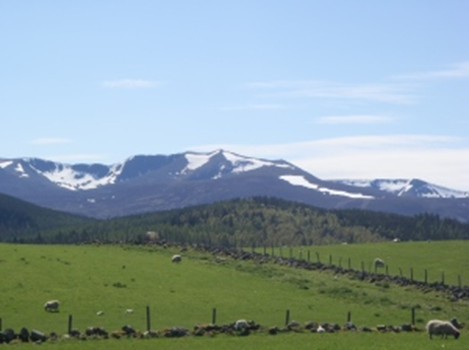
The drive over from the coast was incredible the views of the Cairngorms from my local Dava Moor just before Grantown On Spey were marvelous. The sun and the blue sky and the patches of snow were so clear and it got better and better. The road to Braemar e from here takes you to Tomintoul and the Lecht the patchwork moors and in the back drop the Cairngorms,and Strathnethy. The road goes over some famous bridges that keep you awake and on your toes. Further on Royal Lochnagar with the big Corries still holding a lot of snow, you could still see some of the huge Conices. I thought for a second of all those at work ( not really) and stopped to take some photos. I had a easy day planned for tomorrow but the weather enticed me and I was soon at Braemar buying an ice cream and then off past Linn Of Dee and on to the Linn Of Quoich past Mar Lodge. I remember when Marr Lodge was the focal point of the area with a pub? It is some place a huge estate with so much history. The small car park was nearly full at the end of the road but I managed to get my car in . The time was by now it 1300, the sun was out and off I went on my planned walk on Carn na Drochaide ( hill of the bridge). The track is easy to follow for about 3 ks then breaks up onto the North East to Carn na Criche. I met a couple from Edinburgh who had a grand day out and were on their way off. The hill was very dry and a bit of a wind got up, the path was good and then I saw over 50 hinds on the ridge. They were all in a line looking at me and then as I got into camera distance they were off, like some Grand National race for hinds. All their backside bobbing up and down like they were “mooning” at me. It was great to be out and although still not feeling great after a long 2 months on penicillin to get the views and the wind and sun you just feel so much better. Its must be natures way of making you feel alive. There was a few specs of rain and the wind came in but it was great walking and hard to imagine that only a few days ago John could not cross the rivers, what an ever changing landscape we live in.
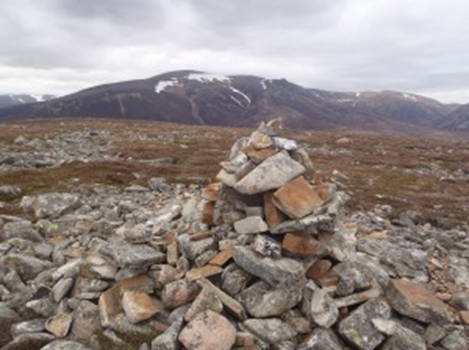
The massive Ben a’ Bhuird and Ben Avon just fill the horizon huge wild corries are just there in front of you the tors on the summit and the great Corries have many memories for me. Big days, big callous, big climbs but it was great just to take it all in slowly and enjoy the peace and solitude. The ridge from here was typical Cairngorm with a faint vehicle track to follow to the summit at 818 metres with various cairns along the way. I enjoyed the walking and the different views the higher you went. The views now of the Dee Valley and Lochnagar are stunning and again I drank it all in leaving my map on the summit, I went back and got it. I descended the ridge it was so dry that the heather felt it was cracking under my feet and was soon back on the track and back to the car. This wee hill was only a 4 hours day but lovely to be on a new hill with such great views of old favorites mountains, the 360 degree panorama is incredible. These huge glens are so impressive and many long days are remembered here, mountain bikes make the days a bit easier. The odd ruined building remind us this was once a place where people lived, loved and worked now most are ruins.
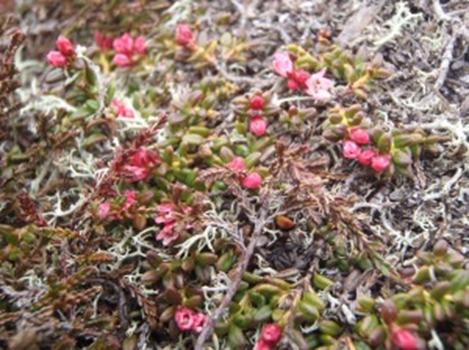
The car park still had 2 cars in it some must be out on the big hill day that is Ben Avon and Ben a’ Bhuird and I was soon in Ballater to meet John who is renting a cottage in the village. I was feeling tired by now but after a shower and some soup we had a bleather. The hips and body a bit sore and recovery takes its time. I saw an adder today on the track on the way in, it scuttled off though no photo. John is off at 0600 for Derry Cairngorm and Ben Mheadion and I hope to get another new hill in tomorrow all being well.
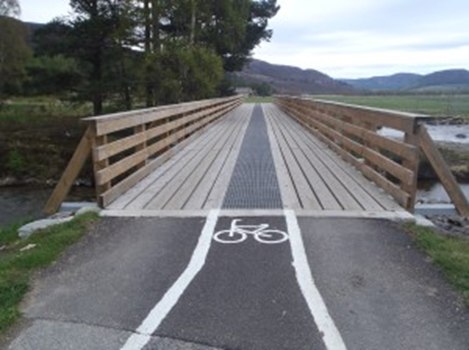
It is great to be out still a bit sore and stiff but what do you expect after a long lay off.
Health is definitely wealth and nature is good medicine! Maybe we should bottle it, what will today bring.
Linn Of Dee and the Corbet Sgor Mor
Posted on May 16, 2014 by heavywhalley.MBE
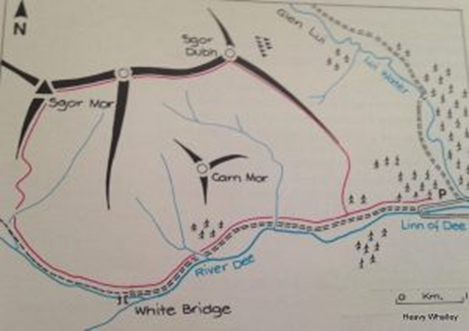
I managed another enjoyable Corbett yesterday, it was a familiar drive up to Linn Of Dee after a good sleep in the accommodation in Ballater Pine Tree Cottage. John was away early on his quest for new Munros, he was after Derry Cairngorm and Ben Mheadhoin a big walk in again and a 30 kilometre round trip. I am still recovering from illness and that would be too much for me. I had another Corbett to do and it was highly rated as a viewpoint of the Cairngorms. I stopped at Braemar fairly early about 0730 and tried to use the toilets but they were closed? As I was driving away I met Andy Lawson The “President of the Moray Mountaineering Club” and he decided to come for a walk with me. He had come down for a day on the hill and I was glad of the company. We parked the car at the Linn Of Dee car park and headed up to White bridge. It is a lovely walk through the Scots Pines and broken crags giving great views. The walk to White Bridge is about 5 kilometers and we had a great chat on the way, from here you head up past the waterfalls that cascade down those in a hurry will miss this! Further on you meet a burn and we followed it up onto the ridge and from here the views were great. We saw a two birds above the crags were they buzzards or Eagles whatever they gave us a great display of flying. This walk is the way many follow to the Larig Gru and the path after White bridge takes you into the heart of the Cairngorms and all the great hills.
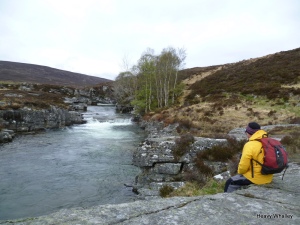
I was following the route in SMC (Scottish Mountaineering Club) Corbett book and it is a great source of information on routes and points of interest. The piece on Sgor Mor was written by Bill Brooker a famous Scottish Mountaineer and he says” it is a high level walk against the backcloth of the stupendous Cairngorm massif ” It was a good to see a different view of familiar hills. Carn Clioch mhullinn a Munro in the original tables now demoted and the bulk of Beinn Bhrotain and Mondah Mor with the depths of the Larig Gru and Devils point looking foreboding today. Why can’t they leave the Munros alone always changing the heights or is sit just me? There was a cold wind no heatwave in the Cairngorms today but it was great walking weather. The summit has some granite outcrops and some water worn slabs and there is a slab with a fine circular potholes scoured wind – blast . There was no wild life about and we even wandered over to the Larig Gru and saw little apart from the huge hills, still with plenty of snow fields. Andy has a great website and is a superb photographer a man of few words but many talents. It was a joy to be out with him, we just took it all in a savoured the wildness of this unique place.

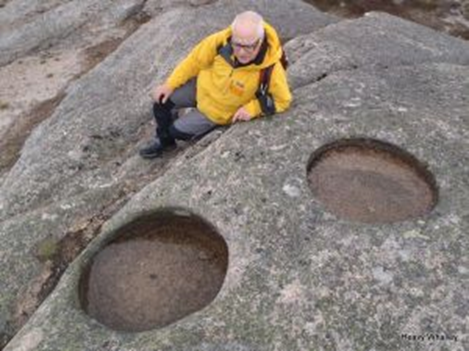
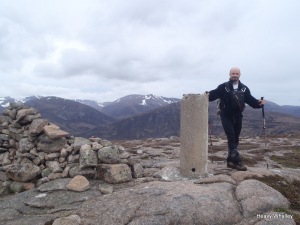
The summit was some view-point and the hills looked great and the Corrie of Sputan Dearg on MacDui looked great,snow filled still and though the sky was grey the hills looked great. We spotted all the hills and enjoyed the views then wandered along to another top Sgor Dubh along an enjoyable ridge. The views all the way were incredible giving differing views of these Cairngorm mountains.
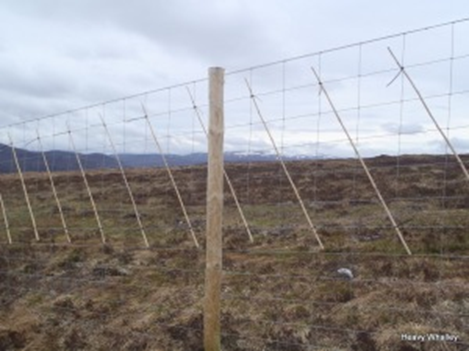
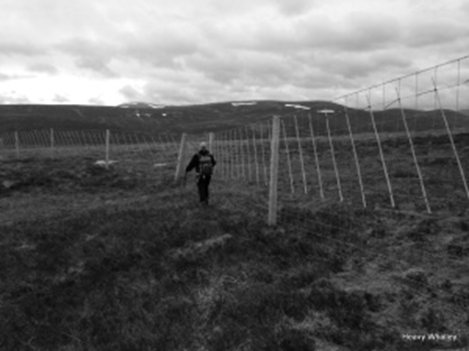
After this is was an easy descent until near the end where the heather got deeper and we came the huge new fence that covers the hill. It is supposed to be bird friendly with the fence having bamboo sticks in between so the birds see it. It was impressive and must have cost a bit but if it helps the wildlife it will be worth it.

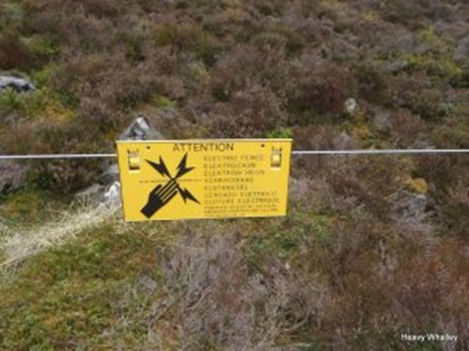
The descent apart from the last kilometer was great but the deep heather and hiden rocks even testing Andy but we soon we ended up down near Linn Of Dee and on the path. Andy had fun with an electric fence, poor Andy got a wee shock. We met a couple of Aberdonians doing the TGO Challenge and they gave us a resume of the journey so far! Hardy men. I offered them a lift but they declined, it reminded me of my epic walk in the late 70,s when the keeper at Linn of Dee offered us a lift down after a 40 k winter epic on An Sgarsoch and Carn an Fhedlier and we declined, brash young 20 year olds! Andy was off home and I enjoyed the drive back through Braemar and to Ballater, lots of people out on bikes and walking enjoying this lovely area/
It was another fine day good to have company and a bit longer than yesterday and Iam feeling a bit better now after a good day our. Thanks to Andy for a good day and to John for his hospitality. I made John stovies as he arrived after his long day and told him to get a mountain bike. He is of on another big day after his long wander yesterday to Derry Cairngorm and Beinn Mheadhion a big day of over 35 k. Today he is away to Carn an Fhidhleir and An Sgarsoch a 40 k day, will he ever learn? The weather is still holding and as its John last day I think he needs a rest, such is the quest for new Munros!
I have to go back but will pick up a wee hill on the way. Feeling a lot better but must still take it easy, magic to be out again.
Corgarff Castle – Culloden – Brown Cow Hill another Corbett.
Posted on May 17, 2014 by heavywhalley.MBE
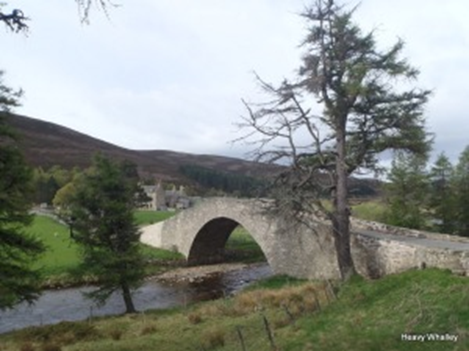
Many drive this road today just for the experience it was quite but there was also a lot of motor bikes out enjoying the road and the scenery. It was all over to soon I was soon parking in the Corgarff Castle Car Park, the Castle was shut and car park was empty when I arrived. I have passed this castle on many journeys to the East in the past and it stands out for miles a white Fortress with a wall round it on all sides, with gun ports every yard. A formidable place to start a walk.
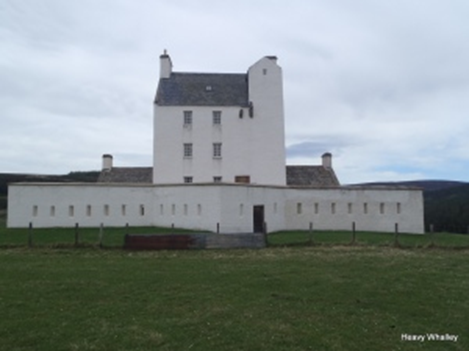
Corgarff Castle is located at Corgaff, in Aberdeenshire, north-east Scotland. It stands by the Lecht road, which crosses the pass between Strathdon and Tomintoul.
The castle was built in the mid 16th century by the Forbes of Towie. In 1571 it was burned by their enemy, Adam Gordon Of Auchindoun, resulting in the deaths of Lady Forbes, her children, and numerous others, and giving rise to the ballad Edom o Gordon. After the Jacobite Risings of the 18th century, it was rebuilt as a barracks and a detachment of government troops were stationed there, on the military road from Braemar Castle to Fort George, Inverness. Military use continued as late as 1831, after which the tower served as a distillery and housed local workers. It remained part of the Delnadamph estate belonging to the Stockdale family until they passed the castle into state care in 1961 and gave the ownership of the castle to the Lonach Highland and Friendly Society. It is now in the care of Historic Scotland and is open to the public at times.
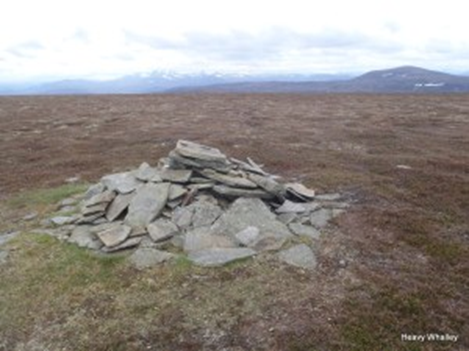
Brown Cow Hill is about as exciting as its name suggests (that is unfair) and I followed a track for about 5k till I hit the ridge. I was lucky the hill was dry as this would be a hard walk in the wet and the path is not easy to follow. There are plenty of grouse butts all the way up, today it was fairly dry and apart from about 15 minutes of peat bog but I was soon on the open ridge. here are plenty of tracks many really cutting up the hill and erosion makes it mark even with the soft new 4 wheel wagons. I passed so many hares and grouse and a few hinds.
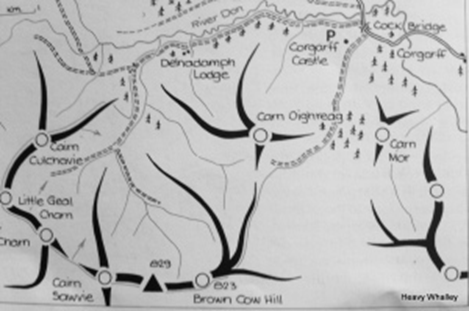
This is a typical rich Cairngorm tundra of short heather, blaeberry, crowberry, cloudberry and mosses. The true summit is the centre top at 829 metres. In a winters day with poor visibility this would be tricky navigation and in a bad wind there is no shelter at all. The summit cairn is very small and there is no shelter at all, I did not hang about The views were good of the back of Ben Avon but the wind was bitter and the sky a cold grey. The way back was uneventful and I met another walker on the way up just passing the boggy bit. We had a laugh about the name of the hill and I left him to it. I never even stopped for lunch and the views on the way back the views of the Lecht and various wind farm and then the formidable Corgaff Castle from a differing view point with its whitewashed walls were impressive. Just before the castle I found a small burn and some wonderful flowers enjoying the shelter and a bit of sun.
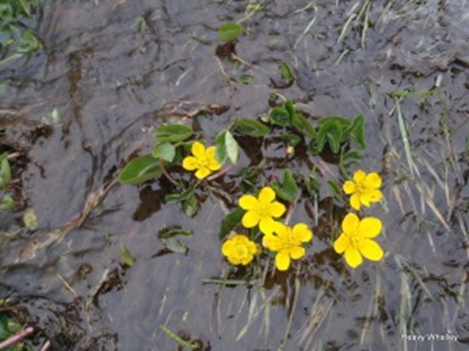
I was soon down at the car a short 4 hours but a good 15 k walk. I must never take these days for granted and Brown Cow Hill was a grand walk, with wild views and magic scenery at times. How many see all these wonderful places with such wild life and appreciate what we have in the hills. A magic 3 days walking nothing hard but so good to be out, perfect walking weather and no midges, the body a bit sore but some new hills and a bit more knowledge of this special land.
Corgarff Castle – In 1715 Corgarff once again played an important role in national events. The 23 Earl Of Mar launched the Jacobite rising from Kildrummy Castle, further down Strathdon. He then came to Corgarff to assemble and equip his army before marching on to Braemar. After the 1715 rising had been defeated, Government forces yet again burned down Corgarff, and the Earl Of Mar’ss estates were forfeited.
The castle was then returned by the Government to the Forbes family. But 30 years later it was caught up in the maelstrom of Scottish history again. In early 1746, Jacobite forces were using Corgarff Castle as an arms store after their retreat from Derby. A forced march by 300 Government foot soldiers and 100 dragoons through the snow from Aberdeen caught the Jacobites off guard.
When the troops arrived the Jacobites had fled, but so hurriedly that there was a cat asleep in front of the still burning fire. The troops also found large quantities of gunpowder and over 300 muskets, which they either destroyed or took back to Aberdeen. The Battle of Culloden which took place some weeks later on 16 April 1746, was so one-sided that the loss of these weapons by the Jacobites was probably not decisive: but it can have done little to help their morale.
The Corgarff Castle you see today owes much to events following the 1745 uprising. In an effort, either successful or unnecessary, according to your point of view, to suppress the Highlands once and for all, the Government stationed outposts of troops right across the country.
In 1748 Corgarff Castle was converted into barracks. At the same time it acquired the flanking pavilions you see today and a very unusual star shaped encircling wall shared only – as far as we know – by Breamar Castle, which lies some 12 miles south west as the crow flies. The outer wall was well equipped with musket loops, but it is obvious from the design that attack by artillery was not expected. In the event, these defences were never tested.
Memories of Wales – The Snowdon Bike Race and ice climbing in Canada.
Posted on May 18, 2014 by heavywhalley.MBE
I am heading to Onich after the cup final this afternoon to meet a friend Pete Kay who I served with at RAF Valley in North Wales in the late 70’s. Pete is on a motorbike trip to Scotland. Pete looked after me on many occasions in the mountains in North Wales when I was at RAF Valley as Deputy Team Leader of the Mountain Rescue Team. I arrived from Scotland very hill fit and I had climbed a bit, but Pete and another mate Jock got me climbing we had some great days. We did some great climbs and Wales is ideal for this, Pete and Jock got me climbing and we did most of the classics. A great day was on the Team Leaders Course an ascent of Main Wall on Cairn Lyas in winter, ice and snow in big boots it was an interesting day to say the least. Pete is such great fun to climb with and very strong when a tight rope is needed.
Every year we had the Annual Charity Bike Race for Charity over Crib Goch Snowdon and Llwyedd, it was an incredible event with both Ogwen and Llanberris Mountain Rescue Teams taking part. My mind travels back to run over Crib Goch with a bike! Wild days, Pete was a winner on many occasions! It was a bit competitive and I can remember taking a young runner over and over the day to ensure he got the route like, crazy days, what would Health & Safety think now!
We visited the Lakes and the Peaks every month and Pete would take me round some of his favourite stomping grounds. 20 vs routes at Stanage and 100 stars in a day got me climbing on all these great areas, with Pete as a guide they were magic days. In return I took him to Scotland and we did new winter routes on Seanna Bhraigh unrecorded as my part of the deal and wonderful days in winter on the classics on Ben Nevis and the Cairngorms.
My first big expedition to Canada in winter to climb the huge ice falls in the early 80’s was with Pete and what a trip that was.
Five weeks of constant climbing and Pete was in his element. In these days there was less than 100 ice routes in the winter guide and we did nearly 30 on our trip, it was an eye opener.
This was the best expedition I was ever on, what wild days, great climbing people, memories. Pete did an early one day ascent of Polar Circus a grade 6 ice route in the Rockies, that was a two-day epoch for most at the time. I will never forget that trip, it was incredible and real eye opener.
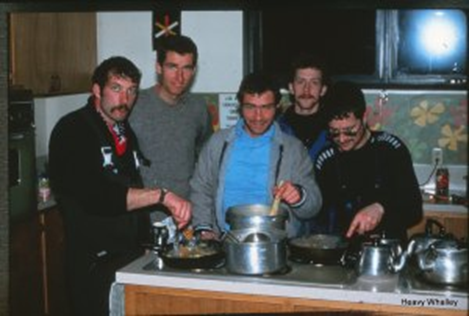
We will have a good chat tonight and maybe a meal at the Four Season’s at Onich. The weather is wet just now and a bit cold, England is on a heat wave and I am feeling the effects of a few days on the hill after not been to great. Anyway we will have a great night and some more tales of great fun in the hills.
It is not what you do or what you achieve but the people you go with that is what adventure in the wild places is about.
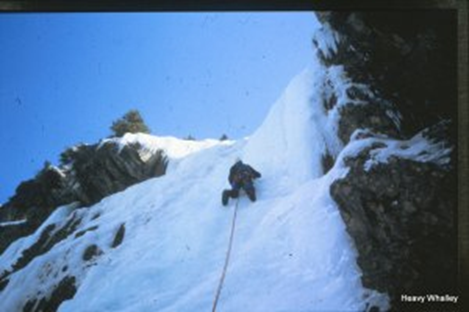
The drive over was so wet, I felt for Pete stuck on the A82 near Loch Lomond in a downpour with a car crash. I met Pete and is mate in the Four Seasons Restaurant at Onich and we had a great bleather and meal. It was still raining when we left and this morning the drive back was wet until the Cairngorms and the sun came out. It was well worth the visit though and great to see everyone again.
Lliwedd climbing and a long way for a climb – Fonaven away from the crowds.
Posted on May 19, 2014 by heavywhalley.MBE
I was reading on Social Media about a friend climbing in North Wales on the magnificent Lliwedd the classic Rock Climbs of Avalanche, Red Wall and Longland’s Continuation. This cliff is 1000 feet and a place of great character and very bold at times poor protection. It is rarely busy and in the late 70’s my mate Jock who was also at RAF Valley Mountain Rescue Team and me went to climb these classic routes They are big routes about 800 feet of climbing and a serious cliff even with the good gear of the late 70’s. There were two climbers in front of us and we caught them up, Jock was very competitive near Red Wall. One had a big fall and broke a leg, Jock climbed up to him and sorted him out. We called the helicopter in by radio and both were evacuated, Jock and me completed the climb, taking it easy as I was definitely a bit shocked and wary. I remember having to work hard at belays it was a big learning curb but wee Jock was a top-notch Glasgow climber and these cliffs were his domain!
I remember telling Jock about the great cliffs of Foinaven up in the North West Of Scotland and I day I had done just before I left RAF Kinloss in 1977. It was the Team Leader Pete Mc Gowan’s last weekend so four of us headed into Fionaven for an adventure. I was climbing with a great pal and hill “gangrel” Jim Green, (RIP) both of us were not great climbers but Pete reckoned we needed a day on these huge cliffs to sort us out. This was Pete’s last weekend before he retired and it was a great privileged to climb in his company. The old Hamish MacInnes Joke book said that the cliff has few recorded routes, with lots of potentail. It was a place of mystery for me as I had climbed the Corbett an incredible day and seen the great cliffs of Creag Urbhard. It is a huge cliff with its 700 – 1000 foot routes, mainly of polished granite, it is generally good but there is a lot of loose rock on the ledges. It is a big 3 hour walk in and in the guide it says 7 miles to the crag. Pete did not hang about and the route chosen was The North Ridge a 1000 foot grade 3 + as the guide book stated? The route description we had for 1000 feet was very basic
182 – North Ridge 1000 foot grade 3 + l. Lovat & T. Weir 1954
From the bottom rocks past the coloured outcrop, up slabby rock which steepens! Up direct, by small walls to base of recess ( tree above)Gain tree by the L wall. Follow up steep rock (variations) Choice of lines to the top!
I remember having a fun day but lots of crazy route finding and near misses with loose blocks and Jim missing me with a huge one that crashed down beside me. The smell of cordite stays with you as the rocks smash down the cliff. The climbing gear in these days was limited, protection basic and we had big bags and big boots it was a scary day but what a place to be. It was along climb 1000 foot but so many variations were possible and our route finding was basic. Thinking back it was a massive learning curb and a big serious place to be, Jim must have smoked 50 fags on that route. We reached the top of the climb and then in true Mountain Rescue Tradition did the complete ridge, with bags bulging and heavy legs. The walk out by moon light was incredible with the fish jumping in the pools on the way off. Eventually we reached the road at 0030! The Team waiting at Kinlochbervie could not go out for a beer till we were off the hill and were not impressed, I think Pete did that big day deliberately to keep us out of the pub and we were very lucky to be out with him on that special day!
Next day it was Ben Klibreck with all the team a grand farewell for Pete. I went back many times to Fionaven. It was a place that many new team member’s who thought they were climbers learned some valued lessons on climbing on a big cliff. The guide books have improved greatly, as has the gear but not my climbing ability. I have done 8 routes and a scramble on this huge cliff and had a big 2 days in winter many years ago. It is a place of great memories and huge learning I would love to go back for a wander there is a magic scramble I did in a great day Ganu Mor Slabs a 3 star Grade 3 scramble what a fun day and well worth the walk in. How many have climbed on this great cliff ot know about it these days?
Sheneval Bothy – Update – Thanks to all for their hard work.Posted on May 20, 2014 by heavywhalley.MBE
Peter Aitken – has recently retired as Maintenance Officer of Shenevall Mountain Bothy He sent me the Association Update Shenevall – a big thank you to Peter for all his work over the years, great people, great work.
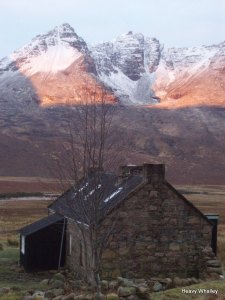

You will be interested to see that we have been at work again at Shenavall
The Annexe at the back was in a rotten state, and best demolished – the space lost has more than been made up by the space created by the work we have done over the previous two years.
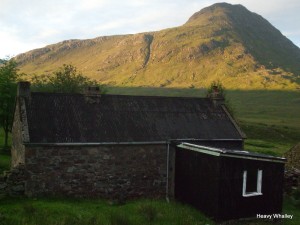

The Annex at the back is now gone – big changes at Sheneval. The hill behind the bothy is now not a Munro what a shame how many will miss out in this great viewpoint. MAKE SURE YOU DO IT!
It was good to have some of our volunteers coming forward from two separate organisations, under workplace release schemes to come and help. I think that they enjoyed their experiences.
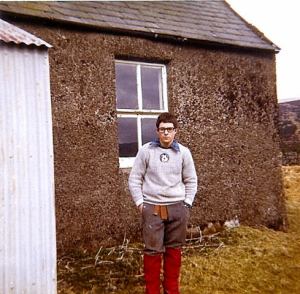
1973 the now closed bothy at Back Hill oF the Bush in Gallway my first expereince of the Bothies was as a 15 year old with the Boys Brigade on Duke Of Edinbugh Award.

This area is wonderful and I love my visits it is busy nowadays with the 5/6 Munros and magic Corbetts in the area. How many who use the bothy donate or join the MBA – They need every penny to keep the bothies going. Great work is beind done all over Scotland by this band of volunteers and great characters.
Cars fly by as you cross the road, to another world, then silence, the traitor’s gate.
The track wYnds through the trees, the river breaks the silence,
The glaciated slabs hide the cliffs, then:
Views of An Teallach open at every turn.
Midges and clegs abound here but not today, too cold, its winter.
Cross the river, is that bridge in the wrong place? Muddy and wet, back on track,
Steep hill, upwards towards the top, the wee cairn, stop, no rush, drink it all in.
An Teallach. Snow plastered, familiar, foreboding.
Open moor, contour round and round, special views,
Every corrie on that great hill has a particular thought.
Memories
Munros, Corbetts and climbs winter and summer
Fisherfield, these great hills, the light changing, o the West
Youthful memories of companions, some now gone.
Epic days, trying to impress?
Pushing it and nearly, losing it?
Descent to Shenevall, steep, slippy and wet,
Eroded now by so many feet.
Collect some wood.
The bothy, the deer, they are still there;
Sheneval. It never changes, only the seasons.
Fire on, primeval.
Tea in hand, alone with thoughts, the Deer rattle the door.
Time for sleep.
Memories – Thanks to the MBA!
Heavy Feb 2013
Moray Coast in the sun. Dolphins, seals and so much wild life.
Posted on May 21, 2014 by heavywhalley.MBE
It was a really hot day yesterday with the shorts on for the first time this year as the temperatures reached 23 degrees at Kinloss. This was Scotland’s hottest temperature of the year so far. I had a visit to the Chiropodist early in the morning, after years of mountaineering it is well worth looking after the feet and I go every three months. It is amazing how many people do not look after their feet and how much work they do for you. This is a top tip this is money well spent! By the time I finished it was lovely and hot and I had a wander round my local golf course Hopeman in the sun. It was a great walk with lots of birds about and even dolphins in the sea, what a privilege to see this on a daily basis. A friend said that last week he had watched a dolphin come into shallow water and give birth to a small calf and then very quickly they were off, nature at its best! Today the dolphins were enjoying the sun and displaying their incredible skills in the sea and it was incredible day. My grand daughters are due up today from down South and I hope we see the Dolphins. Later on I wandered up to Cummingston sea cliffs there were a few from Glenmore Lodge rock climbing in the sun and enjoying the dolphins as well, this is all on my doorstep and the cliffs were looking good. The caves and rock pools are a wonder land for all ages and yet few apart from climbers visit this place, what a grand place to be. The wild flowers are all out with harebells and sea thrift and many others flowers enjoying the sun. Just to sit by the sea with the waves and rocks of all colours looking great in the sun, the orange lichen on the rocks is especially beautiful just now. It is great to be able to take time and feel the heat after a long winter.
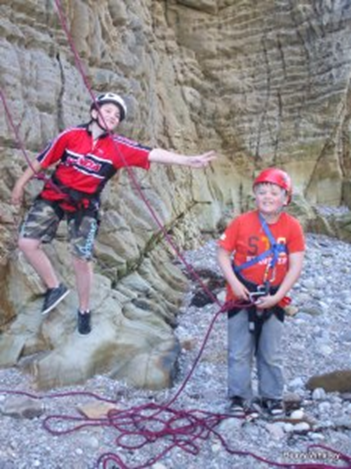
I had sun cream on and hope it is not too late to look after my skin but never took any water with me and needed a long drink after a couple of hours walking.
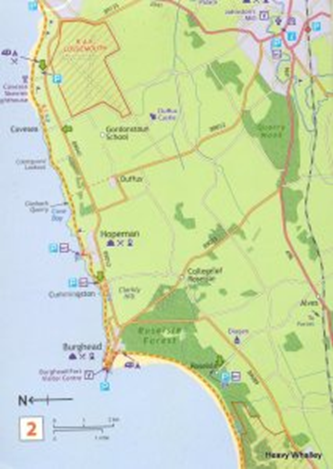
The new path along the coast is so well used with many using it on a daily basis and the Moray Coastal Walk is a great way to see the wildlife and scenery of this great area. It is great to see families out in the sun and we must never take this for granted. It was a great walk and still hot even late in the evening, then out of the blue came a heavy shower but the plants needed it after a hot day.
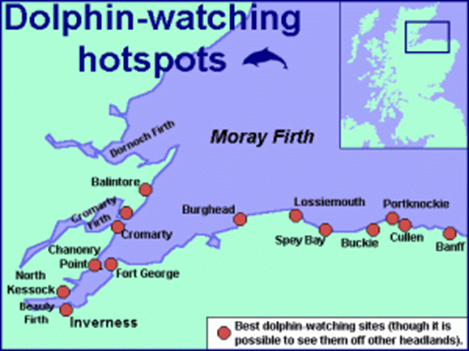
The Moray Firth is one of the most important areas in UK waters for dolphins, porpoises and whales (collectively known as cetaceans). The species most often seen from the shore are Bottlenose dolphins and Harbour porpoises. This has led to several locations around the coast becoming well-known for ‘dolphin watching’ (see map).
Minke whales and White-beaked dolphins are the next most likely species to be encountered, usually further out to sea, although White-beaked dolphins have been seen from the shore at Fraserburgh. Pilot whales, Killer whales and Risso’s dolphins are also present in the Moray Firth, but only Killer whales are likely to be spotted from the shore, with sightings reported from the coastline around Aberdeen and Banff.Bottlenose Dolphins are widely distributed in warm and temperate water throughout the world, although they are relatively uncommon around the UK coast. The Moray Firth dolphins are extremely important as they represent one of only two or three resident populations known to exist in UK waters and probably the only one in the North Sea. There are thought to be over 100 Bottlenosed dolphins living in the Moray Firth.
Adults have a clearly defined beak and a tall sickle-shaped dorsal fin which curves backwards. They are between 3.1 and 3.8 metres in length, about twice as long as Harbour porpoises, and weigh between 180 and 300 kilograms.
They typically live for 25 years, although animals as old as 50 years have been recorded. Females reach sexual maturity between the ages of 5 and 12, and may give birth to a single calf every 2 to 3 years, look out for newborn calves any time between March and September. The calf may be helped to the surface by its mother for its first breath of air. If the mother is weak, other female dolphins in the herd often look after her.
(Courtesy of Scottish Natural Heritage)
Glen Affric – Wind-farm proposal?
Posted on May 22, 2014 by heavywhalley.MBE
I love Glen Affric these great glens mean so much to me and I do not visit them enough these days, I was privileged to walk them when they were very quite places and few ventured. My big walks across Scotland in the 70’s took me on a journey into these wilds. The Glens were my hardest days, Affric, Cannich, Strathfarrar, Strathconnon and in summer and winter a place of incredible memories and wonderful hills. The hydro has changed this area but is now an accepted part of the area but Wind Farms now planned for this area are a huge change in natures balance. The Forestry has re – looked at what it does and more natural wood land gives the area a better balance and place for all to enjoy. It is worth the journey to see the places, to take children for a wander, this is a beautiful area let’s not lose this please. What are we doing to our country, what are we doing to these wonderful areas?
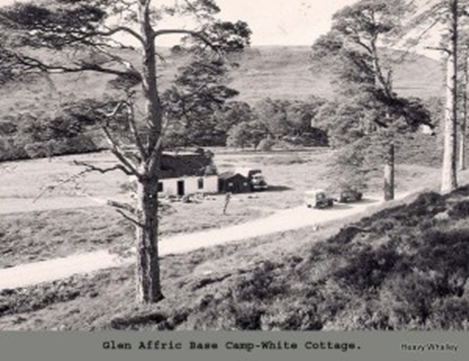
Glen Affric, the world renowned National Nature Reserve, the Glen Affric/Strathconon Golden Eagle Special Protected Area, the proposed Wild Lands (Central Highlands Core Area 24) and Strathglass are under attack from German Wind Developers WPD and ABO Wind,and London-based Wind Prospect Developments 2 Ltd. Following in the footsteps of the local, but smaller […]
Please support the guys trying to fight the ridiculous proposal of putting a wind farm adjacent to the Glen Affric NNR. Adjacent to a National Scenic Area, SSSI, SPA and RSPB reserve. Adjacent to the Tweedmouth memorial cross. Over 100,000 visitors decide to come to Glen Affric and the surrounding communities. Nearly half of these are from overseas. It will destroy the delicate economy that is centred around tourism. This is madness. Objections against planning are now being taken by Highland ePlanning. The reference is 14/01731/FUL, deadline is 4th June 2014. Good luck!
Hello all,
A giant industrial wind farm is planned right at the entrance to one of Scotland’s most loved glens. The John Muir Trust have objected today.
Our friends in the conservation village of Tomich need help.
To save our cherished glen from this absurd development, please, please take a moment to lodge an objection.
This really is one that simply cannot be allowed to go ahead!
Conservation is not landscaping ?
Posted on May 22, 2014 by heavywhalley.MBE
Magnificent wisdom!
Planting in our woods precludes future options that nature might have selected without human interference, says Adam Watson
At Glen Quoich by Braemar in 1942 I first walked in Old Caledonian pinewood. Vividly do I recall the height and girth of the ancient trees, their rough reddish bark, their dark green needles.
In the Scots tongue we called them firs, not the English pines. Every tree was an individual – in size, shape and form. Dead standing pines rose, pale ghosts without bark.
Lichens covered dead lying pines. I saw no saplings, bar one where a seed had settled on an upturned stump, above deer mouths.
Above soared Beinn a’ Bhuird, snow patches gleaming in the sun. Ants scurried up and down trunks, returning with resin to put on an anthill. When I put my face close, they squirted burning liquid in defence of their city.
Turbulent ran the Water of Quoich amongst boulders, but a pine had blown across, so I crawled over dry-footed.
That day still excites me. Old Caledonian pinewoods are a rare treasure. People should respect them. Let us hand them to later generations in a better natural state than now.
By the 1950s I knew all the Old Caledonian woods and began studying them.
Counting rings revealed that many pines began life 200 years ago, and some veterans centuries before. Soon I saw that the Scottish Caledonian woods form part of the boreal forest of Eurasia and North America.
Our woods are unique, however, because they have adapted genetically to Scottish environments. They are of priceless value for landscape, wildlife and human recreation.
Britain ignored its responsibility for decades. When the Nature Conservancy designated the Cairngorms National Nature Reserve, a wise principle was natural evolution of environments with minimum human interference.
The minimum was understood to be reducing unnaturally many red deer, which prevented natural regeneration by eating young trees. Powerless sat the Nature Conservancy, for it
Planting in our woods precludes future options that nature might have selected without human interference, says Adam Watson
At Glen Quoich by Braemar in 1942 I first walked in Old Caledonian pinewood. Vividly do I recall the height and girth of the ancient trees, their rough reddish bark, their dark green needles.
In the Scots tongue we called them firs, not the English pines. Every tree was an individual – in size, shape and form. Dead standing pines rose, pale ghosts without bark.
Lichens covered dead lying pines. I saw no saplings, bar one where a seed had settled on an upturned stump, above deer mouths.
Above soared Beinn a’ Bhuird, snow patches gleaming in the sun. Ants scurried up and down trunks, returning with resin to put on an anthill. When I put my face close, they squirted burning liquid in defence of their city.
Turbulent ran the Water of Quoich amongst boulders, but a pine had blown across, so I crawled over dry-footed.
That day still excites me. Old Caledonian pinewoods are a rare treasure. People should respect them. Let us hand them to later generations in a better natural state than now.
By the 1950s I knew all the Old Caledonian woods and began studying them.
Counting rings revealed that many pines began life 200 years ago, and some veterans centuries before. Soon I saw that the Scottish Caledonian woods form part of the boreal forest of Eurasia and North America.
Our woods are unique, however, because they have adapted genetically to Scottish environments. They are of priceless value for landscape, wildlife and human recreation.
Britain ignored its responsibility for decades. When the Nature Conservancy designated the Cairngorms National Nature Reserve, a wise principle was natural evolution of environments with minimum human interference.
The minimum was understood to be reducing unnaturally many red deer, which prevented natural regeneration by eating young trees. Powerless sat the Nature Conservancy, for it did not own the land.
During 1959, HM Steven and A Carlisle in The Native Pinewoods of Scotland showed that the woods had continued for millennia since our last glaciers melted, by seeds from older pines.
They wrote, “To stand in them is to feel the past” and “The native pinewoods are one of the most important living historical monuments of Scotland”. However, most were in poor shape because deer or sheep ate almost all seedlings.
At Caledonian woods bought with taxpayers’ money by the Forestry Commission (FC), workers felled, fenced and planted, including alien American conifers. Several private owners used FC grants to fence, plough and plant underneath ancient pines, often with aliens.
These excesses have now ended. The FC at Glen More removed aliens. The Nature Conservancy’s successors, Nature Conservancy Council and Scottish Natural Heritage (SNH), cut deer stocks at Inshriach. Natural regeneration of pines followed.
The Royal Society for the Protection of Birds (RSPB) did this at Abernethy, as did owners at Glen Tanar, Glen Feshie and Mar Lodge.
Since 2011 there has been a turn for the worse. The RSPB have started planting at Abernethy. They and Trees for Life at Glen Affric request donations to “expand and restore Old Caledonian Forest”. One cannot expand or restore natural woodland by unnatural methods. The government’s statutory advisers SNH, the FC and Cairngorms National Park Authority approved Abernethy planting.
A common error is that Old Caledonian pinewoods should contain more broadleaved trees such as birch and aspen. The FC demand at least 15 per cent broad-leaved when grant-aiding planted pinewoods.
They should realise that broad-leaved trees are scarce in Caledonian pinewoods because the fertile soils that suit them are scarce. They should visit Scandinavia, where broad-leaved trees are absent on acidic bedrock or excessively drained sands.
Choosing seeds and nursery work involve selection that is unpredictable. Nursery plants are more nutritious from fertiliser and rich soil.
When transferred to poor soil they become tasty morsels for deer, which can find them from afar. Such planting wastes money.
In Caledonian pinewoods, planting is landscape gardening, not nature conservation. Why hurry to “deliver” precise “targets” and “visions”? This signifies arrogance that man knows best.
Why not wait, and admire what nature provides without a penny from donors and taxpayers?
Planting reduces naturalness. It precludes future options without planting. If owners then decide to return to natural regeneration, it will be too late. Those who plant or back planting will have squandered naturalness for ever.
It’s not too late for statutory guardians FC, SNH, CNPA to end this damage and go back to respect for nature.
Planting in our woods precludes future options that nature might have selected without human interference, says Adam Watson
At Glen Quoich by Braemar in 1942 I first walked in Old Caledonian pinewood. Vividly do I recall the height and girth of the ancient trees, their rough reddish bark, their dark green needles.
In the Scots tongue we called them firs, not the English pines. Every tree was an individual – in size, shape and form. Dead standing pines rose, pale ghosts without bark.
Lichens covered dead lying pines. I saw no saplings, bar one where a seed had settled on an upturned stump, above deer mouths.
Above soared Beinn a’ Bhuird, snow patches gleaming in the sun. Ants scurried up and down trunks, returning with resin to put on an anthill. When I put my face close, they squirted burning liquid in defence of their city.
Turbulent ran the Water…
View original post 607 more words
Dealing with Psoriasis – Medical in Confidence?Posted on May 23, 2014 by heavywhalley.MBE
Psoriasis
I have been asked to help with a NHS video about Psoriasis from my friends at Doctor Gray’s hospital in Elgin. I have been unfortunate to have had this awful skin disease since I was 19. It can be a terrible and fairly unknown disease that the general public know little about. I was going to do a piece on my blog about it to try to spread the word, this has hastened it and it may help others. To many Psoriasis is a disease that few know about or understand and can be a huge blow especially for a young person.
Few who read this will know I have psoriasis yet I spent 37 years in the military. I have been hospitalised three times for several weeks at a time when they had a Skin Ward at Raigmore Hospital near Inverness in the early 70’s. These days it was a very basic treatment covered in a tar products it was very hard and upsetting for a young guy. The RAF Doctors had very little clue how to deal with it and many treatments and ointments made the raw skin a lot worse.. The initial signs for me were a red skin rash on my head,legs arms and trunk that got worse and worse, soon about 40% of my body was covered. I was very active at this time with the RAF Mountain rescue and playing football and other sports the rash got raw after a day of heavy physical activity and actually bled with the constant rubbing of clothes. It became pretty obvious and I got a few cutting comments did I have “Scabies” is it contagious? Eventually I was sent to Raigmore Hospital and the three weeks were one of constant treatment with tar products, which ruined any clothes you had. The nurses were great and they had to administer some of the creams, it was a hard job but seeing many others a lot worse than me made me accept it was life. There were increased bouts of it and it was always worse after a winter and meant that there were few summers I could wear shorts and light clothing. I was very embarrassed about my skin and my appearance and the best way for me to cope was to cover it up, not easy in the hot weather. Sun can be a great help with the disease and wearing clothes made you sweat and it became a long battle every year. Treatment of my condition was very hard trying to get some where private to apply creams especially when away most weekends with the Mountain Rescue in village halls or tents. Most of the team accepted it and I got used to educating them about my condition. Psoriasis can be hereditary but no one in my family had it but I have worked out that it can be effected by stress and one thing for me is trauma, especially after an upsetting Air crash or Mountain Rescue Call – Out. Also if I get an illness or sick then it can explode and the process begins again.
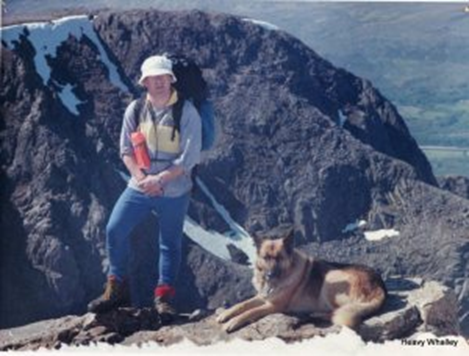
1973 – the sun in the Persian Gulf helped the skin condition!
I was very lucky as all my girlfriends accepted Psoriasis was part of my life but it did put a strain on relationships and even holidays by the sea were dependent on the state of my skin. I was posted to the Persian Gulf in 1974 for 9 months and the sun definitely helped and it was one of the few times I was free of Psoriasis in my life. It was hard at first as I arrived with the condition fairly flared up and you cannot hide it when wearing shorts? Eventually people accepted it and the sun did it work and cleared my skin.
I have had most treatments all my life even taking part in early light treatment in Dundee which made you very susceptible to light as you were given a tablet before treatment. This made you very effected to the sun for 24 hours, not easy if I had a Mountain Rescue Call out after treatment. I have tried all types of creams but the light treatment nowadays is very effective if time-consuming. It is very hard to get a place and this treatment takes several months usually going three times a week and building up from a few seconds to minutes all controlled by the nurses. Treatment has become better but the waiting list is long for the UV treatment. Today I have the time to look after my skin a bit better and keeping the areas moisturizered and treating the areas as they occur with modern creams, unfortunately some include steroids and must be used sparingly. I find alcohol does not help and eating well and getting some sun after a long winter always helps. It is not life threatening but can make life hard for many, after 40 years I can cope and if you or a relative have Psoriasis maybe this will help? It is great when it clears and you can go about in shorts, swim again and wear light clothes, simple things but such a great feeling. Do not be afraid to talk about it to friends and most are fine about it and many have this condition. Get professional help see a dermatologist when you can and hopefully one day there may be a solution to this awful disease? This is an email that I got after my bit for filming yesterday.
“Many thanks for coming along to filming this morning; your participation in our project is very much appreciated!
The videos will eventually (after editing and content checks) appear on the ‘A Better Plan’ website (www.abetterplan.co.uk). A Better Plan, accessible on any internet connected device, allows you to create a confidential, personalised healthcare record. A whole range of information and measurements can be inputted and can be shared, if the patient wishes, with friends, family or health professionals. The UK Government is backing A Better Plan and whilst it is currently only being trialled in a select few regions, it is hoped that the product will eventually be rolled out across the UK.
I hope that you will register for A Better Plan as we are keen to get as much feedback on the site as possible (both positive and negative comments welcome and can be emailed to myself).
Feel free to talk about A Better Plan on your blog! It would be useful though if you could let me know how many people (approximately) visit your blog on a monthly basis as I am required to record how many people could potentially hear about A Better Plan.
Moray Walking Festival 19 -23 June
Posted on May 24, 2014 by heavywhalley.MBE
Only a month to go before the Moray Walking Festival Starts, so book now at
www.moraywalkingfestival.co.uk
While there are still plenty of places left.
The Cameron McNeish events are proving popular so don’t hang around if you want to go!

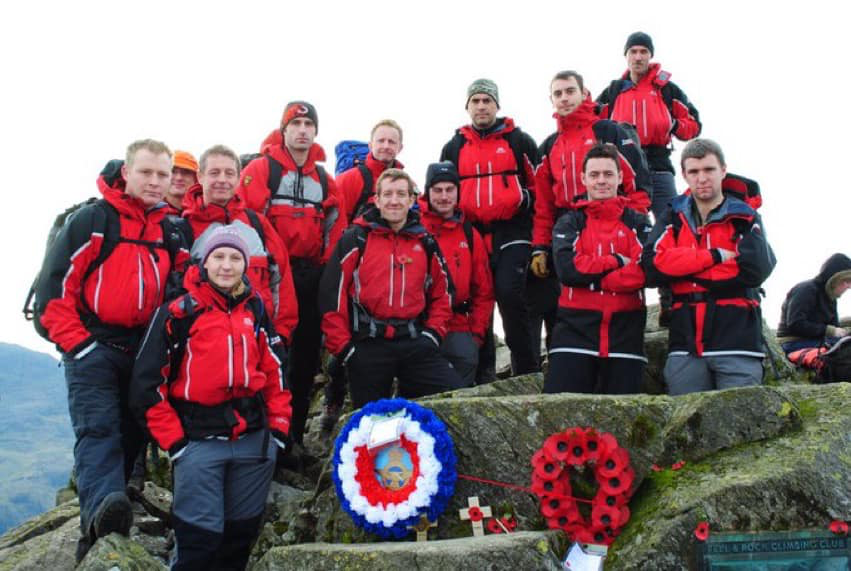
Ben Rinnes Wellington air crash a bit more info. Thanks John Ritchie
Posted on May 25, 2014 by heavywhalley.MBE
My trip to my local Corbett Ben Rinnes (The Headland Hill) last week in very bad weather with a good friend John Ritchie who is a very active aircraft historian visited the site of the Wellington Crash near the summit. The summit has the great name Scurran Of Lochterlandloch and the name Scurran (is applied to the other two tors on this magic wee hill. Many thanks for reminding me of this Donald Watt and Hamish Brown! Hamish Brown’s Mountain Walk and Climbing the Corbetts is a great book for information on the hills in Scotland. (My blog on the 12 May has a bit more information on the aircraft and mountain)
Ben Rinnes was the scene of a terrible plane crash on 14th November 1943.
A Wellington Bomber HF746 of No. 20 Operational Training Unit, based at Lossiemouth, crashed into Ben Rinnes whilst on a navigational exercise. Both crew were killed.
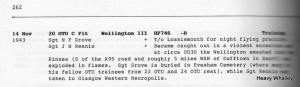

John works for a well known aircraft company has access to a Wellington frame and from this he has shown where these parts of the aircraft we found are in the structure.
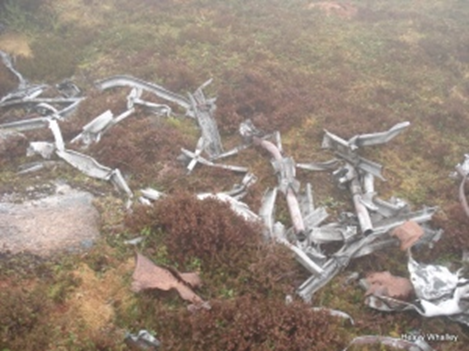
From John “Bits we found probably originate within the red rectangles on these pictures. The nacelle (3rd picture, removed from the wing) – we probably saw skin sections from one of these as well.”
Fuel and oil tanks live on top of the nacelle.
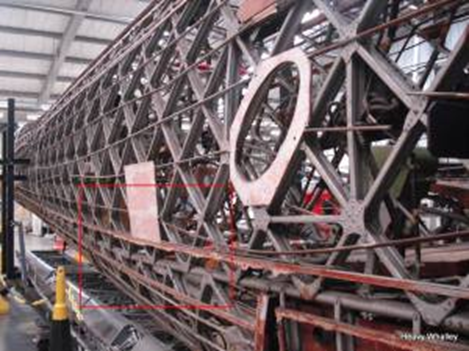
More photos from the crash site.
Alaska Memories – Denali – The flight in to the glacier! One shot Pass!Posted on May 26, 2014 by heavywhalley.MBE
I had an interesting trip to Alaska in 1996 – previous trips by other friends had showed blue skies and great weather, incredible peaks and unlimited sun light! Unfortunately our trip was not like this at all. The long trip to Anchorage was fine and the drive to Talkeetna was fascinating where you await for the weather as you fly into Denali, landing on a glacier at 7200 feet! Most people may be are aware that I hate flying and flying in a little Cessna and landing on a Glacier was something I was not looking forward to at all. To get to the mountain you have to fly from Talkeetna a wonderful wild west town where you wait for the weather to allow you to fly in to the mountain. Packing and unpacking weighing gear, for a month on the hill taking stuff out, what an epic and the weight is incredible. After 4 days waiting for the weather we were off, the weather cleared and we got the message in the pub, that never closed. When the aircraft left Talkeetna is was packed with gear and had an epic taking off we had 3 on board and food and gear for a month. All this to be dragged by you on your sledge, there are no Sherpas in Alaska. In addition we had skis, yes skis for me as well but that was the plan. The flight in to the Base Camp takes about an hour is an incredible journey, mountains everywhere and the huge bulk of Denali just looks so massive and imposing. The flight takes you over high mountain passes and the famous “One shot Pass” is exciting as you pass the huge cliffs, Cornices and a wee gap in a ridge.
Not every landing is as expected landing on a glacier!
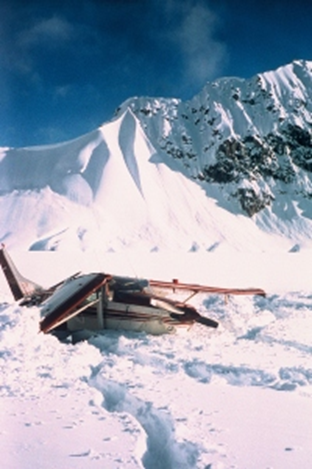
People I naively asked why they call it “One Shot Pass” and got a laugh in response. It’s the best shot you have for flying a direct route to Kahiltna Base Camp. Our plane lifted up out of the cloud layer, and the three great peaks of the Alaska Range I saw them for the first time these amazing peaks of Foraker, Hunter, and Denali rose above the glacier in full view.
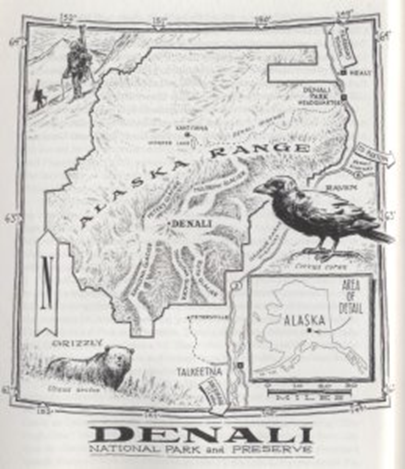
Our pilot Paul skirted over One Shot Pass, giving me a non stop update of how close we were and we had got friendly over the days of waiting to go. He was bringing the plane in low over the crevasse fields of the Kahiltna, the longest glacier in the Alaska Range. The plan in front bumped along the glacier and then crashed, we flew over, they all got out, gave the thumbs up and we flew back to Talkeetna. It was to windy to land and Paul did not want to risk it, I was terrified and agreed with him. We went back and a few hours later the aircraft had been moved and the wind had died down we were off. We landed on skis in the white powder snow and came to a stop before a snow hill cluttered with tents. Most climbers are on their way up the mountain; the others have returned from their attempts. So far this year, only 18 percent of Denali’s 600 climbers have made it to the summit, a very low number for a mountain that boasts a 50 percent chance of success. We had landed and soon we were on the glacier and the wee plane lightened now took off over the glacier and was soon lost in the great peaks. The Plane does not hang about and is gone as soon as we were off, now on the glacier a jumble of tents and gear and the Base Camp Annie met us and gave us a quick brief. Everything is carried with you and each night you break camp and move on or stay and move gear up. It was a wonderful place to be and soon the tent was up and we got organised.
It was going to be an interesting trip!
Thunder and Lightening – very, very frightening, some ways of staying alive.
Posted on May 27, 2014 by heavywhalley.MBE
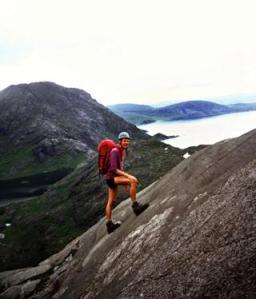
Yesterday I was having a golf match with the Aford Seniors, it was at my local golf club Hopeman. The forecast was for a shower or two but it would be a great day out in good company. I was not expecting thunder or lightening at all. After an hour the sky darkened and it got a bit colder and the clouds looked dark and heavy, then the peel of thunder came and the heavy rain and hail. I had just said if I was in the mountains I would be very scared indeed and even golf course have had their fatalities. We got another big peel of thunder and then some lightening hit the course, then the weather was gone across the Moray Firth. It reminded me that thunder and lightening is even worse in the mountains and a reminder of an epic in Skye.
Skye May 2000 – The Dubhs Ridge – I was just back from the Falklands and was very happy to be in Skye with Kev ( “The Giant and Bob”) We had already come over the main Skye ridge at Sgurr Na Bannadich and descended to sea level again. We were on the classic Dubhs on the magic Island of Skye. This ridge has an exciting abseil and this is when the day started to go wrong. I was at the bottom of the abseil holding the ropes when Bob got stuck on an overhanging rock. The air changed and I felt the hairs on my head singing, the sky darkened and then.
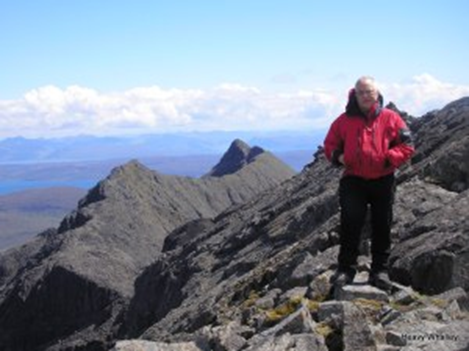
“A big peel of thunder rang out and the hairs on our heads started sticking up, towering cumulonimbus type of cloud were directly above us it was time to go! If you have read where not to be when thunder and lightning are about, this is it. The lightning was flicking along the Skye ridge like you see on a film it was surreal. The narrow ridge radiates for 12 kilometers we were out on a limb and the ridge looked like an electric current was running along it. Nature is so powerful and we mere mortals. We felt so small and vulnerable, the power of nature in such a place is awesome. Keep calm and get off as quick as possible, now the descent from this hill is not recommended. A descent in the late forties by W. H. Murray described it as one of the most serious mountaineering descents in Scotland! The An Grabh Coire is rarely visited and is a huge Corrie of wildness and worth a visit on its own. Not advised even for a man of the “Giants” ability. This is a real area of wilderness saved by people like W.H. Murray for future generations to enjoy, this is a really special place for those who love the wild.. It is also not a place to make a mistake, the phone does not work in this area and any help is along way off, add to that the seriousness of where we were. This was not the place to be.
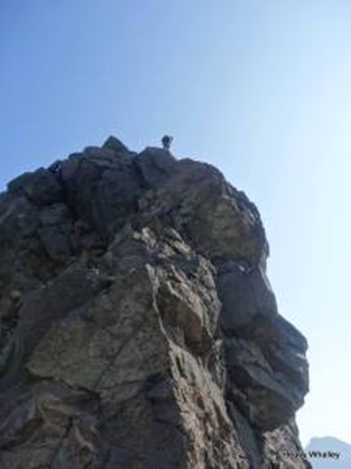
The Giant wanted us to wait for the storm to pass on the ridge, which I vetoed as it was like being next to a lightening conductor! He is that big I was brave and went off ahead to find the way off and to conduct “any lightening”. Bob said little, by now it was pouring with rain and rivers were running down the huge slabs making life worse. I had been in this wild Corrie before on past rescues it was a scary place to be especially at this time when everything was so wet, it took a lot of concentration to be very careful. The noise in the background of peels of thunder was surreal and we felt so vulnerable in this huge Corrie. It was that wet that foam was building up on the slabs and the Corrie was just one great waterfall. We managed it though and after one dodgy abseil and two hours later we were down through the slabs and soon we were on the ground amongst the huge boulder field in the corrie. There are no paths here just massive boulders all slippery and wet. The radio was dead as all the other troops had fled the hill at the first peal of thunder and we were on our own for miles away from anywhere. Being old I remembered doing a similar walk out over twenty years before and it was hell. How do we tell Bob that the only way back is round by Coruisk to Glenbrittle a walk to remember? That is another story!
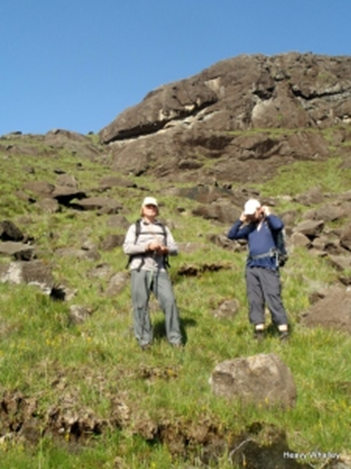
That day one person was killed on the hills by lightning, nature takes no prisoners so be aware if lightening forecast do not be on a tight sharp ridge like the Dubhs in Skye!
Summary –Staying safe
- Stay off ridges & summits, and away from single trees.
- Walls can be protective but keep more than 1m away.
- All metal objects (carabiners, crampons, ice-axe, ski poles, etc) should be stored safely.
- Move quickly away from wire ropes & iron ladders.
- Lightning currents can travel along wet ropes.
- Crouch immediately if there is a sensation of hair “standing on end”.
- Crackling noises or a visible glow indicate imminent lightning strike.
- Airborne helicopters can be struck.Check weather forecast.
- Seek shelter as soon as hear thunder. Don’t wait until you see the lightning.
- Lightning can travel 10 miles in front of storm clouds. 10% strikes occur when blue sky is visible.
- A storm can travel at 25 mph.
- Most common time for injuries are before the storm or at the apparent end of the storm.
- 30-30 rule
- Danger of being struck is when flash to thunder time less than 30 seconds (approximately 10 km away).
- Don’t climb for 30 minutes after last thunder & seeing last lightning.
NO PLACE OUTSIDE IS SAFE DURING LIGHTNING –AVOID THESE:
- Small, open huts, caves & overhangs (increase risk from side flashes).
- Sheltering under small outcrop or overhang may increase risk of injury, as lightning that has hit a hill literally “drips” onto the person with the rain as it arcs over the ground.
- Water or wet stream beds.
- Near the tallest structure in the area e.g. single tree.
- Tents not protective (metal tent poles act as lightning rods).
- Stay away from high ground (ridges and summits).
- Power lines
- Ski lifts
- Metal objects
Stay safe!
SKYE – We who have been go again, and again advise you to go, you will not be disappointed.
Great effort – Munro Round completed.
Posted on May 27, 2014 by heavywhalley.MBE
Mission complete! Many congratulations to Dan Duxbury who has finished his Munro Round when he reached the summit of Ben Hope at 8.22 this morning

(read more at http://danmunro2014.blogspot.co.uk/).
And also huge thanks to everyone who supported his fundraising for the John Muir Trust (http://www.justgiving.com/danduxbury)…
Heroes one and all!
A great effort.
Yosemite memories!
Posted on May 28, 2014 by heavywhalley.MBE
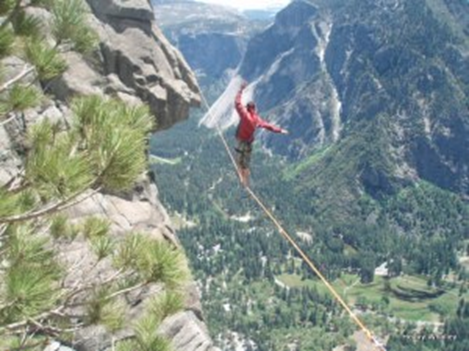
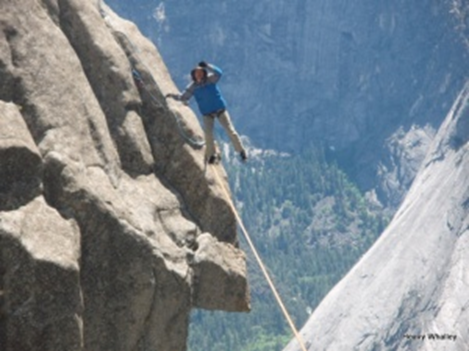
2008 Top Of Yosemite Falls Crazy Guys
It was very early when I met these guys at the top of the Yosemite Falls and they had some fun crossing the void, great characters and offered me a go, I quickly declined!

Some memories of my trip to the USA in 2008 when I was doing some lectures and also managed 3 weeks in Yosemite with SAR Team. It was a trip of a lifetime with some incredible adventures and fun.
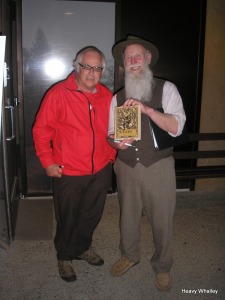
The home of John Muir was a wonderful place full of wildlife and places of great beauty. I was away early most days to miss the heat and at the top of Yosemite Falls I met these crazy guys crossing the Falls,, Base Jumpers and some incredible characters that make this a special place to be.

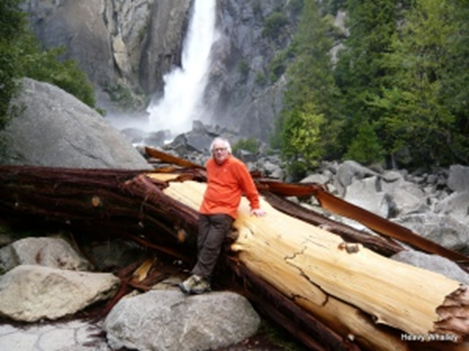
Yosemite Falls
I was over working with a friend who teaches at Unity College in Maine USA ( Americas first Environmental College) and spent a great 3 weeks there. It was an incredible journey and I learned so much from this adventure, hugely differing views on politics, guns all in the same College. My trip ended with being the keynote speaker at the USA – Mountain Rescue Conference in Stowe Vermount.
A magic trip in so many ways, I met the Yosemite SAR and stayed with them it was an interesting time and was impressed by there skill and great company.
A rescue on this wall is very serious!

Rescue is very serious on these cliffs!

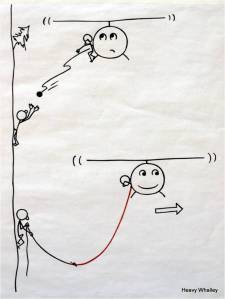

2008 Yosemite throw bag technique.
Time with Grand – kids and then head to Ben Nevis Early start!
Posted on May 29, 2014 by heavywhalley.MBE
Both Grand – kids are up for a few days and today I will meet them in Inverness and hopefully see the Dolphins at Channory Point. I had their dog Flo for a day and what great fun we had, she enjoyed her early walk at 0530 and even went back to bed after it. How much did I miss of the kids in my life,when I was running mad in the mountains, the times never to be got back in their lives unfortunately. I am so happy to be a small part of Ellie and Lexi lives and have some time with them.
Later today I head for Ben Nevis where a group I am meeting want to climb the Ben at 0430 – yes in the morning! So the blog may be a bit quite till Friday night but I will be tweeting! Early morning in the Ben see you at the car park at 0430 – weather looks good!
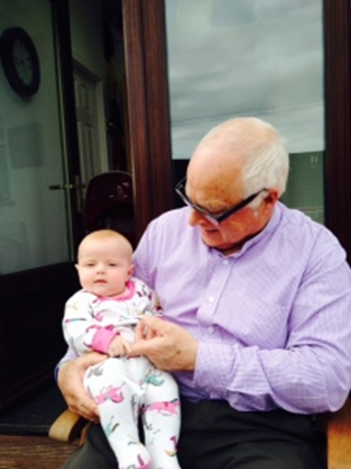
Ben Nevis – early start, magic views, red snows and outstanding views.
Posted on May 31, 2014 by heavywhalley.MBE
I have had a great couple of days and just back from an early morning walk up Ben Nevis. The day before I had a superb day with the grandchildren, we went looking for Dolphins at Channory point but unfortunately we missed them. The weather was magic later in the day and we had a superb afternoon in Inverness, with a Scottish BBQ in the sun. Later on I had a great drive over to Onich near Fort William. I went via the South side of Loch Ness a special drive with incredible view, this quiet road is getting some work done on it but what views, what a drive. I was soon at Spean Bridge and the Commando Memorial what a situation, it is always a place to stop and tonight was special. This is a place of wild beauty and the mountains were looking incredible. They were calling and what a night to be on the hill. This is a place that people drive pass and I regularly stop we must never forget what these incredible people did for us. The view of the Grey Corries and the Anoch’s and the Ben were so clear, the snow, sunlight and clarity all the cliffs were standing out. I was soon in Onich and the midges were out. I had a quick drink and then a few hours’ sleep I was on the hill at 0430 – so it was up at 0300.It would have been a night to be out and doing some of these great mountains at night, May is a great month for the mountains.
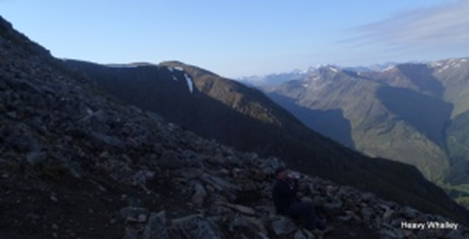
I had been asked to take a group of American serviceman up Ben Nevis; they had driven up from the deep South overnight and wanted to be on Ben Nevis for a 0430 start! The trouble with an Alpine style start for me is that you hardly start to doze off and you wake up frightened to sleep in. Old nightmares of the Alps reminded me of other early starts, in torchlight and sunrises that one will never forget. It was a lovely morning, the light was already bright and the short 20 minutes’ drive to Glen Nevis along the Loch was magnificent. I arrived to a deserted car park and after paying the £3 parking fee at 0430 it was good to know that the toilets were shut! My hill companions arrived and we all had a chat and off we went. The weather was magic and the light ever-changing and no midges. Now the Ben Nevis path is too many some “the mountaineering snobs” is not the way to go up the Ben but today with no one else about it was a great walk. It is hard work and my American friends who were still feeling the effects of the night were in for a special day. There is a lot of work going on at the path the iron bridge the path makers are busy on the Ben path on the way off. This path gets hammered every day with over 200,000 climbing the Ben every year. How many help with its up keep!
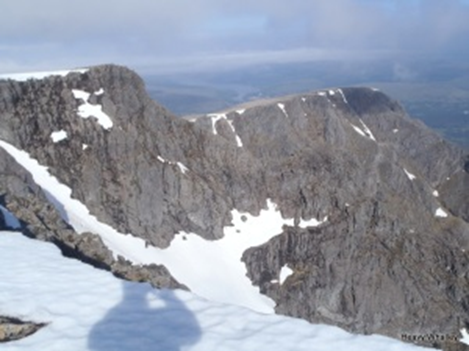
It was a fun walk, the air was chilled and the lambs were about, we passed two huge ravens on the path watching with interest. The birds were singing and then after leaving the river the pull up the mountain starts in earnest. We had great view, Glen Nevis is always outstanding with the greenery and the still snow-capped Mamores and Sgurr A’ Mhain looking great. The progress until the half way Lochan is unrelenting but we had a few stops. The path had little litter and the flowers were lovely by the path the sundew with flower especially pretty. The light here was stunning and we stopped for a break at the Red – burn, the snow clinging to the gully still. It was then onwards up the Zig Zags where we met our first other walker. He was a young lad from Wales working in the Youth Hostel in the Glen and had spent the night on the summit; it was very cold he said as he bounded off back for work! One of our party went back here not feeling good after an upset stomach and we soon reached the snow at the top of the Zig Zags.
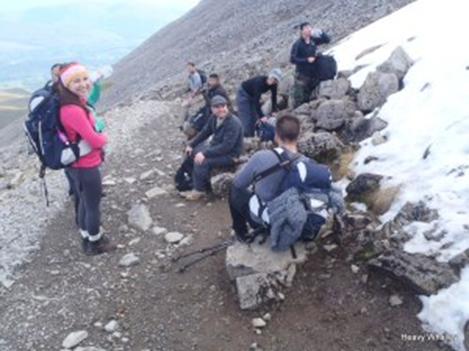
On the way up young lass about 8 and her Dad powered past, she was going so well and Dad was very proud as she seemed a natural. We kept meeting and it was a joy to see such a young girl enjoying the mountains and reminded me of past days with Yvette and Stephen and hopefully with Lexi and Ellie! My group were loving it, the hill was not easy but they were and taking so many photos, they were getting Scotland at its best, no wind and not too hot for walking and plenty of photo stops. The great view of the mountains open up all the time and the panoramas today were magnificent. The snow in places was very hard and frozen but easy to walk on and much near the summit was tinged with red from the sandstorms from the deserts? The big Cairns were soon in view and the great Cornices like some overhanging ice – cream made the views outstanding. We met another group on the summit and had a great break, even views of Tower Ridge looking incredible and the snow in the Corrie. The massive Cornices as much snow as I have ever seen for a while. I never tire of this view so many great days and hopefully so many more to come, this was day to be in the Corrie, the great ridges looked so inviting but so was the magic views today.
We were soon off after lunch. I picked up some rubbish 6 plastic bottles and lots of rotting banana peel from the summit area. From now we met a constant crocodile of people, all ages, shapes and sizes and so many kids, I said good morning about 600 times and it was great to see so many out. How can we not be happy that for many are experiencing their first hill –walk on such a mountain that keeps its secrets till the top? The weather was now warm and all the clothes used on the summit were shed and the snow going downhill was good fun, even with a dodgy knee and hernia! It is hard going on old knees and even the youngsters in the party felt it too. It was hot on the descent and the son was up, we were soon getting down still stopping and drinking as re – hydration is important on such a day. I had a sun hat on and lots of fluid yet still had a slight headache, the sun can cause problems so please be aware. Well worth remembering?
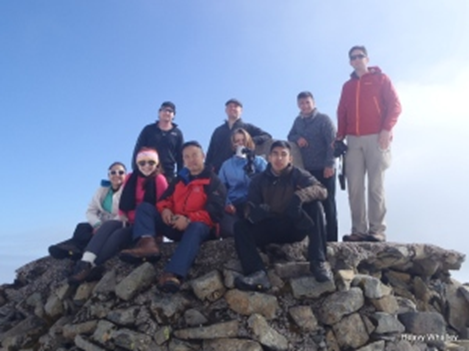
The work party on the iron bridge were now hard at work and a wee queue formed here, what a magic job they do and I put a wee donation in the cairn at the end of the track for path upkeep, do you ever do this? It was then back to the car park where a bacon roll and a brew met us what an end to the day. The group was now off to see the commando Memorial and a trip on Loch Ness then a drive to Kintail, they were all tired but great company and they all loved the Big Ben and had a day never to forget.
I had a slow drive back, Laggan was incredible and the car parks were full, the sun was out and I stopped and rehydrated all the way home. The body was a bit sore but despite the early start the Ben even by the Mountain Path early morning is a place of great beauty. My local Cairngorms were stunning and the Dava Moor a blaze of colour and I was soon home, a bath and an easy night. The knees are sore but worth the effort even the Alpine Start!
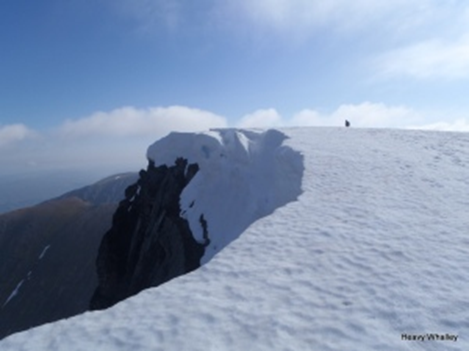
Thanks for the company and a great day out – well worth the effort.